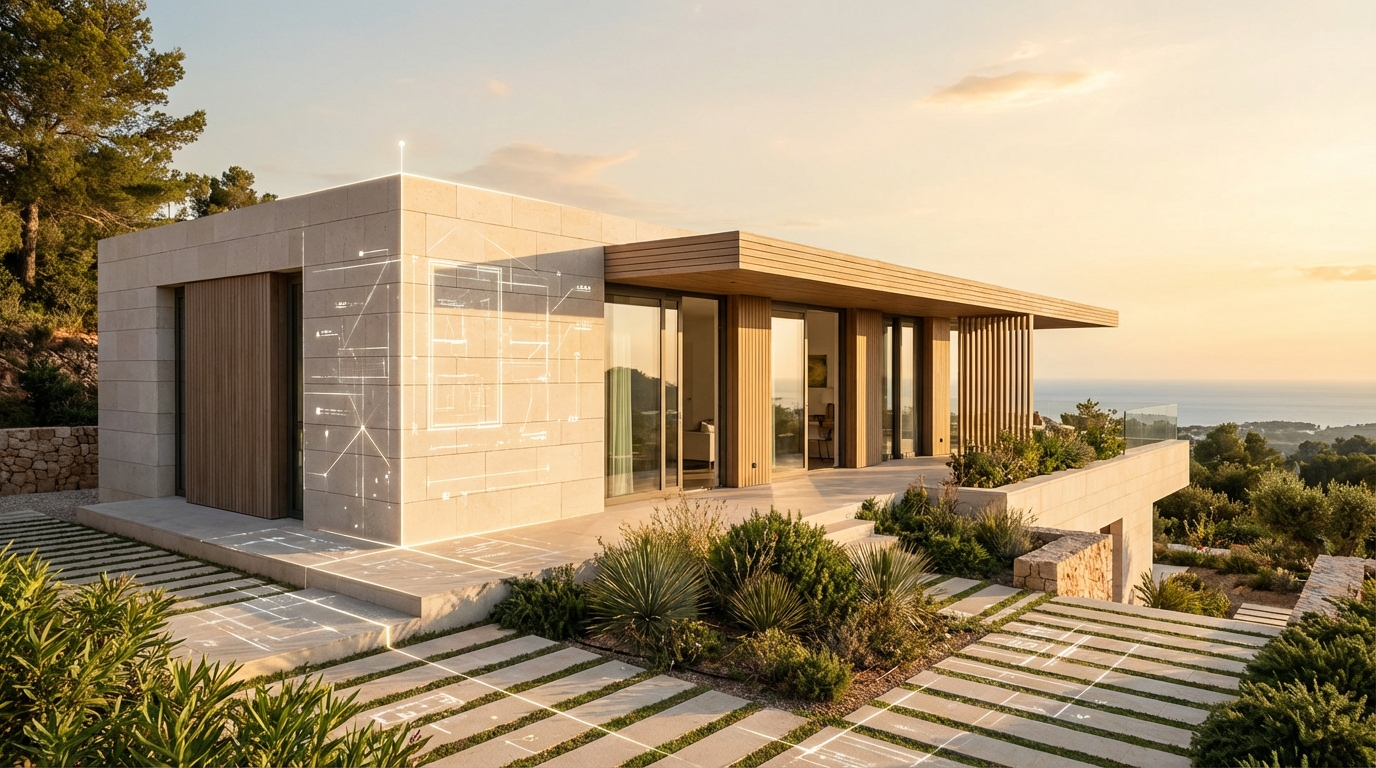
Modular House vs Traditional Build: Practical Comparison
Imagine signing a fixed-price contract and moving into a finished home months earlier than you expected. For many self-builders in Spain, that is the promise driving interest in modular houses. This article compares modular house construction and traditional on-site building in practical terms—so you can decide which route fits your plot, budget and timeline.
Why a Mediterranean modular house makes sense today
Faster delivery, transparent budgets and higher process control are the three core reasons many homeowners are choosing modular solutions. But those advantages depend on the project type, the chosen system and how well the turnkey process is managed.
Key advantages versus traditional construction: time, cost and guarantees
Time: Most modular approaches shift a large portion of the work into factory conditions where weather delays vanish and parallel workflows shorten the schedule. Typical net on-site time can drop to 2–8 weeks for installation, compared with several months for comparable traditional envelopes.
Cost predictability: Modular contracts are often offered with a fixed price for the scope agreed at design freeze. That reduces the risk of on-site scope creep and unforeseen cost increases common in traditional builds.
Quality control and warranties: Factory production enables repeatable quality checks and standardised finishes. Many modular providers include extended warranties and clearer responsibility boundaries for performance defects.
Self-builder profile in Spain 2026: needs and expectations
Today’s Spanish autopromotor typically wants:
- Clear timelines to coordinate sale/lease of existing property.
- Budget certainty to secure bank financing.
- Sustainable, energy-efficient homes aligned with Mediterranean living.
- A turnkey service that reduces project management burden.
For those priorities, a modular house can be a highly competitive option—especially when paired with modern materials and a reputable turnkey provider.
Project types that suit modular construction best
- Single-family primary homes: Efficient layout and quality finishes lend well to family living.
- Second homes and holiday villas: Faster delivery is attractive when timing matters for rental seasons.
- Investment properties: Predictable costs and shorter vacancy periods improve ROI calculations.
Practical comparison: modular house vs traditional construction
Execution times and fixed schedules: examples and industry metrics
In controlled factory production, parallelisation yields measurable time savings. Industry-observed ranges (typical, not guaranteed):
- Design and approvals: similar for both approaches (3–9 months depending on complexity).
- Factory production and finishing: 8–16 weeks for a mid-size modular home.
- On-site assembly and connections: 2–8 weeks for modular vs 6–18 months for traditional structure and enclosure.
Shifting enclosure and finishes into the factory can reduce on-site schedule risk by up to half, primarily by removing weather as a variable.
These figures show why timeline-sensitive owners often prefer modular houses: the critical path shortens and becomes more predictable.
Costs and budgets: fixed price, deviations and numerical examples
Price transparency. Modular offers clearer scope-based pricing: structure, envelope, finishes and mechanical systems are defined before production.
Typical cost dynamics:
- Base per-square-meter cost can be comparable or slightly higher than traditional when using premium finishes and complex forms.
- Total delivered cost often benefits from reduced on-site labour, shorter financing period and fewer overruns.
Example (indicative ranges):
- Mid-range modular turnkey home: competitive delivered cost due to lower indirects and reduced construction margin risks.
- Traditional build: initial lower material cost may be offset by longer site management, weather delays and higher contingency needs.
For autopromoters planning financing, the predictability of a modular house often improves bank assessments for project mortgages and reduces the contingency lenders require.
Quality and finishes: industrial control versus site variability
Factory production offers:
- Standardised quality checks across multiple trades.
- Higher repeatability in finishes and tighter tolerances.
On-site building challenges: Skilled-labour variability, weather exposure and coordination errors increase the chance of rework and finish inconsistencies.
The result: a modular house built by an experienced manufacturer often delivers finishes and envelope performance that are at least as good as, and in many cases better than, traditional construction.
Materials and systems: how to choose
Choosing the right structural and envelope system is a trade-off between thermal performance, embodied carbon, speed and architectural flexibility. Below are the most relevant options for Mediterranean modular houses.
Industrialised precast concrete: structural and thermal advantages
Strength and durability: Precast concrete modules deliver excellent structural stability and fire performance. Thermal mass benefits can be used to moderate summer temperatures when integrated with shading and ventilation strategies.
Considerations: Higher embodied carbon than wood systems unless low-carbon mixes or recycled aggregates are used. Transport and crane needs may increase logistics costs for large precast units.
Light timber framing: efficiency, Mediterranean aesthetics and sustainability
Advantages: Wood is lightweight, renewable and performs well thermally when detailed correctly. It suits Mediterranean contemporary designs with warm interiors and natural finishes.
Sustainability: Engineered timber systems often have lower embodied carbon and pair well with Passivhaus-level insulation strategies.
Steel frame: speed, versatility and insulation strategies
Steel offers: Rapid fabrication, slimmer structural profiles and high precision. It is ideal where long spans or open-plan layouts are required.
Key caveat: Steel has higher thermal conductivity and thus requires robust insulation and thermal bridging mitigation to meet high-efficiency targets.
Sustainability and energy efficiency: from Passivhaus to lifecycle emissions
Passive and active strategies for the Mediterranean climate
Combine passive design with modern systems to maximise comfort and minimise consumption:
- Shading, orientation and thermal mass to reduce cooling demand.
- High-performance insulation and airtightness to cut heating losses in winter.
- Mechanical ventilation with heat recovery to maintain indoor air quality and energy efficiency.
Many modular house manufacturers can integrate these strategies at the factory level to ensure consistent performance on delivery.
Comparing emissions and lifecycle between systems
Material choice drives embodied carbon. General guidance:
- Timber systems typically show lower embodied carbon than steel or concrete.
- Low-carbon concrete mixes and circular-material strategies can narrow gaps.
- Operational energy is principally controlled by insulation, airtightness and HVAC choices—areas where modular solutions excel due to factory precision.
Certifications, subsidies and improving efficiency in a turnkey project
Look for providers who can deliver certification pathways (e.g., Passivhaus, NZEB compliance) and advise on available Spanish regional subsidies for energy-efficient homes. Integrating these goals during early design delivers the most cost-effective results.
The turnkey process: steps, risks and guarantees for the self-builder
From plot search to handover: a typical turnkey timeline and control points
Key stages in a turnkey modular project:
- Parcel feasibility and preliminary site survey.
- Design and technical specification freeze.
- Permitting and licensing (municipal planning).
- Factory production and quality inspections.
- Site preparation, assembly and systems commissioning.
- Handover and after-sales service.
Critical control points: specification freeze before production, on-site utilities coordination and final commissioning. Clear contractual milestones and payment stages protect the autopromotor.
Documentation, permits and coordination with utilities
Turnkey providers typically assist with documentation and coordination, but responsibilities must be explicit in contract: who secures the connection to grid, water and sewage; who handles geotechnical works; and who obtains the final occupancy certificate.
Warranties, quality control and post-sale support
Ask for documented factory QA processes, thermal and airtightness test targets, and a clear warranty regime including the length and scope of coverage for structure, envelope and installations.
Financing and economic implications for self-builders
Mortgage options for self-build and modular projects
Spanish banks increasingly recognise modular house models within self-build mortgage products. Two common instruments:
- Progressive disbursement mortgages: Funds released against milestones (design freeze, factory start, installation, completion).
- Specific modular construction loans: Lenders may accept fixed-price turnkey contracts as security to reduce perceived risk.
Providing a detailed turnkey contract and realistic schedule typically improves lender confidence and reduces the margin applied on the loan.
Cost model: breakdown, savings and risk points
When comparing budgets, analyse:
- Direct construction costs (materials, labour).
- Indirects (site management, contingency, longer financing costs for extended schedules).
- Lifecycle operational costs (energy, maintenance).
Modular houses often reduce indirect costs and financing time, which can outweigh slightly higher per-unit material prices—especially for owners who value time certainty.
Practical conclusion: is an industrialized home the right choice for you?
Decision checklist for self-builders
- Do you prioritise a predictable timeline and fixed-price delivery?
- Is your plot accessible to modular logistics (crane, transport)?
- Do you value lower operational energy and modern finishes delivered consistently?
- Are you seeking a turnkey experience to reduce management burden?
If you answered yes to most of the above, a modular house is likely a strong contender.
Recommended scenarios for each structural system
- Timber frame: Best for low-carbon, warm interiors and typical Mediterranean single-family designs.
- Precast concrete: Recommended where structural mass, fire performance and longevity are priorities.
- Steel frame: Choose for larger spans, flexible plans or when slimmer profiles are desired.
Next steps: resources, case studies and visits
Start by requesting a feasibility review from a modular provider that includes site assessment, a preliminary budget and an indicative schedule. Visit at least one finished modular home and review airtightness and thermal test reports. Ask to see comparable turnkey contracts and warranty terms before committing.
Real-world metric to watch: compare the total delivery time from contract signature to handover and the fixed-price clauses—these are the two variables that most affect your cash flow and stress levels.
Choosing between a modular house and a traditional build is a decision about risk allocation as much as about materials. If you want time certainty, tighter quality control and a streamlined process to move into a modern Mediterranean home, industrialized modular construction deserves serious consideration.
If you’d like, we can review your plot and provide an indicative turnkey estimate tailored to your preferences and budget—book a no-obligation feasibility consultation to get concrete numbers for your decision.