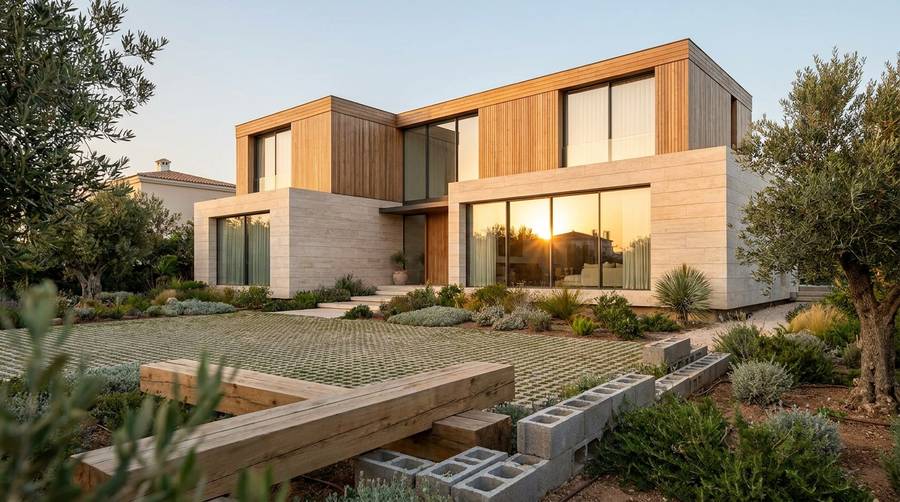
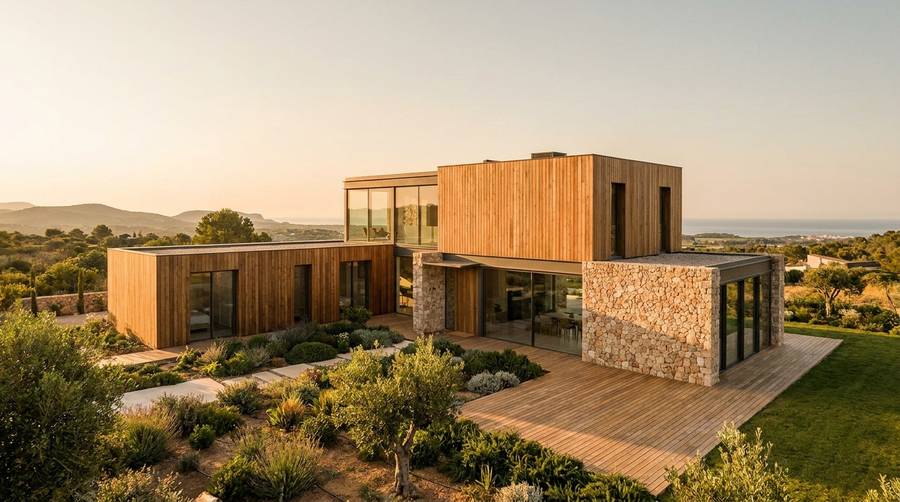
Prefabricated House vs Traditional Home: Clear Comparison
When a missed deadline cost a couple their dream move-in month, they switched to a prefabricated house — and saved three months and 8% on budget. This article cuts through marketing and myths to give you the facts you need to decide between a prefabricated house and a traditional home for self-promoted projects in Spain.
Why choose industrialized housing today: context and opportunities
Industrialized housing is no longer an experimental niche. In 2026 the Spanish market shows steady growth driven by faster delivery, predictable budgets and tighter energy rules. If you are an autopromotor (self-builder), the choice affects costs, timing and compliance with low-carbon objectives.
Trends in Spain 2026: demand, regulation and the modular market
- Demand: increasing interest from families seeking quality, energy-efficient homes outside dense cities.
- Regulation: stricter energy codes and municipal incentives favor designs meeting near-zero energy performance.
- Market: a maturing supply chain with factories offering turn-key packages and better local logistics.
What 'low-carbon' means in practice: targets, benefits and metrics
Low-carbon in housing focuses on embodied carbon in materials plus operational energy. Measure both with:
- Embodied carbon (kg CO2e/m2) — lower with engineered timber and optimized concrete.
- Operational energy (kWh/m2·year) — reduced via insulation, airtightness and heat-recovery ventilation.
- Certifications — Passivhaus or local energy performance certificates (EPC) are practical benchmarks.
Key criteria for self-builders: cost, schedule, quality and sustainability
Decide by weighting four dimensions against your project goals:
- Budget certainty — do you need a fixed-price contract?
- Timeline — is a rapid delivery essential?
- Quality control — how much factory QA matters to you?
- Sustainability — are low-carbon targets mandatory or voluntary?
General comparison: prefabricated house vs traditional home
This section compares performance, timing and cost transparency with concrete metrics where possible.
Energy performance and carbon footprint: comparative data and standards
Typical outcomes observed in recent projects:
- Prefabricated houses with high-performance envelopes often deliver 30–70% lower operational energy than conventional builds when designed to Passivhaus principles.
- Embodied carbon varies by structure: engineered timber systems can reduce embodied CO2 by 20–50% compared to conventional reinforced concrete frames, while industrialized low-carbon concrete narrows the gap.
- Real projects in Spain show that a modular home meeting Passivhaus can achieve an EPC A and operational energy of 10–20 kWh/m2·year in favorable climates.
Construction timelines and schedule control: fixed timelines and less uncertainty
Factory-controlled manufacturing shortens on-site work. Typical comparisons:
- Traditional build: structural and finishing works can span 9–18 months depending on complexity and weather.
- Prefabricated approach: factory fabrication 8–14 weeks, on-site assembly 2–8 weeks; total 4–6 months for a typical single-family home.
Reduced wet works on-site and parallel workflows explain the time savings and reduced weather-related delays.
Costs and transparency: fixed price, contingencies and hidden costs in traditional builds
Key cost observations:
- Prefabricated offers commonly provide clearer fixed-price packages that include manufacturing, transport, assembly and standard finishes.
- Traditional builds have more variable budgets due to on-site uncertainties, change orders and escalating material/labor prices.
- Account for land preparation, utilities and permits in both cases; these are common hidden costs if not included in turn-key quotes.
Low-carbon materials: industrialized concrete, light timber frame and steel frame
Material choice shapes carbon, cost and design flexibility. Below is a pragmatic assessment for autopromoters.
Industrialized concrete: efficiency, durability and emission reductions
Modern industrial concrete solutions aim to cut emissions via optimized mixes, recycled aggregates and factory casting:
- Pros: thermal mass useful in Mediterranean climates, durable and low maintenance; factory casting improves quality control.
- Cons: higher embodied carbon than timber unless low-carbon binders are used; heavier transport costs to site.
- Best use: where durability, acoustic performance and solid finishes are priorities.
Light timber frame: carbon capture, insulation and Passivhaus compatibility
Engineered timber systems perform strongly for low-carbon goals:
- Pros: lower embodied carbon, excellent thermal performance, fast assembly and warm interiors.
- Cons: attention to detailing for moisture control and fire regulations is essential.
- Best use: compact to medium-size family homes aiming for Passivhaus or NZEB standards.
Steel frame: lightness, speed and carbon comparison
Steel frames offer precision and speed but require careful carbon accounting:
- Pros: high accuracy, long spans and quick erection.
- Cons: higher embodied carbon per kg vs timber; however, optimization and recycled steel reduce impact.
- Best use: where structural spans or specific architectural needs require steel.
Practical advantages and disadvantages for the self-builder
This section translates technical differences into practical effects on your project.
Advantages: quality control, fixed timelines, energy efficiency and cost certainty
- Factory QA: consistent quality with documented processes and inspections.
- Schedule predictability: fewer weather delays and parallel workflows shorten delivery time.
- Energy-ready: easier integration of high-performance envelopes, mechanical ventilation and renewable systems.
- Budget control: fixed-price turn-key offers reduce financial surprises.
Disadvantages: design limits, transport logistics and public perception
- Design constraints: some industrialized systems impose module size or joinery limits—still, many manufacturers now offer high customization.
- Logistics: large elements need road access and crane access; site constraints can add cost.
- Perception: residual stigma exists; mitigate with high-quality finishes and references.
Decisive factors by project: parcel, budget, energy targets and timeline
Use this simple prioritization:
- If timeline and budget certainty top your list → prefabricated solutions often win.
- If full design freedom and unique architecture are essential → traditional methods may be preferable.
- If low-carbon targets are mandatory → timber or low-carbon industrial concrete in prefabricated systems typically offer advantages.
The turn-key process explained: from plot to move-in
A clear process reduces surprises. Turn-key delivery typically follows five phases.
Key phases: feasibility, design, fabrication, assembly and finishes
- Feasibility study: plot analysis, orientation, budget estimate and regulatory review.
- Project design: architectural and structural design, energy model and permit drawings.
- Factory fabrication: panels/volumes produced with QA documentation.
- On-site assembly: foundation, lifting and installation, followed by systems connection.
- Finishes and handover: final inspections, commissioning and delivery of warranties.
Administrative and technical coordination: permits, execution and QA
Key administrative tasks require early attention:
- Secure municipal licenses and utility connections before fabrication.
- Arrange geotechnical and topographic surveys during feasibility.
- Implement independent QA checks at factory and on-site to ensure warranties are enforceable.
Expected metrics: average timelines, delivery milestones and real examples
Representative figures from recent Spanish projects:
- Average total delivery for a 120–160 m2 turn-key prefabricated home: 4–6 months from contract signature to handover.
- Average for traditional build: 10–16 months, accounting for weather and procurement delays.
- Cost example (illustrative): prefabricated A-level energy house ~€1,800–2,400/m2 turn-key; traditional similar spec often 10–20% higher when accounting for overruns.
Choose the method that aligns with your priorities: speed and certainty, or maximum design flexibility. Both can deliver high-quality, low-carbon homes when specified correctly.
Financing and mortgages for self-build and modular housing
Financing industrialized housing follows similar rules to conventional self-build, but there are specifics lenders assess.
Financing options in Spain: self-build mortgage, bridge loans and common conditions
- Self-build mortgages: released in tranches tied to project milestones; used for on-site construction and foundations.
- Turn-key loans: some banks finance a completed turn-key contract as a more conventional mortgage once the house is delivered.
- Bridge loans: short-term funding to cover land purchase before construction loan finalization.
Documentation and guarantees lenders request for industrialized homes
- Detailed project schedule and budget, including factory contract.
- Building permits and technical project documentation.
- Warranties from manufacturer and installer, and evidence of compliance with energy or quality certifications.
Practical tips to secure financing: planning, budgeting and energy certifications
- Prepare a realistic cost contingency and present a turn-key quote with clear inclusions.
- Obtain energy certificates or preliminary Passivhaus feasibility to strengthen the loan case.
- Work with lenders experienced in modular/industrialized housing; they understand milestone-based disbursements.
Practical guide and real cases to decide: how to choose
Concrete steps and examples help translate theory into a decision.
How to design an industrialized home step by step in Spain (2026 checklist)
- Evaluate plot constraints and orientation for solar gain.
- Set clear priorities: budget cap, delivery date, energy target.
- Request three turn-key quotes with identical specifications.
- Check factory visits and ask for QA records and references.
- Confirm logistics: road access, crane location and foundation type.
- Secure financing with milestone-based release and include a contingency reserve.
- Plan commissioning and snagging inspections before final payment.
Case studies: timelines, real costs and customer satisfaction
Two anonymized examples illustrate typical outcomes:
- Case A — Timber prefabricated home, Madrid outskirts: 130 m2, Passivhaus-ready envelope. Manufactured and assembled in 3 months. Final delivered cost €2100/m2. Client reported high satisfaction and moved in 4 months from contract.
- Case B — Industrialized concrete modules, Valencia province: 160 m2, robust acoustic performance. Factory lead 10 weeks; on-site 6 weeks. Delivered cost €2,350/m2. Client highlighted durability and low maintenance.
Decision criteria matrix: simple tool to choose between prefabricated and traditional
Rate your project's priorities (1–5): budget certainty, speed, design freedom, low carbon. Sum the weighted scores to reveal the best-fit approach.
Conclusion: decide with data and confidence
Both prefabricated and traditional builds can deliver excellent homes. Your choice should match project priorities: choose prefabrication if you value speed, predictable cost and energy performance; prefer traditional methods when unique architecture and on-site flexibility are decisive.
If you are planning a self-build in Spain, start with a feasibility study that includes energy modeling and at least two turn-key offers. Visit factories and recent completed homes. That combination of data and real-site evidence turns uncertainty into a confident decision.
If you want, we can help gather tailored turn-key quotes and a feasibility checklist for your plot — request a comparison and we'll prepare a clear, no-obligation summary specific to your project.
Artículos relacionados
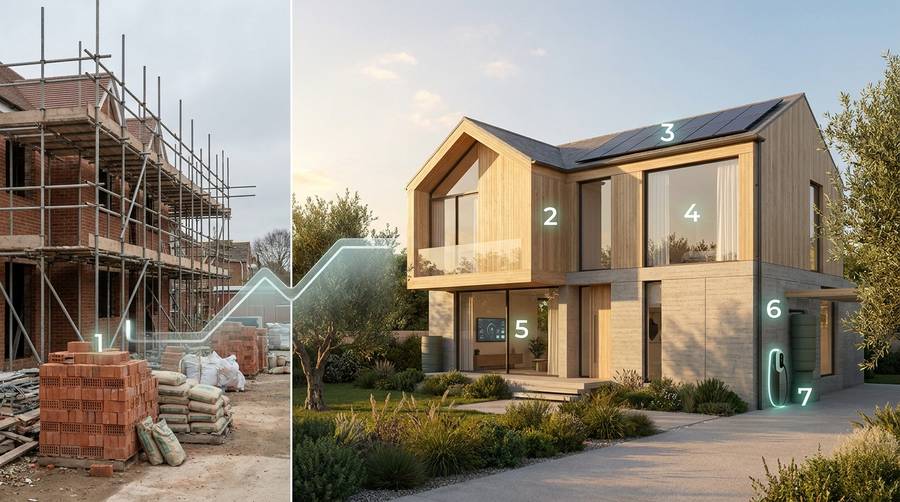
Low-Carbon Industrialized Housing: 5 Materials for Spanish Self-Builders
A focused guide for Spanish self-builders comparing five low-carbon materials used in industrialized housing—concrete, timber frame, steel frame, SIPs and bio-based composites—with real metrics, finance and turnkey considerations.