Industrialized Housing: 7-Step Guide for Spain 2026
1. A fast overview: what is industrialized housing and why it matters in 2026
Imagine reducing construction uncertainty by half while improving energy performance. Industrialized housing applies factory-led production, modular systems and standardized processes to build homes faster, with predictable costs and higher quality control. In Spain 2026 this approach matters because demand for sustainable, fast-delivery housing is rising, regulations are tightening, and autopromotion (self-build financing) is growing as an accessible route for families.
Definition and scope: industrialization 3D and scalable systems
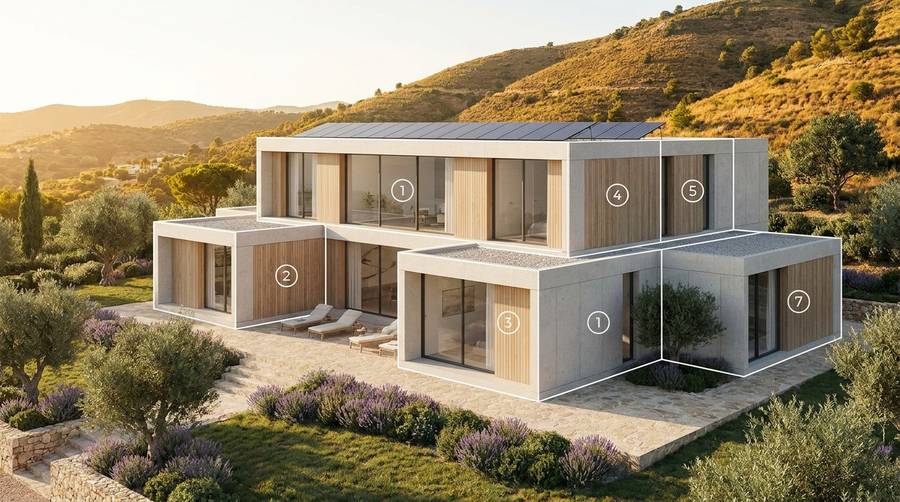
Industrialized housing includes off-site manufactured elements—panels, volumetric modules or engineered components—assembled on site. It ranges from 3D-printed components and prefabricated concrete panels to light timber frames and steel-frame systems that are fully integrated into a turnkey delivery.
Trends in Spain: demand, regulation and the self-builder market
Key trends shaping the sector in Spain: rising interest in energy-efficient homes, incentives for low-carbon building, and more lenders offering mortgages for autopromotion. Urban growth constraints and the need for speed after market slowdowns make industrialized solutions attractive for families and developers.
Immediate benefits vs traditional building (time, cost control)
- Shorter schedules: parallelized factory work and on-site assembly cut calendar risk.
- Fixed-price clarity: modular manufacturing reduces variability in labor and material usage.
- Quality control: factory conditions lower defects and rework.
Deliverability trumps promise: homes manufactured under controlled conditions typically show fewer defects and more consistent thermal performance than equivalent in-situ builds.
2. Key advantage: efficiency and cost control (fixed price and guaranteed schedules)
Predictable budgets and tight deadlines are the real competitive edge. For autopromoters this means less stress when arranging financing and clearer expectations for resale or occupancy.
How off-site manufacturing reduces financial deviations
Factories standardize material procurement and labor processes. That reduces last-minute subcontractor claims and material price escalations tied to long site durations. Contracts based on manufactured scope and assembly phases are simpler to price and to audit.
Real-world delivery times and savings compared to traditional builds
Typical patterns observed in Spanish industrialized projects: design-to-permit often 3–6 months; factory production 6–12 weeks; on-site assembly 4–12 weeks depending on size and logistics. Compared to a conventional build that might stretch 12–24 months, the modular route compresses uncertainty. These condensed timelines often translate into lower holding costs and less interim financing.
Common risks and how to mitigate them in turnkey contracts
- Logistics risk: specify delivery windows and penalties for delayed transport.
- Scope drift: freeze design at permit stage and use change-order pricing for later changes.
- Quality acceptance: include factory witness inspections and defined snag lists with remediation timelines.
3. Materials and systems: industrialized concrete, light timber frame and steel frame
Choosing materials is a balance between performance, cost and site constraints. Each system has clear strengths—understanding them upfront avoids costly retrofits.
Accessible technical comparison: durability, thermal performance and cost
- Industrialized concrete: excellent thermal mass and longevity; higher initial cost but low maintenance and strong acoustic performance.
- Light timber frame (entramado ligero): fast, lightweight, excellent embodied carbon profile when sourced responsibly; great for Passivhaus envelopes but requires careful moisture management.
- Steel frame (steel frame): dimensional stability, long spans and design freedom; insulation must be detailed to avoid thermal bridging.
Choosing by project: when to prefer concrete vs timber vs steel
Use concrete for coastal or high-thermal-mass needs and where acoustic performance matters. Choose timber for low-carbon targets and rapid assembly on smaller footprints. Opt for steel when long spans or complex geometries are required. Site access and crane needs also influence the decision.
Maintenance implications and long-term value
Concrete tends to require the least structural maintenance. Timber needs periodic inspection for moisture and pest control; modern treatments and factory precision lower that risk. Steel requires protection against corrosion at penetrations and connections. Each system, when detailed and built correctly, supports long-term value and resale appeal.
4. Sustainability and energy efficiency: Passivhaus and carbon reduction
Industrialization makes high-performance targets affordable and repeatable. Factory-made envelopes achieve tighter tolerances that simplify reaching Passivhaus-level airtightness and insulation performance.
How industrialization helps achieve Passivhaus and other certifications
Prefabricated wall and roof components come assembled with continuous insulation, factory-sealed joints and preinstalled windows. This reduces on-site thermal bridging and makes airtightness testing at completion more likely to succeed.
Impact on carbon footprint: materials, processes and lifecycle
Key levers to reduce carbon:
- Choose low-embodied-carbon timber or low-clinker concrete mixes.
- Minimize transport by optimizing factory-to-site logistics.
- Design for energy efficiency to cut operational emissions—this dominates lifetime carbon in mild climates like much of Spain.
Practical strategies to boost efficiency without inflating budget
- Prioritize airtightness and insulation over costly mechanical systems.
- Use standard module sizes to reduce bespoke manufacturing costs.
- Integrate solar-ready roofs and passive solar orientation early in design.
5. Turnkey process for self-builders: from plot search to handover
A clear, phased process reduces surprises. Turnkey means the provider coordinates design, production, permits, delivery and assembly.
Clear phases: plot search, design, fabrication, logistics and assembly
- Plot selection: verify access, utilities and zoning before offers.
- Design & permits: freeze envelope and services for factory production.
- Fabrication: schedule production slots and allow for QA inspections.
- Logistics & assembly: sequence deliveries to match on-site readiness.
- Commissioning & handover: airtightness test, MEP commissioning and final snagging.
Documentation and permits in Spain: keys to avoid delays
Start permit applications early; municipal timelines vary. Ensure the turnkey provider supplies complete as-built details and the project’s energy compliance documentation to avoid last-minute reworks.
Coordinating financing and a sample timeline
Align mortgage drawdowns with project milestones. Typical turnkey timeline for a single-family home:
- Design & permits: 3–6 months
- Factory production: 6–12 weeks
- Site assembly & finishes: 4–12 weeks
6. Financing and self-promotion: mortgages, incentives and payment models
Financing industrialized housing is easier with clear, stage-based certainties. Lenders are increasingly comfortable with modular projects when value and completion risks are controlled.
Financing options for self-builders and modular homes in Spain
- Self-build mortgages: staged disbursements aligned with permit, production and completion.
- Construction-to-mortgage conversions: short-term credit that converts at handover.
- Green loans and regional incentives: available for energy-efficient builds—check local programs.
Typical requirements for self-build mortgages and work valuation
Banks usually require a clear turnkey contract, certified cost break-downs, and an independent valuer comfortable with industrialized methods. Demonstrating factory quality control and a guaranteed assembly schedule reduces perceived risk.
How to present a modular project to lenders (practical tips)
- Provide the turnkey contract with fixed-price clauses and liquidated damages.
- Supply factory production documentation and QA certificates.
- Share a conservative cash-flow plan and contingency for unforeseen sitework.
7. How to start today: practical steps and next actions for your project
Start with clarity: plot, budget and an experienced turnkey partner. The earlier you freeze the envelope and structural system, the lower the risk.
Quick checklist to move forward
- Confirm land constraints, access and utilities.
- Define a realistic budget including fees and contingencies.
- Request references and factory visits from at least two turnkey providers.
- Ask for a sample schedule and warranty terms.
Questions to ask an integrated provider: guarantees, references and KPIs
- What is the fixed-price scope and what triggers change orders?
- Can I visit the production facility and see finished projects?
- What are your standard airtightness and thermal performance KPIs?
- Which warranty covers structural elements, envelope and services?
Useful resources: guides, case studies and technical comparisons
For a deep technical comparison and practical Q&A see Casa prefabricada vs tradicional: guía práctica 2026 and for reasons to choose industrialized housing consult Vivienda industrializada: 7 razones para elegirla. These articles complement the steps above with checklists and FAQs relevant to self-builders in Spain.
8. Inspiring close: why industrialized housing is a real, scalable option
Industrialized housing is not a niche craft; it is a repeatable system for delivering better homes faster and cleaner. For autopromoters it unlocks predictability in cost and performance while supporting energy and climate goals.
Summary of competitive advantages and expected outcomes
- Faster delivery and reduced financing holding costs.
- Higher fabric performance and consistent airtightness.
- Lower long-term maintenance when materials and detailing are chosen for context.
Client satisfaction and outcome metrics
Feedback from modular homeowners typically highlights predictable budgets, faster occupancy and lower initial snagging compared to traditional builds. Focus on verified references and real photos of completed homes when validating a provider.
Next steps with a turnkey provider
If you are ready to explore options, start with a site feasibility and a provisional budget. Schedule a factory visit and request a fixed-price proposal tied to milestones. Taking these steps will show whether industrialized housing fits your ambitions and financing needs.
Ready to take the next step? Contact a certified turnkey provider to review your plot and get a provisional schedule and budget—small early investments in feasibility reduce large late-stage surprises.