Industrialized housing: smart modular homes in Spain
Why industrialized housing is the smart choice for your home in Spain
Imagine signing a fixed-price contract and moving into a finished, energy-efficient home months earlier than a conventional build. That’s the core promise of industrialized housing in Spain: repeatable processes, factory precision and a coordinated “turnkey” workflow that turns those expectations into predictable outcomes.
Industrialized construction can cut on-site time by 50–70% and reduce cost overruns that commonly exceed 15% in conventional projects.
In this guide you’ll get concrete, actionable insights: how fixed pricing is achieved, the real timelines from parcel search to handover, material comparisons (concrete systems, light timber frame, steel frame), Passivhaus strategies tailored to Spanish climates, and two case studies with measured metrics. This is aimed at self-builders (autopromotores) who need clarity to make decisions.
What we mean by industrialized 3D housing and modular homes
Industrialized housing uses off-site prefabrication and standardized workflows to produce repeatable building elements or volumetric modules. In practice this ranges from panelized walls and floors to complete modules that arrive ready for assembly. The outcome: better quality control, shorter on-site assembly and clearer cost forecasting.
Key advantages vs. traditional construction
- Predictable costs: packages with fixed scope and priced options reduce surprises.
- Shorter timelines: parallel design and factory manufacture compress the program.
- Higher quality control: indoor factory conditions reduce weather delays and defects.
- Better energy performance: precise assemblies improve airtightness and thermal continuity.
Who benefits most from this model
Best-fit autopromotores include families with a defined budget and schedule, buyers on seasonal site windows, and developers seeking replicable plots. It also suits owners aiming for high energy standards like Passivhaus without unpredictable local labor variability.
1. Fixed price and economic control from day one
How fixed cost is achieved: industrial processes and disciplined planning
Fixed pricing in industrialized projects rests on three pillars: modular design libraries, controlled supply chains and a defined scope for finishes and interfaces. Manufacturers price tested modules with known materials and production times. When design changes are frozen after a certain stage (usually once manufacturing drawings are approved), the risk of later cost creep decreases dramatically.
Practical comparison: common deviations in traditional builds vs industrialized projects
- Traditional: change orders driven by site surprises, price inflation for materials, and variable subcontractor bids — typical overrun 10–25%.
- Industrialized: change orders often limited to aesthetic options; material costs hedged through manufacturer contracts — typical overrun 0–5% when scope is controlled.
Financing options: self-build mortgages and modular-specific solutions
Spain offers traditional autopromoción mortgages that bridge construction stages. For industrialized builds, lenders increasingly accept staged disbursements based on factory milestones and installation completion. Key practical tips:
- Negotiate a payment schedule tied to factory QA reports and delivery, not vague site percentages.
- Ask lenders for examples of financed prefabricated projects to confirm acceptance.
- Include contingency within the loan for client-directed finish changes — lenders often allow a modest margin.
2. Shorter build times and faster turnkey delivery
Process breakdown: from parcel search to final handover
The typical industrialized workflow compresses tasks by overlapping them:
- Pre-contract: site feasibility and site survey (4–6 weeks).
- Design stage: modular configuration and approvals (8–12 weeks).
- Factory manufacture: modules or panels produced (6–10 weeks).
- Site works and assembly: foundation, craning and connections (2–6 weeks).
- Finishes, commissioning and handover: utility connections and QA (2–4 weeks).
Typical total: 20–32 weeks from design approval to handover for a single-family home — roughly half the duration of many conventional builds.
Realistic timelines: design, manufacture, assembly and finishes
Key drivers of timing include permit lead times, site access, and complexity of bespoke elements. To avoid delays:
- Start permits in parallel with detailed design.
- Choose modules that match your site constraints to minimize on-site modification.
- Plan for utility connection windows early — they can be the longest lead item.
Benefits for autopromoters: lower bridge financing and faster move-in
Shorter programs reduce interest and holding costs and accelerate income realization (if you plan to rent or sell). A predictable handover date also simplifies logistics for families planning a move.
3. Modern, durable materials: industrialized concrete, light timber frame and steel frame
Technical features and advantages of each system
- Industrialized concrete: excellent thermal mass, robust acoustic performance, fire resistance. Best for coastal or high-wind situations where mass improves comfort.
- Light timber frame: fast, lightweight, high thermal performance when combined with modern insulation and airtight systems. Excellent for inland and mild climates.
- Steel frame (steel-frame): high strength-to-weight, long spans and design flexibility. Ideal for larger clear spans or multi-storey modular solutions.
Recommended use cases by climate, terrain and design
In Spain:
- Coastal Mediterranean: concrete or hybrid (concrete foundations + timber envelope) balances thermal comfort and salt-laden air durability.
- Inland continental areas: timber frame with robust insulation works well for thermal performance and cost-efficiency.
- Complex topography or multi-storey designs: steel frame offers dimensional stability and lighter foundations.
Maintenance and lifespan: myths and realities
Modern prefabricated systems are not disposable. With proper detailing, industrialized components exceed 50 years with routine maintenance. Common myths — that modular equals short-lived — stem from early low-quality products, not from current engineered systems.
4. Sustainability and energy efficiency: Passivhaus-ready modular homes
How industrialization improves energy performance and reduces waste
Factory assembly enables consistent insulation installation, better airtightness and lower thermal bridging. Waste is reduced through optimized material cuts and reuse of offcuts in controlled environments. The result: lower embodied waste and improved operational efficiency.
Practical strategies to achieve Passivhaus in modular buildings
- Prioritize continuous insulation and taped airtight membranes at factory joints.
- Use high-performance triple glazing with warm-edge spacers sized for Spanish solar gains.
- Integrate mechanical ventilation with heat recovery (MVHR) sized to actual module volumes.
- Optimize solar shading and orientation for Mediterranean climates to reduce cooling loads.
Climate impact: measurable reductions and examples
When compared to traditional builds, a well-executed industrialized home can reduce site waste by 30–60% and operational energy by 40–70% depending on specification and occupant behaviour. Combining low embodied carbon materials with high operational efficiency yields the strongest lifecycle carbon reductions.
5. Real-world case studies: time, cost and client satisfaction
Case 1 — Mediterranean family home: timeline and real costs
Project snapshot: 140 m2 single-family home near the Valencian coast. System: hybrid precast concrete ground floor + timber-frame upper. Key metrics:
- Total time (design approval to handover): 26 weeks.
- Final cost variance vs. initial fixed quote: +2% (client-chosen upgrades).
- Airtightness result: 0.35 ACH@50Pa after commissioning.
- Client satisfaction (survey): 9/10 — praised timeline predictability and quality finishes.
Case 2 — Rural steel-frame home: efficiency and user feedback
Project snapshot: 180 m2 rural plot, steel-frame modules with high-performance envelope. Key metrics:
- Total time: 30 weeks from approved drawings to handover.
- Operational energy: 55% lower than local code baseline due to MVHR and optimized envelope.
- Client satisfaction: 8.7/10 — noted excellent acoustic comfort and low maintenance to date.
Lessons learned and practical recommendations
- Freeze scope early; decisions during manufacture are costly.
- Inspections at factory milestones avoid expensive site corrections.
- Choose a finance plan that ties disbursements to documented production milestones.
How to start today: clear steps for your industrialized housing project
Practical checklist: parcel, project, permits, finance and provider
- Parcel due diligence: terrain survey, accessibility and utilities availability.
- Early concept: choose a modular typology that fits your brief to limit bespoke work.
- Permitting: submit documentation early; modulars sometimes streamline specific permit elements but local rules differ.
- Finance: align your mortgage or bridge loan with payment milestones.
- Provider assessment: request factory QA reports, references and full scope proposals.
Key questions to ask suppliers to avoid contractual surprises
- What’s included in the fixed price and what are priced options?
- Can you provide records of on-time delivery for similar projects?
- Who manages site interfaces (foundations, utilities, warranties)?
- What are the warranty terms for structure, envelope and finishes?
Support resources: technical advice, soil studies and turnkey management
Invest in a pre-contract soil study and an independent technical review of factory drawings. When you choose a turnkey provider, ensure they coordinate permits, foundations and utility commissioning. For more context on comparative risks and benefits, see Casa prefabricada vs tradicional: guía práctica 2026.
Image brief for Findnido (for blog use)
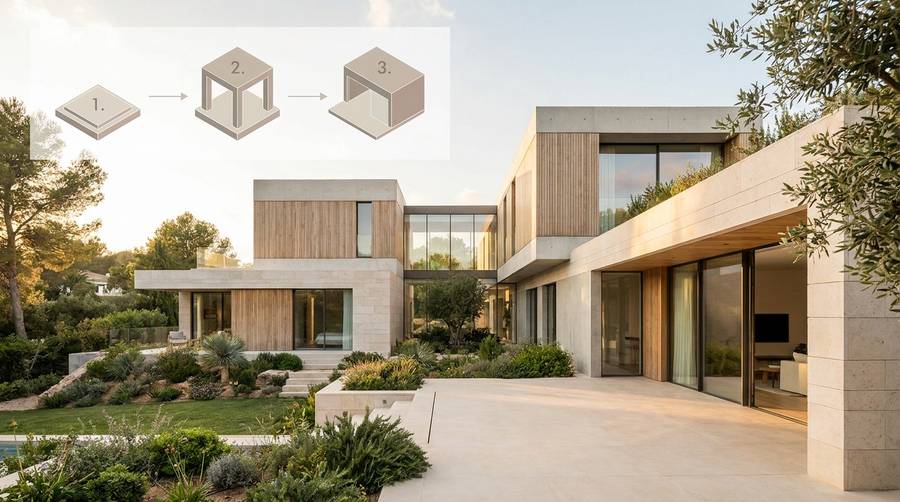
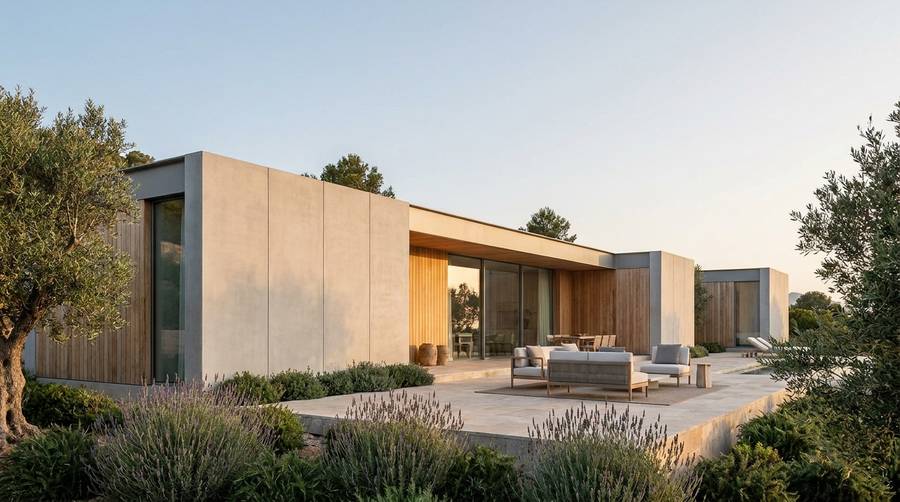
Photographic brief: high-quality architectural photo of a finished Mediterranean-contemporary modular home in Spain. Features: light façade, natural materials (stone, wood, light concrete), large windows, landscaped terrace, soft golden-hour light, a family enjoying the porch. Real residential setting, warm and aspirational mood, editorial real-estate quality. Avoid any visual cues of temporary or low-quality prefabrication; no exposed structure, containers or factory scenes.
Final note: industrialized housing is not a single product but a disciplined process. If you prioritise fixed budgets, faster delivery and high energy performance, start by fixing scope and selecting a manufacturer with verifiable QA and on-time delivery records. When you’re ready, request a detailed quote tied to factory milestones — it’s the clearest way to protect your time and money and move confidently to a turnkey handover.
If you'd like, we can review your parcel and provide a preliminary modular fit report to outline realistic budgets and timelines tailored to your site—let us know and we’ll schedule a complimentary consultation.