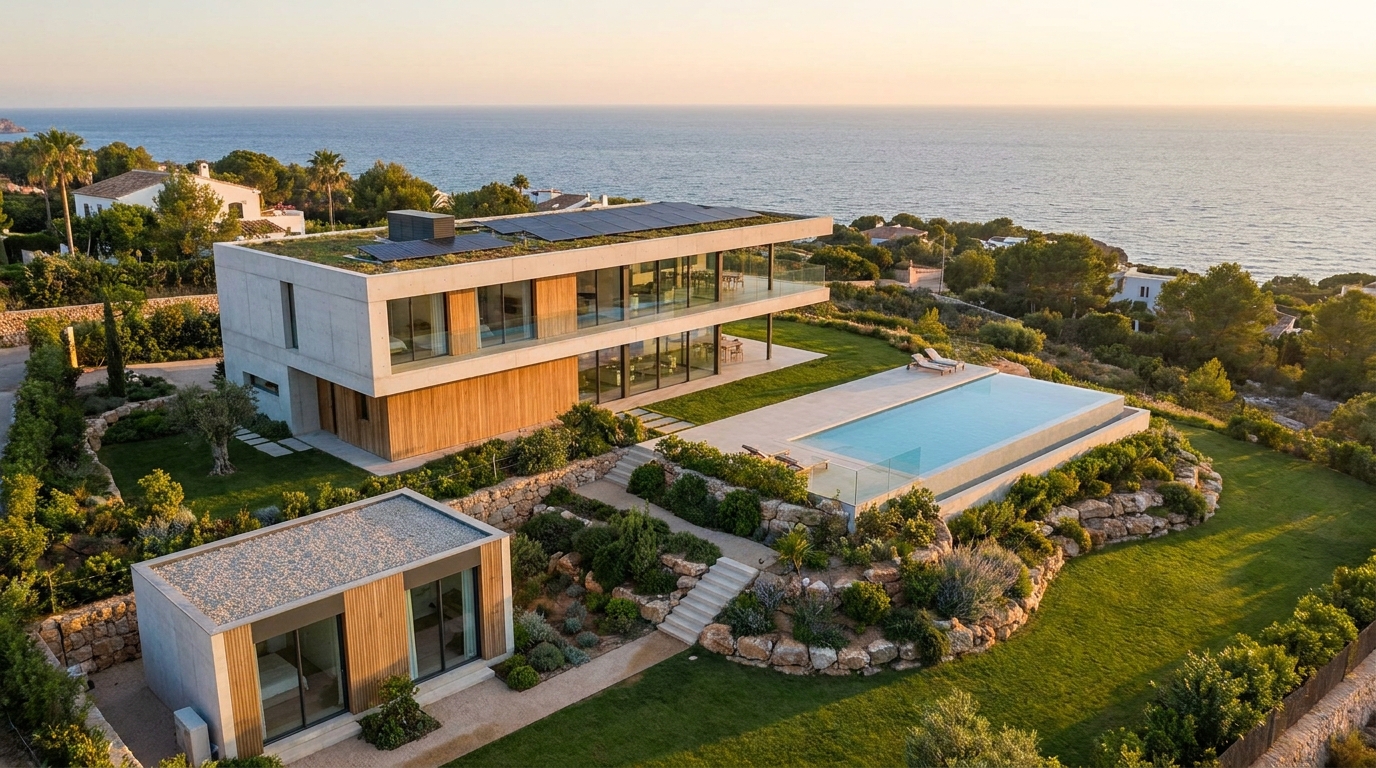
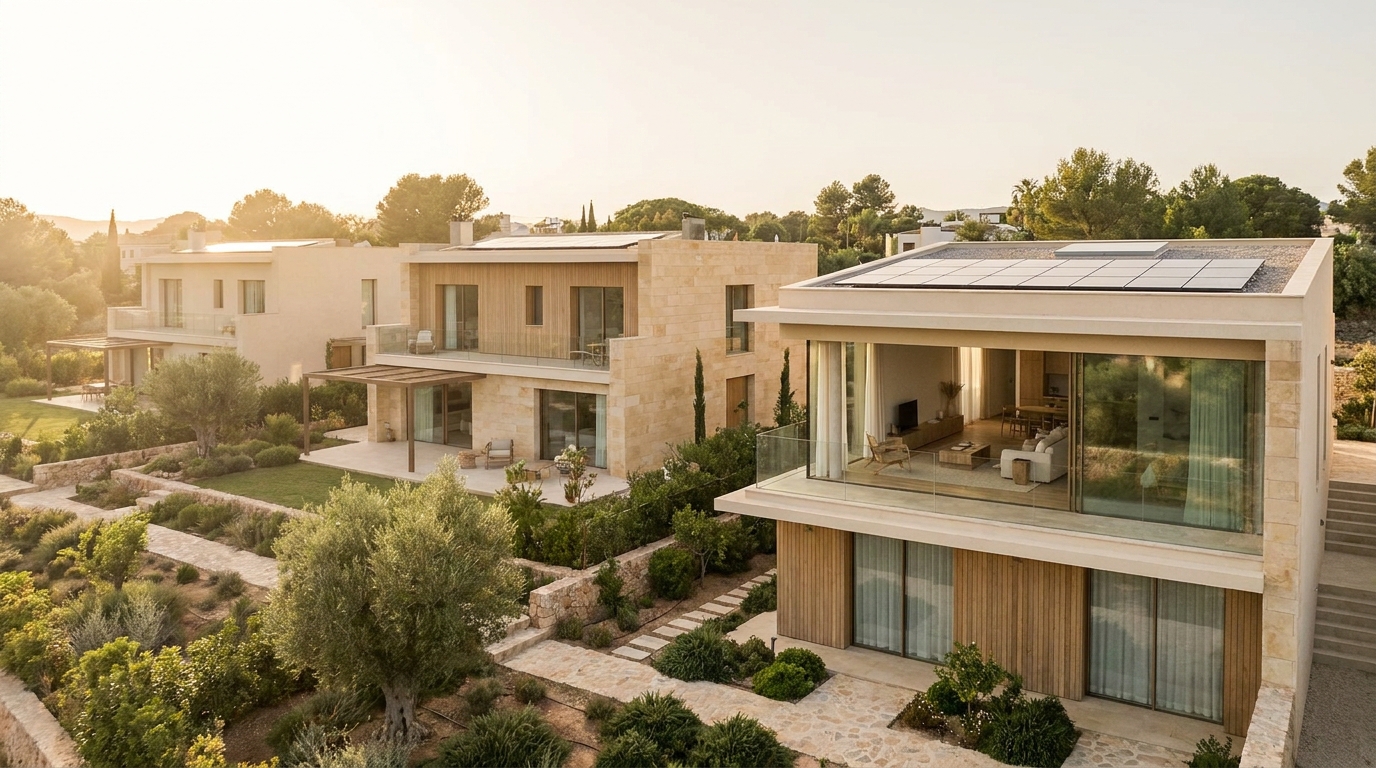
6 Reasons to Choose Industrialized Housing in Spain 2026
1. Why bet on industrialized housing in Spain (quick overview)
The choice to build a home should reduce uncertainty, not increase it. For many Spanish self-builders, the promise of faster delivery, fixed pricing and better energy performance is the turning point. This section summarises the strategic reasons to consider industrialized housing and the typical metrics you can expect.
Key advantages over traditional construction for self-builders
- Predictable schedules: Off-site manufacturing condenses on-site work and reduces weather-related delays.
- Fixed-price contracting: Turnkey offers reduce budget drift common in stick-built homes.
- Higher quality control: Factory settings enable repeatable QA: consistent thermal seals, accurate finishes and fewer defects at handover.
- Energy performance: Systems are designed for airtightness and insulation continuity, making Passivhaus-level targets achievable.
- Material choice and durability: Options like industrial precast concrete, light timber frame and steel frame allow tailoring to site, climate and maintenance preferences.
When modular or industrialized construction makes the most sense
- Projects with a tight deadline (e.g., family relocation, rental revenue timelines).
- Owners who prioritise budget certainty over speculative savings from sequential contracting.
- Sites with short on-site work windows (seasonal weather or restrictive permits).
- Clients seeking high energy-efficiency targets (Passivhaus or nearly zero-energy buildings).
Typical metrics: timelines, costs and predictability
Benchmark figures from recent pilot projects in Spain show:
- Construction time (on-site): 6–10 weeks for a medium single-family home vs 6–12 months for traditional builds.
- Total project time (design to delivery): 6–10 months in a turnkey industrialized model vs 12–24 months traditionally.
- Budget variance: ±3–5% typical in fixed-price turnkey contracts vs +15–30% in conventional projects without strict scope control.
Data from measured pilot projects indicate industrialized housing reduced on-site labour time by up to 80% and cut budget overruns by more than half compared to local averages for self-builds.
2. Efficiency and shorter timelines: closed schedules that change the game
Speed is not just convenience — it lowers risk and cost. Shorter exposure on-site reduces financing interest, interim accommodation needs, and the odds of scope creep.
Schedule comparison: traditional vs industrialized
- Traditional: Sequential activities (foundations, structure, enclosure, finishes) take place largely on-site and depend on weather and subcontractor availability.
- Industrialized: Parallelisation: foundations and site works coincide with factory production of assemblies, so on-site erection is rapid and predictable.
Less coordination, fewer weather-related delays
With most components produced in controlled conditions, the number of on-site trades and handoffs drops significantly. That means fewer scheduling conflicts and a much lower chance that rain or heat will halt progress.
Practical example: pilot project timeline and outcomes
One Spanish pilot 120 m² single-family home followed a 7-month turnkey timetable:
- Design and permits: 10 weeks
- Factory production: 8 weeks (overlapped with permits)
- On-site foundation and assembly: 6 weeks
- Finishes and commissioning: 4 weeks
Result: family moved in at month 7; interest-paid period shortened and interim housing costs reduced by €8,000 compared to a 15-month benchmark.
3. Cost control and fixed pricing: predictability for your budget
Cost certainty is the single most valuable trait for self-builders. A clear, fixed-price turnkey contract shifts the burden of unexpected cost increases to the provider — when the scope is well defined.
How a closed price is achieved in turnkey contracts
- Detailed scope definition at contract signing (materials, finishes, systems).
- Factory bills of materials and repeatable production processes reduce variability.
- Incorporation of contingencies and escalation clauses tied to transparent indices.
- Integrated value engineering in design phase to match cost targets without surprises.
Direct costs vs hidden costs in conventional builds
Common hidden costs in traditional projects include:
- Weather-related rework.
- Late change orders and design coordination fees.
- Higher interim financing interest due to schedule slippage.
- Unaccounted waste and material theft on site.
Real case: budget deviation metrics in a pilot
Measured deviation data from a controlled pilot showed:
- Turnkey industrialized home: final cost +2.7% versus contract.
- Comparable traditional self-build: final cost +21% versus initial estimate.
That difference converts into thousands of euros and greater emotional stress for owners — and for many, it is decisive.
4. Modern materials and longevity: precast concrete, light timber and steel frame
Choosing the right structure affects performance, maintenance and comfort for decades. Industrialized housing uses three mainstream systems suited to Spanish climates and self-build goals.
Characteristics and benefits of each system
- Industrial precast concrete: Excellent thermal mass, durability and low maintenance. Ideal for coastal and urban conditions where robustness matters.
- Light timber frame: Fast, lightweight and thermally efficient. Allows flexible interior layouts and high prefabrication of insulating panels.
- Steel frame (cold-formed): Precise tolerances, long spans and quick assembly. Best when you need open-plan spaces and repeatable manufacturing.
Technical comparison: thermal performance, maintenance and service life
- Thermal performance: Timber frame with continuous insulation often achieves the highest U-values per wall thickness; precast combined with internal insulation benefits from thermal mass for stable indoor temperatures.
- Maintenance: Concrete and steel require less frequent upkeep; timber requires careful detailing to avoid moisture risks but performs well when protected.
- Service life: All systems exceed 50 years when properly designed and maintained; lifecycle cost differences depend more on envelope detailing than material alone.
How to choose for your project: practical criteria
Consider:
- Site conditions (wind, humidity, seismic risk).
- Desired interior layout and ceiling heights.
- Local supplier expertise and lead times.
- Energy target: reach for continuous insulation and airtight detailing regardless of structure.
5. Sustainability and energy efficiency: designing for Passivhaus and lower carbon
Sustainability is measurable when industrial processes and design combine. Off-site production reduces waste while assembly precision supports airtightness and thermal continuity essential for low-energy homes.
Passive and active strategies for industrialized homes
- Passive: Compact form, orientation, high-performance glazing, continuous insulation and controlled solar gains.
- Active: Mechanical ventilation with heat recovery (MVHR), solar PV with storage, efficient heat pumps sized to lowered heating loads.
Measured savings and emission reductions in real cases
Performance data from certified projects indicate:
- Space heating demand reductions of 75–90% compared to typical 2010 Spanish homes when combining envelope upgrades and MVHR.
- Operational CO2 reductions of 60–85% when integrating renewables and efficient systems.
Certifications and incentives available in Spain
Owners should consider:
- Passive House (Passivhaus) certification for verifiable performance.
- National and regional grants for energy renovation and new builds with low energy demand (check local Comunidad Autónoma programmes).
- Tax incentives and reduced connection or other municipal charges in some jurisdictions for near-zero energy buildings.
6. Turnkey service and financing: from plot to keys with support for self-builders
A well-managed turnkey package simplifies the path for autopromotores. The provider coordinates parcel selection, design adaptation, permits, construction and handover — and can help with financing packages tailored to self-build projects.
Turnkey phases: plot search, design, permits and delivery
- Pre-feasibility: Site assessment for access, geology and local regulation.
- Design development: Fixed scope and value engineering to match budget.
- Permitting: Management of local approvals and technical documentation.
- Factory production: Manufacturing of elements while site works progress.
- On-site assembly and finishes: Rapid erection and commissioning.
- Handover and aftercare: Formal commissioning, certifications and warranty follow-up.
Financing options and self-build mortgages in 2026
Common routes for financing an industrialized project:
- Self-build mortgage: staged draws tied to milestones (permitting, foundations, completion).
- Turnkey mortgage: single-contract loan that funds the full turnkey price at delivery, often with a short-term draw phase.
- Green or energy-efficient mortgages: preferential rates for certified low-energy homes or projects integrating renewables.
Tip: Prepare accurate, factory-backed production schedules and the turnkey contract to provide lenders with low-risk documentation — this eases approvals and can reduce margin requirements.
Final checklist and next steps to start a pilot
- Define budget range and non-negotiable features (size, number of bedrooms, energy target).
- Assess parcel constraints and local regulations early.
- Request fixed-price turnkey proposals that include clear exclusions.
- Ask for measured case studies or references with scope, timeline and final cost data.
- Secure pre-approval for financing based on the selected turnkey provider’s documentation.
How to evaluate providers and avoid common pitfalls
Focus on evidence, not promises. The right partner will provide performance data, warranties and transparent contracts.
Questions to ask every supplier
- Can you show measured projects with timelines and final costs?
- How do you manage on-site variability such as foundation surprises?
- What is your airtightness strategy and expected n50 result?
- Which certifications and warranties accompany the home?
Red flags to watch
- Vague scopes or open-ended pricing assumptions.
- Absence of performance data or client references.
- Unclear responsibilities for permits or site remediation.
Real case study summary: a 140 m² pilot that illustrates the value
Project snapshot:
- Location: suburban plot near Valencia.
- Structure: light timber frame with continuous exterior insulation.
- Target: near-Passivhaus ventilation and heating demand.
- Outcome: delivered in 8 months turnkey, final cost variance +3.1%, airtightness 0.35 h-1 at 50 Pa, heating demand <15 kWh/m²·year.
Owner feedback: high satisfaction with communication, cost transparency and a comfortable indoor environment that halved winter heating bills compared to their previous home.
Industrialized housing transforms uncertainty into measured choices. For self-builders in Spain seeking a modern, sustainable and predictable route to homeownership, industrialized housing is a pragmatic strategy — not a compromise.
Ready to explore a pilot for your plot? Start by gathering a shortlist of turnkey providers and request documented pilot cases that match your priorities. That evidence will make lender conversations and decision-making far simpler.
Artículos relacionados