Industrialized Housing: Pros and Cons in Spain
Industrialized housing: overview and why choose it today
When a young family lost two years to endless delays on a traditional build, they switched to an industrialized solution—and moved into a finished home in under nine months. That story captures why many Spanish self-builders are reconsidering how houses are made.
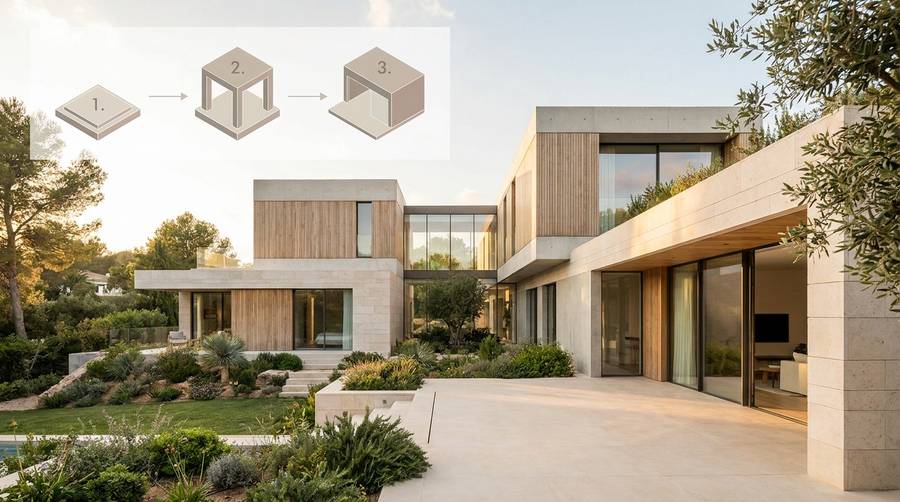
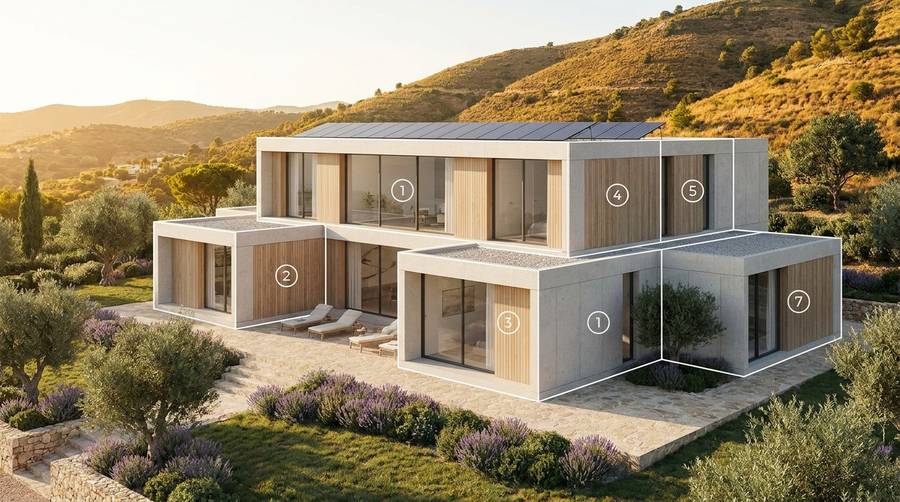
Industrialized housing (also called modular or prefabricated housing in common parlance) means that significant parts of a home are produced in factories under controlled conditions and assembled on site. The approach blends factory efficiency with on-site customization, and in Spain 2026 it sits at the intersection of faster delivery, predictable budgets and improved sustainability.
Executive summary: what it is, scope and key benefits
- Scope: From volumetric modules to panelized systems and turnkey delivery.
- Key benefits: shorter timelines, tighter cost control, consistent quality and improved energy performance potential.
- Limitations: transport constraints, design limits on very complex forms, and the need for early decisions on finishes.
Profile of the Spanish self-builder in 2026: motivations and expectations
- Primary motivations: cost transparency, speed to move in, and energy-efficient homes.
- Expectations: clear fixed-price offers, Passivhaus-ready options, and single-point responsibility (turnkey).
- Typical plots: peri-urban and suburban lots where access and crane logistics are manageable.
When to consider industrialization over traditional construction
- Choose industrialized housing if you value fixed schedules and a high degree of prefab coordination.
- Traditional build may be better for highly irregular land, extremely bespoke architecture, or inaccessible sites.
Industrialized housing reduces on-site uncertainty by shifting variability into controlled factory workflows—cutting weather risks and many common causes of delay.
Objective comparison: industrialized housing vs traditional building
Below we compare the two routes across the most decisive dimensions for self-builders.
Project and construction time: closed timelines vs traditional variability (guideline metrics)
Typical timelines (guideline):
- Industrialized turnkey: design-to-handover commonly 8–14 months for 120–200 m² single-family homes.
- Traditional build: 12–30 months depending on contractor coordination, weather and approvals.
Why the difference? Factory production allows concurrent activities: while foundations are prepared on site, modules or panels are produced simultaneously. In contrast, traditional sequencing depends on many trades operating in series.
Cost and budget control: fixed price, deviations and metric examples
Cost behavior:
- Industrialized contracts frequently offer a near fixed-price package for structure, envelope and M&E core. Variation margins typically ±5–8% from contract changes.
- Traditional projects commonly see wider deviations: ±10–30% due to scope creep, delays and subcontractor claims.
Illustrative metric (2026 Spain, average-region): a 150 m² turnkey industrialized home can range €1,400–€1,900/m² (depending on finishes and systems). A comparable traditional build often starts at similar base costs but runs higher once delays and variations accumulate.
Build quality and warranty: factory control, finishes and maintenance
Quality advantages of industrialization:
- Controlled environment reduces workmanship variability and improves tightness of thermal and acoustic layers.
- Factory testing of MEP and interfaces before site delivery reduces commissioning issues.
However, good factory quality depends on the manufacturer's process controls and supplier ecosystem. Insist on documented QA, third-party testing and clear warranty terms.
Materials and construction systems: technical trade-offs
Selecting the right structural system is central to matching project priorities—speed, sustainability and architectural ambition.
Industrialized concrete: structural performance, insulation and uses
Strengths: high structural resilience, excellent thermal inertia when combined with proper insulation, and long service life. Panelized or precast systems can be used where high loads or shading cantilevers are needed.
Limitations: heavier components mean higher transport and crane costs. Thermal bridging must be addressed through integrated insulation strategies.
Light timber frame: speed, sustainability and construction details
Strengths: rapid production and erection, superior embodied carbon performance when sourced responsibly, and excellent suitability for Passivhaus envelopes due to continuous insulation and airtightness potential.
Considerations: moisture management and detailing at connections are critical. Fire safety is solved through certified systems and protective layers.
Steel frame: strength, design flexibility and thermal implications
Strengths: large spans, thin sections and high precision fit well with industrialized workflows. Steel allows open-plan layouts and fast assembly.
Considerations: thermal bridging and condensation risks require thermal breaks and robust insulation detailing. Embodied carbon is improving with recycled content but should be quantified.
Sustainability and energy efficiency: real impact and certifications
Industrialization can improve sustainability, but outcomes depend on design choices, transport logistics and factory energy sources.
Carbon footprint reduction: factory, transport and assembly (comparative metrics)
Measured examples show potential reductions of 10–30% in embodied carbon for timber-based industrialized systems versus traditional masonry, depending on transport distances and material sourcing. Concrete-heavy prefabrication can still deliver lifecycle benefits if optimized for durability and reduced material waste.
Passivhaus strategies and passive measures applied to industrialized housing
Why industrialized systems suit Passivhaus:
- High-precision manufacturing enables consistent airtightness targets.
- Continuous insulation and factory-applied membranes reduce onsite errors.
- Integrated MVHR (mechanical ventilation with heat recovery) can be pre-tested in factory conditions.
Costs and energy payback: savings and resale value
Investment in higher-performance envelopes tends to pay back in reduced energy bills within 8–15 years depending on energy prices and occupant behavior. Energy-efficient, certified homes also command a resale premium and better marketability in Spanish regions prioritizing sustainability.
Turnkey process: stages, timings and risks to manage
Turnkey industrialized offers promise simplicity, but you must manage key decision points to avoid scope drift.
From plot to handover: milestones and mandatory documentation
- Feasibility & site survey: access, topography, utilities and geotechnical report.
- Design & approvals: planning permission, technical project and building permit.
- Factory production & foundations: parallel workflows reduce total time.
- Assembly & commissioning: on-site erection, connection of services, final inspections.
- Handover: warranty documents, operation manuals and energy performance certificates.
Quality control and coordination: roles, inspections and acceptance
Recommended controls:
- Factory QA reports for each production lot.
- Independent third-party inspections at key milestones.
- Clear acceptance criteria in the turnkey contract, including snag lists and remedies.
Common risks and mitigation: permits, timelines and site adaptation
- Permitting delays: submit early and maintain a permit contingency in schedule.
- Site constraints: confirm crane reach and transport routes during feasibility.
- Scope changes: lock finishes and systems before factory production begins to avoid costly rework.
Financing and paperwork for self-builders of modular homes
Financing an industrialized home follows similar principles to traditional builds but with some specific lender expectations.
Mortgage and credit options for self-promotion in Spain 2026
Options include:
- Standard mortgage post-completion: many banks finance the finished property once registered.
- Self-build or construction mortgages: tranche payments linked to milestones or certificate-of-advance systems.
- Specialized lenders and green mortgages: better rates for energy-efficient certified homes (ask for Passivhaus or EPC A documentation).
Budgeting realistically: guarantees, downpayments and cashflow
Practical tips:
- Expect at least 20–30% initial financing requirement covering land and pre-construction costs.
- Negotiate retention clauses with the manufacturer or supplier to cover minor defects after handover.
- Plan for VAT timing and municipal fees; industrialized turnkey may include VAT on work differently than pure product sales.
Administrative and tax requirements: permits, certificates and available aids
Key documents: building permit (licencia de obra), EPC (energy performance certificate), occupancy permit, and warranty insurance. Also review regional incentives for energy-efficient new builds or renewable systems.
Practical conclusion: how to decide based on your project and priorities
Decision-making must be pragmatic and based on your constraints: site, timeline, budget and sustainability goals.
Quick decision checklist: when to pick industrialized housing
- Need to move in quickly and want predictable timelines.
- Value cost transparency and a largely fixed-price contract.
- Prioritise energy efficiency and airtightness like Passivhaus targets.
- Have a plot with good access for transport and cranes.
Case examples: quick comparative snapshots with metrics
Example A — Suburban 140 m² family home (timber frame industrialized)
- Timeline: 10 months delivery.
- Total cost: €1650/m² turnkey (incl. foundations and standard finishes).
- Occupant satisfaction (post-occupancy survey): 92% rated process and comfort positively.
Example B — Rural 160 m² bespoke stone-faced traditional build
- Timeline: 20 months.
- Final cost: €1,850–2,100/m² with mid-project scope changes.
- Satisfaction: 78% cited delays and budget stress as main negatives.
Next steps recommended: technical consultation, budget and timeline
- Book a technical feasibility visit for your plot to validate access and foundation type.
- Request two turnkey proposals with itemized scopes and warranty terms.
- Obtain preliminary financing pre-approval and align payment tranches with project milestones.
If you’re leaning towards industrialization, insist on factory QA documentation, clarity on transport logistics and a detailed handover protocol—these three items are where most disputes originate.
Choosing the right delivery method is less about trend and more about aligning your project’s schedule, budget discipline and sustainability goals.
Ready to evaluate your plot and compare realistic turnkey offers? Start by gathering your land documents and a site plan—those are the two things manufacturers ask for first. If you’d like, arrange a no-obligation technical feasibility assessment to receive tailored cost and timeline estimates.
Artículos relacionados