Prefabricated House Case Study: From Plot to Turnkey Home
From dream to delivery: a real prefabricated house that changed expectations
They wanted a sunny Mediterranean home, fixed budget and a reliable calendar — and they got it. This case follows a family in Spain who chose a prefabricated house with a turnkey process. I describe what they needed, the technical choices, measurable results and the financing path that closed the loop. Read on if you are an autopromoter seeking concrete metrics and actionable steps.
"We signed a fixed-price contract and moved in 18 weeks after the panels left the factory — the predictability saved us time and money."
Project context: family, plot and practical needs
Family profile and brief
The clients were a couple in their early 40s with a young child. Their brief focused on three priorities: energy efficiency (low running costs), a strong connection to the garden, and a predictable schedule with a fixed final price to avoid budget overruns common in traditional builds.
Plot characteristics and constraints
The plot was a 600 m² parcel on the outskirts of a Mediterranean town. Key constraints: a gentle slope, local façade regulations requiring light earthy tones, and limited access for oversized trucks. These factors shaped the design and logistics.
Why industrialized housing over traditional construction
- Predictability: Fixed-price turnkey contract reduced financial risk.
- Speed: Off-site production cut on-site time and weather delays.
- Quality control: Factory processes improved consistency.
For a deeper look at timelines and practical guidance, see our guide Vivienda industrializada: futuro y guía práctica 2026.
Design and materials: technical choices with a Mediterranean soul
Selected structural system and reasons
The team selected a hybrid solution: industrialized concrete elements for the foundations and ground slab and a light timber frame for the above-ground envelope. Reasons:
- Concrete ensures a durable, thermally stable base and solid acoustic performance.
- Timber frame delivers speed, excellent thermal performance and a warm interior feel aligned with Mediterranean living.
- The combination enabled factory precision while keeping façades and interiors feeling natural and premium.
Finishes and energy-aware components
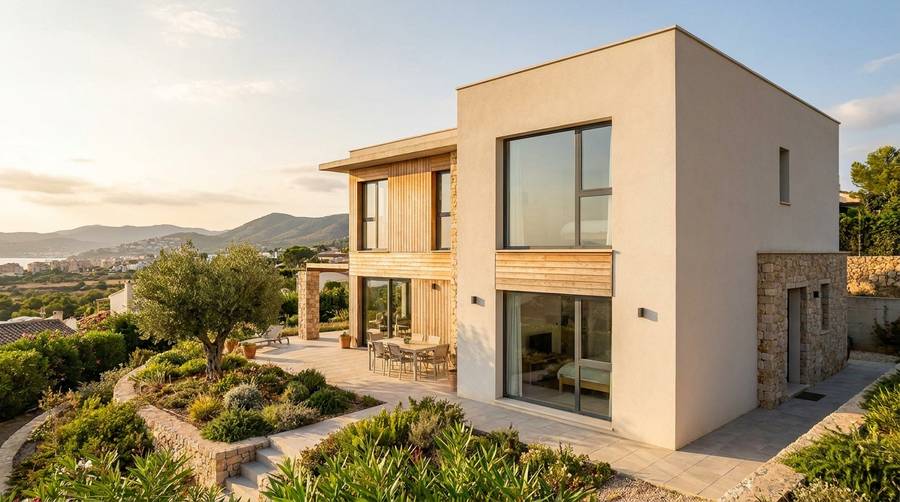
Exterior finishes used light lime-based render and local stone cladding around the entrance. Windows were high-performance triple-glazed frames with low-E coatings and thermally broken frames. The roof included a ventilated cavity and high-grade mineral wool plus a continuous external insulation layer. These choices prioritized airtightness and reduced thermal bridges.
Mediterranean integration: light, porches and landscape connection
Design decisions emphasized cross-ventilation, generous porches and large south-facing glazing to capture winter sun while overhangs shade the interior in summer. The ground floor opens onto a terrace with native planting to create a direct connection between indoor and outdoor life — a key expectation for the family.
Turnkey process step by step: plot to keys
Finding and adapting the plot: permits and constraints
Early work focused on due diligence: topography, local urban rules and utility connections. The team prepared a site adaptation plan and confirmed required permits before ordering factory production — a critical step to ensure the on-time schedule.
Production, logistics and on-site assembly
Factory fabrication lasted eight weeks, producing wall panels, roof elements and pre-assembled bathroom pods. Logistics planning accounted for narrow access; deliveries were scheduled at dawn to minimize disruption. On-site assembly took five weeks, including crane operations, mechanical and electrical integration, and finishing.
Quality control, guarantees and handover
Quality checks occurred at three stages: factory QA, on-site assembly review, and a pre-handover inspection with the clients. The project included a two-year workmanship warranty and a ten-year structural guarantee. The handover included commissioning of the MVHR (mechanical ventilation with heat recovery) and user training for energy systems.
Timelines, costs and measurable metrics
Time comparison: industrialized vs traditional
Actual project timelines:
- Permitting and design: 14 weeks (parallelized with factory ordering)
- Factory production: 8 weeks
- On-site assembly and finish: 5 weeks
- Total from contract to handover: 27 weeks (≈6.5 months)
Comparable traditional build estimates for a similar home average 12–18 months for the same region and complexity. The industrialized route shortened on-site work by over 60% and reduced weather-related delays to near zero.
Cost breakdown: fixed price, deviations and real savings
Budget summary (rounded figures, Spain 2025 market context):
- Land preparation and foundations (including industrialized concrete slab): €45,000
- Factory components and assembly (timber frame envelope, glazing, roof): €140,000
- Interiors, finishes and MEP (mechanical, electrical, plumbing): €55,000
- Professional fees, permits and contingencies: €20,000
- Total turnkey price: €260,000
The fixed-price contract protected the family from the common 10–20% overruns seen in traditional projects. Measurable savings came from reduced on-site labour time, fewer delays and lower waste disposal costs.
Client satisfaction and post-occupancy metrics
Three months after moving in the family reported:
- Overall satisfaction: 9/10
- Perceived indoor comfort: 9/10
- Observed annual energy use projection (space heating + hot water): 35–45 kWh/m²·year based on system sizing and monitoring data — a 40% reduction compared with similar local traditional builds.
The family praised the predictability of the timeline and the clarity of invoicing during the process.
Sustainability and energy performance: measurable outcomes
Energy performance and certification targets
The design targeted high-performance envelope metrics comparable to a low-energy standard and aimed to meet many Passivhaus principles: excellent airtightness (target 0.6 ACH at 50 Pa), high insulation levels and thermal bridge minimization. The hybrid concrete/timber solution achieved a projected heating demand of about 30–45 kWh/m²·year depending on behaviour and system settings.
Carbon reduction across production and construction
Key measures to reduce embodied and operational carbon:
- Using certified sustainable timber for the frame reduced embodied carbon relative to a full-masonry solution.
- Factory precision lowered material waste by an estimated 20%.
- Shorter site time reduced heavy machinery hours and transport-related emissions.
Passive and active measures applied
Applied measures included:
- High-performance continuous external insulation and thermal breaks.
- Balanced mechanical ventilation with heat recovery to control indoor air quality with minimal heat loss.
- Solar-ready roof and domestic hot water pre-installation to add photovoltaic or solar thermal panels later with minimal changes.
Financing and subsidies: how the project closed the loop
Mortgage options for self-builders and modular projects
The family financed the project via a self-promotion mortgage structured in stages: initial land mortgage, construction drawdowns aligned with factory completion and assembly milestones, and final mortgage conversion upon handover. Lenders required:
- Detailed fixed-price contract with production and delivery schedule.
- Performance guarantees and warranties from the manufacturer.
- Professional-costed calendar showing cashflow needs.
How to present a modular project to a bank
Successful documentation that convinced the bank included:
- Factory QA certificates and production timelines.
- Photos of completed reference houses and a site logistics plan.
- A clear schedule tying payments to milestones rather than subjective progress.
These elements reduced perceived risk and secured better loan terms than a loosely defined traditional construction project.
Subsidies and regional incentives
The project qualified for a regional energy-efficiency rebate aimed at low-energy homes. The team submitted the required envelope U-values, airtightness targets and a commissioning report to access the aid after handover.
Lessons learned and clear advice for future self-builders
Mistakes to avoid and recommended practices
- Do not order factory components before confirming permits. Align approvals and production plans.
- Insist on an itemized, milestone-linked payment schedule in the contract.
- Choose a manufacturer with demonstrable reference projects in the same climate and regulatory context.
Practical checklist before signing a turnkey contract
- Verify warranties and scope of what 'turnkey' includes.
- Request a detailed calendar: design, factory, transport, assembly and commissioning dates.
- Confirm who coordinates permits and utility connections.
- Ensure commissioning tests (airtightness and MVHR balancing) are included in the price.
How to replicate this success: selection criteria for supplier and team
Prioritize suppliers who provide:
- Transparent fixed pricing and well-documented QA processes.
- Reference builds with post-occupancy data you can verify.
- Experience with financing documentation for banks.
For a real family story and visual context, read Casa prefabricada: caso real de una familia en España, which complements this analysis with lived experience and imagery.
Final thought: Industrialized housing provides measurable advantages when managed with professional planning: shorter timelines, controlled budgets and demonstrable energy performance. If you are an autopromoter, approaching the project as a packaged program — with clear milestones, technical guarantees and a coordinated financing plan — turns a dream into a predictable outcome.
If you want tailored guidance for your plot and budget, start by gathering the parcel documents and a basic brief. We can help prioritize systems, estimate timelines and prepare the bank-ready package to secure financing.