Industrialized Housing Success: A Spanish Turnkey Case
Beginning: the story of a family who chose industrialized housing
They wanted a durable, energy-efficient family home without endless delays — and they got it in under a year. This case follows a four-person household near Valencia that chose an industrialized, turnkey solution to build a Mediterranean-style home on a tight urban plot. The project combined modern materials, a fixed price contract and tailored financing for autopromotion.
Case presentation: plot, aims and family context
The plot was 420 m² inside a growing residential neighborhood. The clients’ objectives were clear: a compact 150 m² single-family house, high thermal comfort, predictable cost, and delivery before their eldest started school. They wanted Mediterranean aesthetics: light façades, wood accents, and generous windows to the garden.
Why choose industrialized housing over traditional construction?
The family prioritized three non-negotiables: reduced time to move-in, fixed overall price, and high energy performance. Traditional on-site build estimates ranged 18–30 months with cost variability. The industrialized option promised a controlled schedule, factory-quality elements and clear guarantees — a decisive factor for their planning and peace of mind.
“We needed certainty — of timing, costs and energy bills. Industrialized housing gave us all three without aesthetic compromises.”
The challenge: logistics and urban assembly in a real setting
Plot constraints, regulations and municipal timelines
The plot’s urban classification required respecting a 6m setback and limiting height to two storeys. Municipal permit processing added a 10-week fixed window for approvals, and the architects adapted the industrialized modules to the local code rather than redesigning from scratch.
Logistical challenges: access, transport of modules and civil works coordination
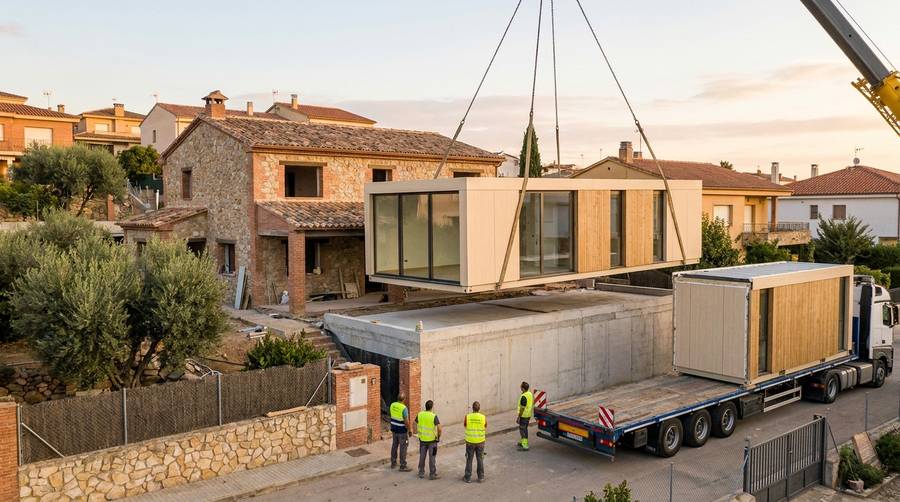
Access was narrow: a single-lane street with parking on both sides. Deliveries had to be scheduled in morning windows and coordinated with neighbor notices to avoid conflicts. The solution combined:
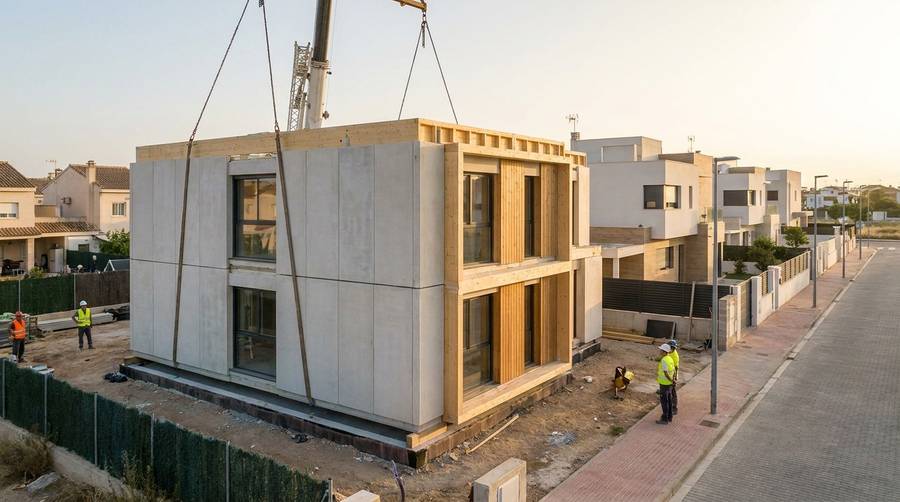
- Pre-assembly in the factory into large panels rather than full oversized modules.
- Just-in-time delivery of panels and mechanical elements during a four-day installation window.
- Coordination with the civil contractor to ensure foundations and utilities were ready the day the panels arrived.
Client expectations on time, cost and quality
The clients expected a fixed price contract with limited change orders and a target delivery in 10–11 months from contract signing. Quality expectations included durable finishes, no visible structural systems inside the home, and Passivhaus-inspired performance.
The turnkey solution: step-by-step process
Finding the plot and adapting the design to local regulations
The turnkey partner handled the plot verification: cadastral checks, cadastral boundary confirmation and municipal pre-checks. That allowed the design team to produce a permit-ready adapted layout in eight weeks. Key decisions made early:
- Orienting living spaces to the garden for daylight and passive solar gains.
- Optimizing module dimensions to comply with street transport limits.
- Specifying fixed-price finishes to avoid scope creep.
Manufacturing, transport and assembly in a closed timeline
Factory manufacturing started once permits were secured. The process included foundation verification, offsite fabrication of structural panels and bathroom pods, and pre-installation of MEP (mechanical, electrical, plumbing) connectors. Timeline highlights:
- Design and permitting: 8 weeks.
- Factory production: 12 weeks.
- Transport and on-site assembly: 2 weeks (including civil hook-ups).
- Finishes and commissioning: 4 weeks.
The whole turnkey delivery took 26 weeks from contract to keys once permits were granted — significantly shorter than comparable traditional builds.
Integrated coordination: installations, finishes and final delivery
The project manager ran weekly coordination sprints between factory, logistics and local subcontractors. This avoided idle time on site and ensured that bespoke finishes (kitchen, sanitary ware, built-in wardrobes) were fitted within the planned two-week finishing window.
Materials and sustainability: the technical choices that mattered
Materials used: industrialized concrete, light timber framing and steel frame
The structural strategy blended three systems to match performance and urban constraints:
- Precast industrialized concrete for foundations and a smooth basement slab — durable and low-maintenance.
- Light timber frame for exterior walls and thermal continuity, allowing fast factory assembly and high insulation levels.
- Steel frame elements in cantilevers and lintels where spans required additional stiffness.
This hybrid approach preserved the Mediterranean aesthetic while optimizing weight for transport and assembly.
Energy efficiency and Passivhaus criteria applied
The design targeted low energy demand using passive measures and efficient systems:
- High-performance envelope with continuous insulation and airtightness detailing.
- Triple-glazed, thermally broken windows oriented for summer shading and winter solar gains.
- Mechanical ventilation with heat recovery (MVHR) sized to the dwelling.
- Solar thermal support for domestic hot water and provision for PV panels.
Measured and modeled results estimated heating demand reductions of 70–80% versus a baseline Spanish code-compliant home.
Carbon footprint reduction and medium/long-term advantages
Using timber for the envelope and industrialized concrete only where structurally necessary lowered embodied carbon. The case showed:
- Estimated 30% lower construction-phase CO2 compared to an equivalent traditional build.
- Reduced waste and higher recycling rates due to factory production.
- Operational energy savings that translated into lower life-cycle emissions and running costs.
Quantifiable results: times, costs and customer satisfaction
Time comparison: industrialized model vs traditional construction (real dates)
Project timeline (real):
- Contract signature to permit approval: 8 weeks.
- Permit approval to factory start: 2 weeks.
- Factory run & site assembly: 14 weeks.
- Finishes & commissioning: 4 weeks.
Total: 28 weeks (permit window included). For a similar on-site project the expected time was 18–24 months, depending on weather and subcontractor availability. The industrialized route saved approximately 10–16 months.
Cost analysis: fixed price, financing and mortgages for autopromotion
The turnkey contract offered a fixed price that included design adaptation, factory work, transport, assembly and final finishes. Key financial points:
- Predictability: The family avoided the cost overruns common in traditional builds.
- Financing: The project qualified for autopromotion mortgage products that underwrite turnkey industrialized projects. These mortgages consider the fixed-price contract and manufacturer guarantees when evaluating risk.
- Cost breakdown: Higher upfront unit cost in factory components was offset by lower on-site labour and shorter financing periods (less interest during construction).
Net effect: similar or slightly lower total cost vs conservative traditional estimates once financing and time-to-completion were accounted for.
Customer satisfaction and post-delivery metrics
Post-occupancy surveys at 6 and 12 months recorded high satisfaction:
- Overall satisfaction: 9.3/10.
- Thermal comfort rating: 9.1/10.
- Adherence to schedule: 9.5/10.
- Perceived value for money: 8.8/10.
Residents reported significantly lower heating/cooling bills and appreciated the factory-level finish quality and acoustic performance.
Inspirational conclusion: lessons and recommendations for autopromoters
Keys to replicate this success in urban projects
For autopromoters considering industrialized housing, these practical principles worked well:
- Define non-negotiables early (budget caps, delivery date, performance targets).
- Choose a turnkey partner who coordinates permits, factory and site works under one contract.
- Plan logistics from day one — transport limitations can drive module geometry and cost.
- Insist on life-cycle data for materials and energy models to compare real savings.
Practical tips on financing, materials selection and logistics
Specific, actionable advice:
- Discuss autopromotion mortgage options early; lenders favour fixed-price turnkey contracts with manufacturer warranties.
- Prioritize airtightness and MVHR to reduce operational costs rather than chasing marginal façade savings.
- Select hybrid structural systems to balance transport weight and finished appearance.
- Schedule deliveries outside peak traffic hours in constrained urban areas and coordinate neighbor notifications to avoid delays.
Future outlook: how industrialized housing reshapes autopromotion in Spain
Industrialized housing is shifting expectations for self-builders: faster delivery, higher factory-level quality and measurable environmental benefits. As mortgage products and permitting pathways adapt, autopromoters will find it increasingly feasible to plan family timelines around predictable, turnkey industrialized delivery.
For families seeking a practical, modern Mediterranean home, the industrialized route is no longer an alternative — it's often the optimal approach.
If you want a concrete example of logistics and assembly in a finished project, see our case study Vivienda industrializada: caso real de éxito, or read a detailed comparison in Casa prefabricada vs tradicional: guía 2026.
Ready to plan your own turnkey industrialized home? Start by clarifying your non-negotiables and ask potential partners for a timeline and fixed-price breakdown. That first clear estimate will tell you whether industrialized housing is the right path for your family’s goals.
Artículos relacionados