Modular High-Rise Flats: A Turnkey Success Story
From vision to skyline: how a modular high-rise project began
They wanted certainty: a fixed price, a reliable schedule and homes that would outlast market trends. That demand turned a speculative idea—building premium, sustainable housing on a constrained urban plot—into a modular high-rise pilot in Spain that delivered measurable results.
This case study follows the project from brief to handover. You'll find clear figures on times, costs and energy, technical choices that mattered, and actionable lessons for autopromoters considering modular high-rise flats or other industrialized housing approaches.
Client context and objectives
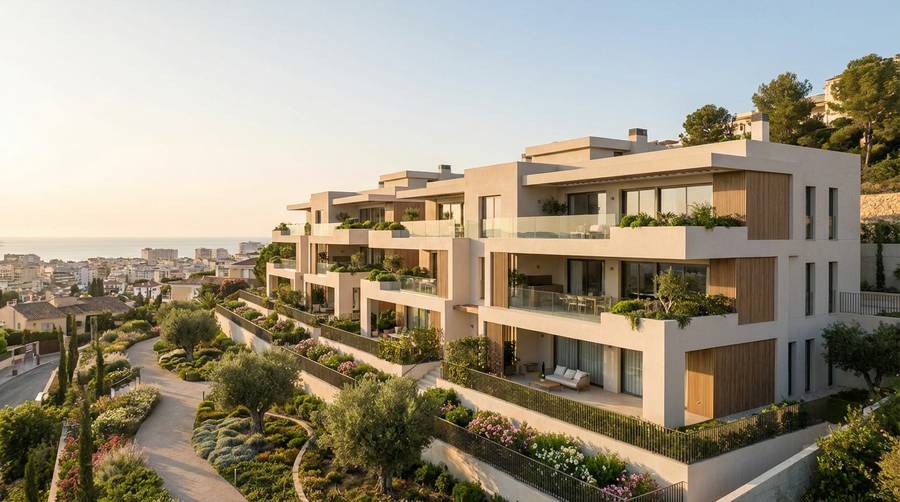
The client was a local autopromoter collective seeking to develop a mid-rise apartment block on a 650 m² inner-city plot. Their brief prioritized: predictable budgets, fast delivery, high energy performance (Passivhaus aspiration), and a Mediterranean contemporary aesthetic that would appeal to families and investors alike.
Why they chose modular construction over traditional methods
Traditional cast-in-place construction meant open-ended schedules and weather-dependent risks. The team selected modular construction for three core reasons:
- Time certainty: significant off-site fabrication reduces on-site duration and weather delays.
- Cost predictability: factory workflows and fixed bills of materials reduce change orders.
- Quality control: factory conditions improve tolerances, insulation continuity and airtightness—critical for Passivhaus-level performance.
Design vision: Mediterranean, sustainable, liveable
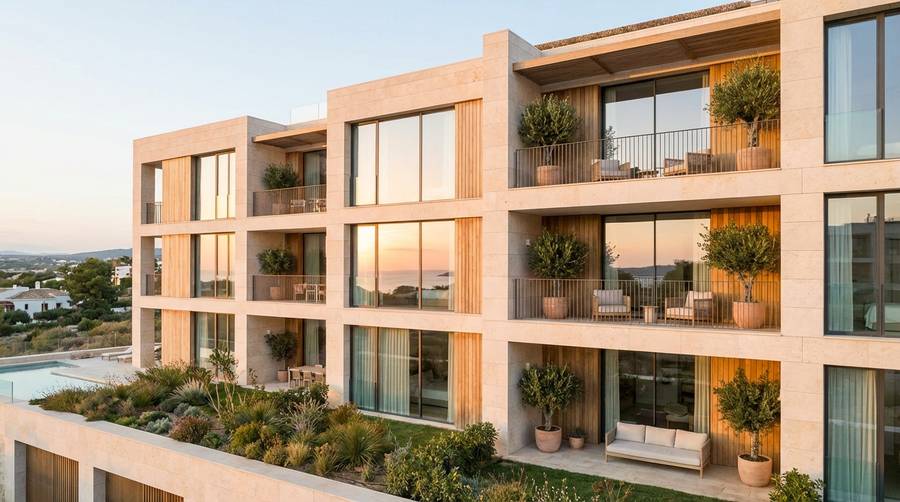
The architectural brief combined light façades, warm natural materials and large terraces. Internally, modules were sized and oriented to maximize daylight, cross-ventilation and thermal performance while preserving the handcrafted look of stone and wood that buyers expect in Spain.
“We needed a method that guaranteed delivery without compromising on finish or energy performance. Modular high-rise flats gave us both predictability and premium quality.”
The constraint: regulations, plot limits and Passivhaus ambitions
Urban constraints that shaped the project
The municipal plan imposed setbacks, limited height and facade articulation rules that forced the design team to optimize every square meter. Parking requirements and setback distances reduced buildable area by almost 12%, pushing the team to increase efficiency per floor.
Energy targets and reducing the carbon footprint
From the outset the project targeted near-Passivhaus performance: high continuous insulation, airtightness below 0.6 ACH and mechanical ventilation with heat recovery. To hit those metrics, the team prioritized factory-integrated building envelopes and third-party air-tightness testing prior to shipment to site.
Schedule and finance pressures
With buyers pre-committing units and a narrow window for financing, the client demanded a locked schedule and defined cashflow milestones. This pushed the project team to adopt a turnkey contractual model with milestone-based payments and lender-ready documentation for autopromoción mortgages.
Technical solution: hybrid materials and systems
Why a hybrid of industrialized concrete, steel frame and light wood was selected
The structural and envelope strategy combined industrialized precast concrete cores for vertical stability with steel-frame floors and light timber-framed modules for apartments. This hybrid approach balanced durability, weight and thermal performance:
- Precast concrete cores provided stiffness, acoustic separation and a robust fire strategy for a multi-storey building.
- Steel frame enabled long spans and accurate alignment for stacked modules.
- Light timber framing in apartment modules improved thermal performance and allowed warm, tactile finishes.
Benefits: durability, thermal control and moisture management
Factory assembly ensured continuous insulation layers, controlled junctions and pre-installed mechanical systems. The result was:
- Lower on-site moisture risk due to reduced open work.
- Higher airtightness from factory-applied tapes and seals.
- Improved acoustic separation via concrete cores and resilient floor junctions.
Short comparison with traditional construction
Compared to cast-in-place builds, the modular high-rise flats approach yielded:
- Time: on-site assembly reduced by 60% compared to an equivalent traditional schedule.
- Cost variance: final cost stayed within ±3% of the fixed estimate, while traditional builds often exceeded budgets by 8–15% under similar conditions.
- Quality: airtightness and insulation continuity were measurably superior because of controlled factory processes.
Turnkey process: step-by-step
Parcel search to planning permissions
The project began with a targeted parcel audit: proximity to services, sun orientation and municipal allowances. Early engagement with the town hall reduced approval time. The turnkey provider compiled a complete planning pack that included thermal simulations and noise studies—documents lenders expect for autopromoción mortgages.
Off-site fabrication and logistics
Fabrication of modules, facade elements and the precast core occurred simultaneously in different controlled facilities. The key coordination steps were:
- Standardized module interfaces and connection details documented centrally.
- Frequent digital model reviews to ensure fit during stacking.
- Just-in-time delivery to minimise site storage and local disruption.
On-site assembly, commissioning and handover
Once the concrete core was set, modules were craned into place over a two-week window per floor. Systems were pre-tested in the factory; final commissioning included airtightness testing, MVHR balancing and energy performance verification. The turnkey agreement included a 2-year post-handover warranty and a package of energy documentation for buyers and lenders.
Measured results: metrics and real client feedback
Project metrics at a glance
Final verified figures for this modular high-rise flats project:
- Total construction period: 9 months (from first foundation works to occupancy).
- On-site assembly: 6 weeks for core module installation and finishes.
- Budget variance: +2.7% final over the fixed price estimate (including change orders requested by buyers).
- Energy performance: 45–55% lower heating demand compared to local new-build baseline (measured first-year consumption).
- Airtightness: 0.42 ACH at 50 Pa on typical apartment tests.
Client satisfaction and qualitative feedback
Homeowners rated their satisfaction at 4.7/5 in a post-occupancy survey. Common themes:
- Appreciation for rapid delivery and minimal disruption during construction.
- High perceived build quality and finish comparable to traditionally built premium apartments.
- Noticeable comfort and lower heating bills, especially during winter months.
“The best surprise was the consistent thermal comfort. Our energy bills dropped and the apartments feel quieter than expected.” — early occupant
Performance comparison with traditional flats
Measured against nearby conventionally built developments of similar size and specification, the modular high-rise flats achieved:
- Circa 50% lower operational heating energy.
- 10–15% less embodied carbon on a like-for-like apartment basis, thanks to efficient material use and shorter construction sequences.
- Higher resale perception value due to the visible finish levels and energy credentials.
Lessons learned and practical recommendations for autopromoters
Common pitfalls to avoid
- Underestimating site logistics: ensure cranage, access routes and storage are resolved early.
- Vague scope definitions: define finishes and services in detail to avoid late change orders.
- Late stakeholder engagement: consult town hall and neighbours early to reduce approval friction.
Risk-reduction strategies
Three practical approaches to reduce project risk:
- Turnkey contracts with milestone payments: align payments to clear deliverables and include liquidated damages for delays.
- Third-party verification: independent airtightness and thermal tests before and after assembly to secure lender confidence.
- Design for manufacture: limit bespoke items on modules to speed production and reduce error rates.
Securing finance: autopromoción mortgages and lender expectations
Lenders look for predictable costs, certifications and clear completion milestones. To secure favorable autopromoción financing:
- Prepare a lender-ready pack with construction schedule, warranties, and third-party performance evidence.
- Use a turnkey provider that offers a fixed-price commitment and clear guarantees.
- Demonstrate marketability with finished show apartments and energy certifications—these reduce perceived sales risk.
Scalability and the road ahead for modular high-rise flats in Spain
How this case can be replicated
The core ingredients that made this project replicable were: a narrow but achievable design language, standardized module interfaces, early municipal engagement, and a finance-ready turnkey offering. These elements can be scaled to other infill sites and mid-rise housing typologies.
Opportunities for developers and families
Modular high-rise flats provide a compelling path for:
- Developers seeking speed-to-market and lower construction uncertainty.
- Autopromoters who need predictable budgets and lender-friendly documentation.
- Families wanting premium finishes, energy savings and modern Mediterranean design without long waits.
An optimistic closing: housing industrialized, humane and premium
Industrialized housing is not a compromise; it's a strategy to deliver premium, sustainable homes with predictability. For autopromoters and developers in Spain, the modular high-rise flats model shows that you can achieve Passivhaus-level comfort, controlled costs and a fast path to occupancy—without sacrificing Mediterranean character or build quality.
If you're evaluating modular options for your next project, start with a site audit and a turnkey proposal that includes energy verification and lender documentation—these early steps create the conditions for a predictable, high-value outcome.
Explore practical examples and deeper technical guides like Pisos modulares de gran altura: guía completa 2026 or learn from other turnkey successes in our archive to shape your plan.
Ready to move from concept to concrete results? Contact a turnkey provider with clear portfolio evidence and demand an initial feasibility that includes schedule, budget and energy forecasts. That conversation is the fastest way to turn a modular high-rise vision into homes people love.
Artículos relacionados
Modular Housing Case Study: High-Rise Turnkey Success
A Spanish developer chose modular construction for a high-rise turnkey project. This case study details choices in materials, a strict schedule, real cost metrics and measurable energy savings—plus practical advice for future autopromoters.