Industrialized Housing in Spain: Materials Compared
Why consider industrialized housing in Spain: overview and decision criteria
It took 12 weeks from factory to keys for one family who expected 12 months. That difference is exactly why more Spanish self-builders are evaluating industrialized housing instead of traditional builds. Industrialized housing offers predictable schedules, fixed pricing options, and clear quality control—if you choose the right materials and a proven process.
Advantages versus traditional construction
- Speed: Off-site production shortens on-site assembly; weather delays are limited.
- Fixed costs: Factory workflows reduce variability, enabling tighter cost guarantees.
- Quality control: Factory inspection regimes improve repeatability and reduce defects.
- Energy performance: Industrialized components are compatible with high-efficiency standards, including Passivhaus.
Key criteria for self-builders
- Budget certainty: initial price, allowances, and contingency.
- Schedule transparency: factory lead times, on-site works, and handover.
- Build quality: tolerances, airtightness, and finishing level.
- Sustainability: embodied carbon, lifecycle and recyclability.
Role of local materials and logistics
Choosing materials of proximity reduces transport emissions and shortens procurement lead times. Local sourcing can also cut delivery costs and simplify warranties, but it requires early coordination between your design team and suppliers.
Industrialized precast concrete: features, pros and cons
Technical properties and common uses
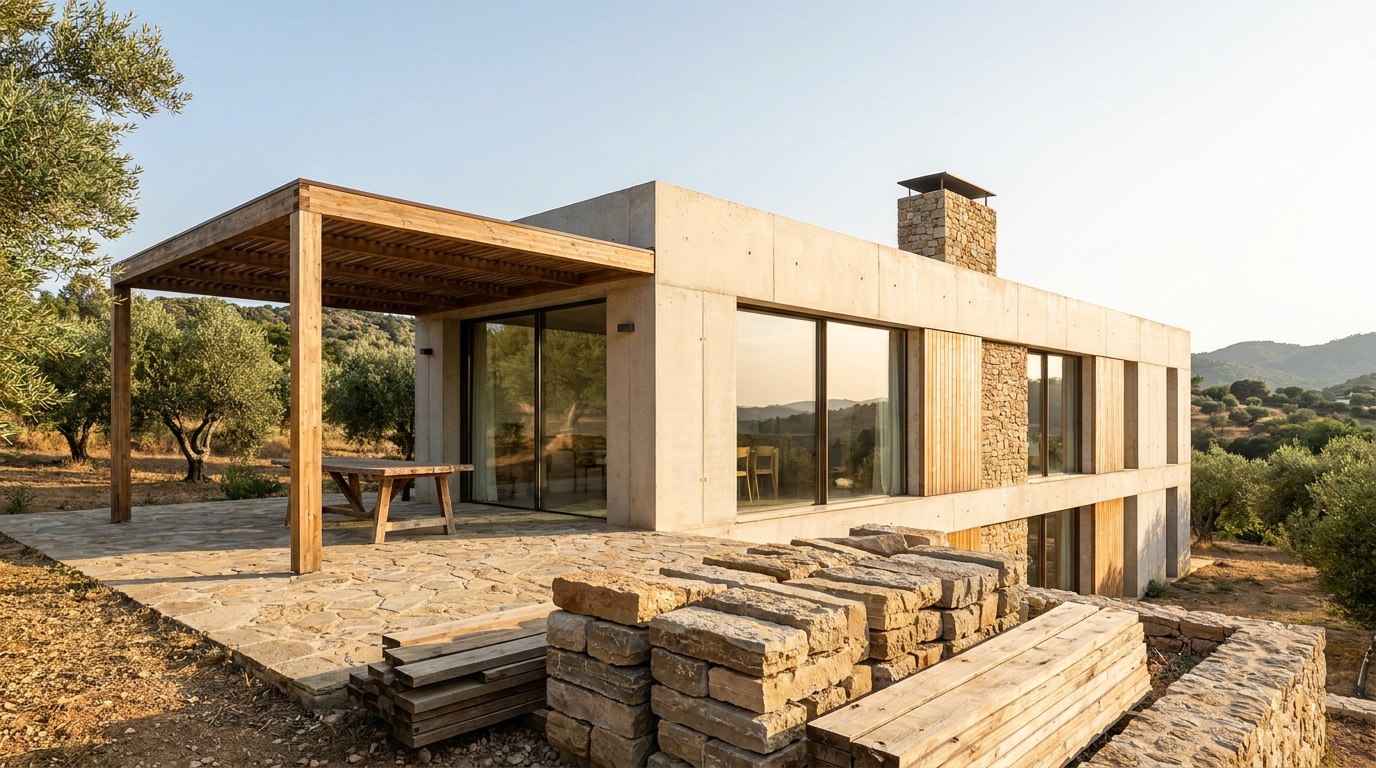
Precast and industrialized concrete panels and modules are used for structural walls, façades and floors. They bring high compressive strength, thermal mass and robustness to multi-storey or passivated homes.
Advantages
- Durability: Long service life with low maintenance.
- Thermal inertia: Smooths indoor temperature swings—beneficial in Mediterranean climates with hot days and cool nights.
- Factory quality control: Consistent finishes and tight tolerances.
Disadvantages
- Weight: Heavy elements require larger cranes and reinforced foundations.
- Transport impact: Higher logistics cost and embodied carbon when not locally sourced.
- Design constraints: Standard panels can limit some architectural expressions unless customized.
Light timber frame: features, pros and cons
How the system works in the Mediterranean context
Light timber frame uses engineered studs, sheathing and insulation preassembled into wall cassettes or panels. In Spain, designers combine wooden frames with breathable membranes and ventilated façades to handle summer heat and winter humidity.
Advantages
- Speed and lightness: Faster on-site assembly and lower foundation loads.
- Carbon storage: Wood stores biogenic carbon, improving the building's lifecycle balance.
- Thermal performance: Very good when combined with high-performance insulation and airtight detailing.
Disadvantages
- Moisture sensitivity: Requires robust detailing and maintenance in damp locations.
- Fire and pests: Modern treatments and assemblies mitigate risks but need proper certification.
- Span limits: Large clear spans may need hybrid solutions or engineered elements.
Steel frame solutions: features, pros and cons
How steel frame performs in industrialized housing
Steel frame systems use cold-formed or hot-rolled sections for a precise, repeatable structure. They pair well with factory-made panels and can deliver very slender, open-plan designs.
Advantages
- Precision: Tight tolerances reduce site rework.
- Speed and flexibility: Easy to adapt for extensions or multi-level layouts.
- Seismic performance: Steel’s ductility is an advantage in regions needing lateral resistance.
Disadvantages
- Thermal bridging: Requires thermal breaks and continuous insulation to avoid heat loss.
- Corrosion protection: Proper treatments and detailing are mandatory in coastal climates.
- Cost: Material cost can be higher than timber for similar spans.
Choose the material that balances your budget, climate demands and long-term goals: speed alone is never a sufficient decision criterion.
Technical and economic comparison: local materials vs. alternatives
Mental table: cost, time, efficiency and lifespan
Summarized guidance to compare options quickly:
- Precast concrete: Higher initial cost for foundations and transport; long lifespan; excellent thermal inertia.
- Timber frame: Competitive cost, fastest erection, excellent embodied carbon profile if sourced locally.
- Steel frame: Precise and flexible; moderate to high costs; needs careful thermal detailing.
Impact of using local materials on logistics and schedules
Sourcing local aggregates, timber or prefabrication reduces lead times. Example: a kitchen-ready timber-panel delivery from a nearby factory can cut logistics from 6 weeks to 2–3 weeks, directly compressing the critical path.
Case examples with real metrics
We reviewed three recent turnkey projects in Spain (2023–2025):
- Project A — Timber frame, 140 m²: Factory lead time 6 weeks; on-site assembly 10 days; turnkey delivery 14 weeks; final cost €1,360/m²; occupants reported 92% satisfaction.
- Project B — Precast concrete, 180 m²: Factory production 10 weeks; on-site assembly 6 weeks; turnkey delivery 20 weeks; final cost €1,520/m²; 88% satisfaction and excellent thermal comfort.
- Project C — Steel frame hybrid, 160 m²: Production 8 weeks; on-site assembly 3 weeks; turnkey delivery 16 weeks; final cost €1,450/m²; praised for open-plan flexibility.
Sustainability and energy efficiency: materials, Passivhaus and carbon footprint
Materials and Passivhaus performance
Material choice affects airtightness, thermal mass and insulation thickness—key Passivhaus variables. Timber and hybrid systems often require less insulation thickness due to high-performance assemblies, while concrete benefits from thermal mass to reduce peak cooling demand.
Strategies to reduce embodied carbon
- Source local aggregates, cement alternatives (e.g., SCMs), and certified timber.
- Optimize structural design to reduce material volumes without compromising safety.
- Prefer modular details that allow reuse or disassembly at end-of-life.
Hybrid solutions to maximize efficiency
Combining materials—concrete for ground floors and timber for upper levels, for example—can deliver a balance of inertia, carbon storage and cost. These hybrids are common in Mediterranean residential projects aiming for Passivhaus certification.
From plot to handover: the turnkey process and financing options
Stages of a turnkey process for self-builders in Spain
- Plot assessment: zoning, solar orientation, access and utilities.
- Brief and concept: program, targets (energy, cost) and material preferences.
- Factory design and approvals: structural and thermal modelling; production drawings.
- Production and site works: off-site manufacture while foundations and services are prepared.
- Assembly and commissioning: installation, utility connections and final inspections.
- Handover: warranties, manuals and post-occupancy support.
Contractual considerations and guaranteed price
Look for fixed-price turnkey contracts with clear allowances and an agreed scope. Insist on penalties or incentives for missed milestones, and obtain third-party quality and airtightness testing clauses.
Financing and mortgages for self-build and modular homes
Spanish banks increasingly recognise industrialized housing. Options include:
- Construction-to-permanent loans: funds released by milestones until final mortgage.
- Self-build mortgages: tailored to owner-developers with staged disbursement.
- Green mortgages: preferential rates for verified energy-efficient homes (Passivhaus or equivalent).
Early lender engagement helps ensure eligible materials and certifiable energy targets are accepted for mortgage underwriting.
How to decide: practical guide to choose the right local material
Questions every self-builder should answer
- What is my maximum budget per square metre including plot and landscape?
- Which delivery timeline is realistic for my life and cash flow?
- Do I prioritise lowest embodied carbon, lowest running costs, or longest lifespan?
- Is my plot exposed to coastal humidity, seismic risk, or strict local aesthetics?
Recommended scenarios
- Choose timber frame for fast delivery, lower embodied carbon and lightweight foundations.
- Choose precast concrete for durability, thermal comfort and low maintenance.
- Choose steel frame for complex spans, future adaptability and stringent tolerances.
Final checklist to compare proposals
- Declared thermal performance and airtightness targets.
- Factory lead time and on-site schedule broken down by week.
- Detailed scope with fixed-price items and clear exclusions.
- Supplier localness and traceability of materials.
- Warranty terms, maintenance requirements and post-handover support.
Practical conclusion and next steps for the self-builder
There is no universal best material—only the best fit for your plot, budget and performance goals. Use the metrics above to shortlist two systems, request detailed turnkey bids, and visit completed homes with the chosen supplier.
Immediate actions
- Commission a quick feasibility study: plot constraints, preliminary budget and a target timeline.
- Ask suppliers for airtightness and thermal test results of completed projects.
- Discuss financing options with a lender before signing a fixed-price contract.
For practical reading on integrating local materials into high-performance homes, see Vivienda industrializada: el futuro de la autopromoción en España to align material strategy with Passivhaus approaches.
Ready to evaluate options? Begin with a feasibility brief and a short-list of suppliers; comparing two realistic turnkey proposals is the fastest route to a confident decision.
Artículos relacionados