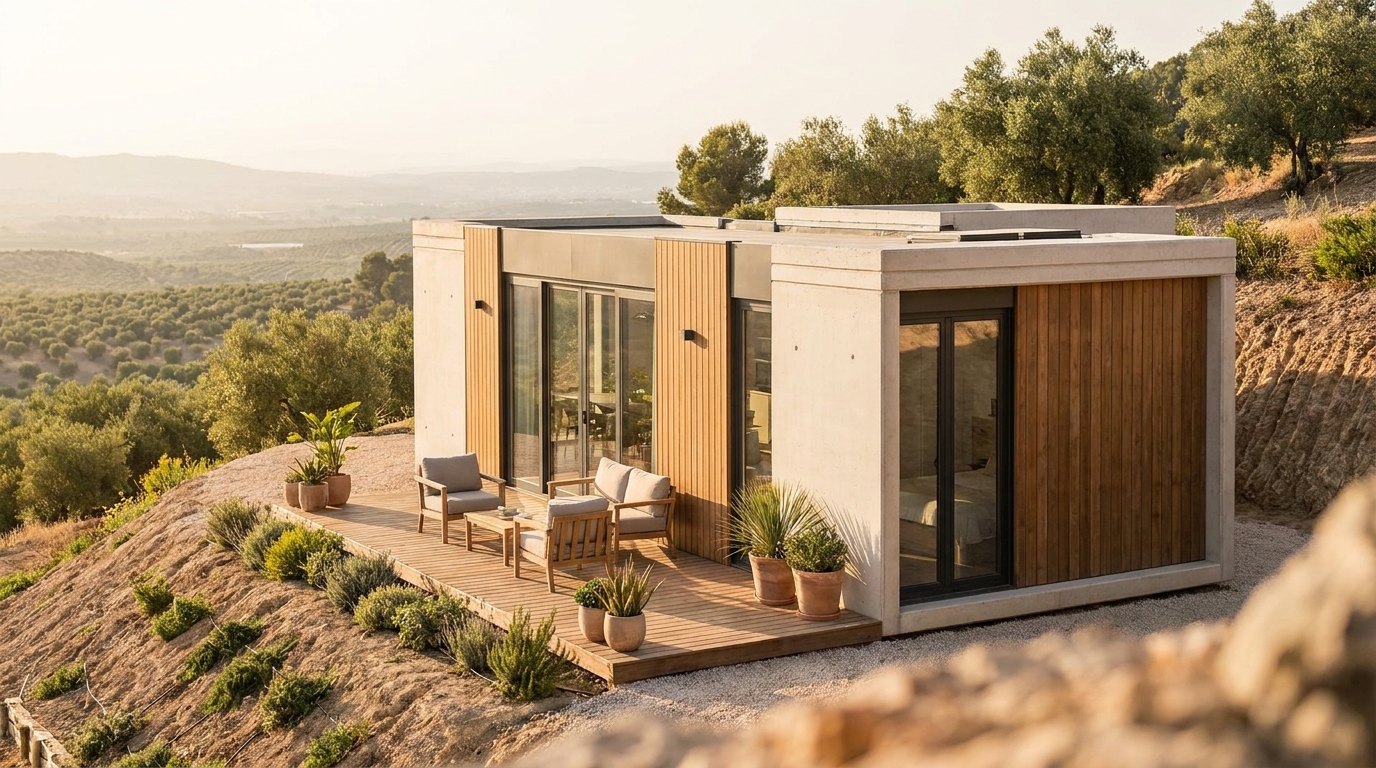
Prefabricated Home in Spain: 9-Month Success Story
From plot purchase to family meals in 9 months: a real prefabricated home story
They signed on a Monday and were unpacking boxes nine months later. That opening sentence summarizes an uncommon result in residential construction—especially in Spain, where traditional builds often stretch beyond a year. This case study walks through the concrete decisions, metrics and trade-offs a family made to deliver a high-quality prefabricated home on time, on budget and with impressive energy performance.
Delivered: 9 months from contract to handover. Total final cost: €220,000 (built area 110 m²). Primary heating demand: 18 kWh/m²·year. Result: happier family, predictable budget, measurable carbon savings.
De parcela a hogar en 9 meses: the family context and why they chose a prefabricated home
Initial context: why they picked a compact prefabricated home
The household was a couple with one child, recently sold an apartment in Madrid and purchased a 450 m² plot on the outskirts of Valencia. Their priorities were clear: fixed budget, short time to occupancy, good indoor comfort year-round and a contemporary Mediterranean look. After speaking with two local architects and three modular providers, they chose a prefabricated home approach because it offered predictability, factory-level quality control and a fixed price contract.
Timeline with hard metrics: milestones, costs and unavoidable deviations
Key milestones and final numbers were tracked during the build. The client requested monthly reporting and independent third-party blower-door and thermal tests at handover.
- Month 0–1: Plot purchase and feasibility — €18,000 for the plot reservation and geotechnical study paid by the client.
- Month 1–2: Project, permits and bank approval — design and paperwork; loan in principle obtained. Official building permit received in 6 weeks.
- Month 3–4: Factory production — structural modules, finishes and technical systems were manufactured in 6 weeks. Factory QA reduced onsite rework to under 2% of items.
- Month 5: Foundation and utility connections — foundation using industrialized concrete slab completed in 3 weeks.
- Month 6: Assembly and envelope closure — modules installed and roof sealed in 5 days; external finishes completed in 3 weeks.
- Month 7–8: MEP, finishes and commissioning — systems installed, airtightness tested and commissioning performed.
- Month 9: Handover and client occupancy — final snagging resolved within 2 weeks after handover.
Final cost breakdown (rounded):
- Base turnkey prefabricated home: €170,000
- Foundations, site works and connections: €30,000
- Permits, documentation and fees: €7,000
- Contingency and client changes: €13,000
- Total: €220,000 (110 m² built area, €2,000/m²).
Final satisfaction: measured feedback and independent tests
The family completed a satisfaction survey at month 3 of occupancy. Highlights:
- Overall satisfaction: 9/10
- Perception of indoor comfort (winter/summer): 8.7/10
- Timeliness vs expectation: 9.5/10
- Likelihood to recommend prefabricated home approach: 85%
Independent tests showed airtightness at 0.5 ACH @50Pa and heating demand of ~18 kWh/m²·year—close to Passivhaus-lite performance for the Mediterranean climate.
Why industrialized construction outperformed traditional methods in this project
Faster calendar and reliable closed-envelope phases
One decisive advantage was the separation of factory and site work. While foundations were prepared, modules were built concurrently in controlled conditions. This parallelization reduced the critical path and produced a short closed-envelope period. The site was weather-exposed for less than two months, which lowered risk of rain-related delays.
Fixed-price predictability: numbers that mattered
The turnkey contract included a clear specification and limited change windows. Because components were predefined and manufactured in-house, the provider could offer a capped price. Notable figures:
- Change orders after production start: 1.6% of contract value (minor finish changes)
- Budget overrun compared to initial quote: +6% including site surprises and client selections
In contrast, traditional local builds of similar scope often report overruns above 15–20% when procurement and subcontractor variability are high.
Factory-controlled quality reduced on-site surprises
Factory QA cut rework dramatically. The team used checklists, fixed jigs for joinery and digital tracking for finishes. The result: fewer open snags at handover and a smoother commissioning of mechanical systems.
Materials and systems that made the difference
Industrialized concrete foundations and modular modulation
The project used an industrialized reinforced concrete slab designed for quick connection to modular units. Benefits realized:
- Rapid, flat substrate that aligns precisely with module connections.
- Lower long-term settlement risk compared to strip foundations on similar soils.
- Reproducible interface details that simplified waterproofing and winter assembly.
Light timber frame vs steel frame: technical and sensory trade-offs
The provider offered both wood frame and steel frame modules. The family chose a hybrid approach: timber for interior partitions and non-load-bearing façades for better acoustic comfort and tactile warmth; steel frame for primary load paths where spans required higher strength. Practical outcomes:
- Timber zones felt warmer to touch and required fewer internal trims.
- Steel frame areas enabled larger open-plan spaces and slimmer profiles for big windows.
- Both systems were compatible with industrial prefabrication and allowed predictable lead times.
Mediterranean finishes: stone, wood and generous glazing
To integrate the house into the Spanish context, designers prioritized light façades, natural stone plinths and teak-effect external cladding. Large triple-glazed windows oriented south-east provided daylight without overheating—paired with external shading. The result was a home that reads as contemporary Mediterranean rather than an industrial product.
Sustainability and energy: reaching near Passivhaus performance
Passive strategies and measured consumption
Key passive decisions included compact geometry, optimized orientation, high-performance glazing with solar control and a high insulation standard (λ values aligned with current best practice). The measured primary heating demand was 18 kWh/m²·year—competitive for coastal Mediterranean climates and a strong indicator that prefabricated homes can approach Passivhaus metrics.
Insulation, airtightness and controlled ventilation
Airtight build details from factory production, continuous insulation and a balanced mechanical ventilation system with heat recovery (MVHR) were decisive. Measured outcomes:
- Blower-door: 0.5 ACH @50Pa
- MVHR efficiency: 75–85% depending on season
- Annual electricity for ventilation and pumps: ~420 kWh/year
Carbon footprint comparison with a conventional build
Using lifecycle estimates focused on embodied and operational emissions over 30 years, the prefabricated home showed an approximate 15–25% lower carbon footprint than a comparable traditional masonry build. Savings were driven by efficient walls, reduced on-site waste and lower operational demand due to better airtightness and insulation.
Turnkey service and financing: how autopromoters navigate the process
Turnkey stages: what the provider handled
The project's turnkey scope covered end-to-end delivery:
- Parcel feasibility and geotechnical guidance
- Design adaptation and local permit management
- Factory production, site assembly and finishes
- System commissioning, testing and final handover
This packaging reduced coordination burden for the family and mitigated common client risks such as subcontractor disputes or scheduling clashes.
Mortgage options for self-build and modular housing in Spain
Financing a modular or prefabricated home is similar to traditional self-build in Spain if you follow documentation best practices. Key points for autopromoters:
- Obtain a mortgage in principle and align payment tranches with production milestones.
- Document turnkey contract with a clear completion certificate for lender disbursements.
- Consider specialized autopromoter loans that fund both land purchase and construction phases.
Working with a provider experienced in Spanish autopromotion simplifies lender requirements and speeds approvals.
Permits, coordination and risk mitigation
The provider took responsibility for most permit submissions and coordinated grid and water connections. Their factory-led approach reduced the number of subcontractors onsite and minimized schedule risk. Still, the project budgeted a 6–8 week buffer for municipal processes—an effective hedge against bureaucratic delays.
Lessons learned and a practical guide to design your prefabricated home in 2026
Checklist to guide decisions early
Essential checklist for autopromoters considering a prefabricated home:
- Parcel: check topography, access and connection points.
- Program: fix bed/bath count and maximum footprint early to avoid late changes.
- Orientation: prioritize southern glazing with shading for Mediterranean climates.
- Budget: include site works, permit fees and contingency (at least 8–10%).
- Energy targets: set a clear target (e.g., heating demand <20 kWh/m²·year).
For more procedural detail on permissions and approvals, see Vivienda industrializada: guía completa paso a paso 2026.
Common mistakes and how to avoid them
Frequently observed pitfalls and corrective actions:
- Late design changes: freeze finishes before factory production to avoid costly rework.
- Underestimating site complexity: commission a thorough topography and soil study early.
- Ignoring commissioning: plan airtightness and system tests into the schedule and budget.
What to ask your provider and what to measure
Questions to use in provider selection and milestones to measure:
- Factory QA processes and number of projects delivered in similar climate zones.
- Lead times for production and typical on-site assembly durations.
- Standard airtightness targets and MVHR specs; request example blower-door certificates.
- Warranty terms, service response times and post-occupancy support.
Measurable outcomes and an inspiring close: the before and after
Final comparison: total cost, delivery time and energy savings
Compared to an equivalent local masonry build, the prefabricated home achieved:
- Delivery time: 9 months vs 14–18 months
- Total cost: competitive at €2,000/m²; reduced exposure to subcontractor price inflation
- Energy demand: heating demand ~18 kWh/m²·year; lower annual bills and faster payback for insulation and MVHR investment
Impact on family life and daily routines
Post-occupancy interviews revealed tangible improvements: more daylight, fewer drafts, stable indoor temperatures and improved acoustic comfort compared to their prior apartment. The family reported spending more time outdoors on the terrace and a lower anxiety level around future maintenance thanks to the warranty and service plan.
A close that invites action
If you are considering self-building in Spain, a prefabricated home can deliver quality, speed and energy efficiency without sacrificing Mediterranean character. Start by clarifying your budget, defining energy targets and selecting a provider that publishes measurable QA data. When paired with careful site review and a turnkey contract, the result can be the kind of transformation this family experienced in under a year.
Ready to explore what a prefabricated home could look like on your plot? Gather your site information and project priorities, and request factory QA records and recent blower-door results from prospective providers—those documents will tell you more than promises alone.