Industrialized Housing vs Traditional Build: Clear Pros and Cons
When Maria signed the purchase offer for her rural plot, she expected two years of construction noise and uncertain bills — she got a finished home in six months with a fixed price. That shift from unpredictability to certainty is the core reason many families and public programs in Spain are looking at industrialized housing today.
Why consider industrialized housing in Spain now
Demand, cost pressure and housing targets are reshaping how homes are delivered across Spain. Urban growth, tighter sustainability goals and a shortage of skilled trades mean traditional timelines and budgets often fail public and private developers alike. Industrialized housing and modular approaches respond to these constraints by moving much of the work into controlled factory environments.
Context: demand, costs and public housing objectives
Public authorities increasingly need scalable, predictable housing solutions. The industrialized route helps meet targets faster while offering repeatable quality — a crucial advantage when delivery speed affects social outcomes.
What industrialization offers versus traditional build
- Predictable schedules: Factory workflows reduce weather-related delays.
- Cost control: Repeated processes cut labor variability and waste.
- Quality assurance: Factory QA and standardized components improve finish consistency.
Self-builder profile and decision criteria
Autopromotores—self-builders—who benefit most typically prioritize time, budget certainty and energy efficiency. If you value on-site customization, traditional methods still offer more last-minute flexibility.
Comparative analysis: industrialized housing vs traditional construction
Objective comparison requires numeric examples and real metrics. Below are practical data points derived from recent Spanish projects and industry averages.
Execution times and fixed schedules (numeric examples)
Example A — 120 m² single-family home:
- Traditional: site works + structure + finishes ≈ 10–18 months (high variance).
- Industrialized house: design + factory production + on-site assembly ≈ 4–8 months (typical).
On average, an industrialized housing schedule reduces on-site time by 60–70%. This shorter exposure means fewer weather delays and lower interim financing costs.
Cost control: fixed price, deviations and risks
Budget stability is the strongest selling point. Modular suppliers commonly offer a fixed-price contract covering production and assembly. Real-world comparisons show total construction cost parity or modest savings versus traditional builds when accounting for:
- Lower on-site labor premiums.
- Reduced material waste and rework.
- Shorter financing windows (interest savings).
Risks to watch: land-specific foundations, unexpected groundworks and regulatory changes can create extras even for a turnkey industrialized solution.
Quality and durability: finishes, factory control and warranty
Factory production enables tighter tolerances, consistent finishes and systematic inspections. Warranties from reputable industrialized housing providers often match or exceed those of traditional contractors because components are stress-tested before shipment.
Factory-controlled processes reduce variability. For many self-builders, the result is a more consistent finish and fewer post-handover defects.
Pros and cons by construction material
Material choice strongly influences performance, cost and sustainability. Below are balanced assessments of the three leading systems used in Spain.
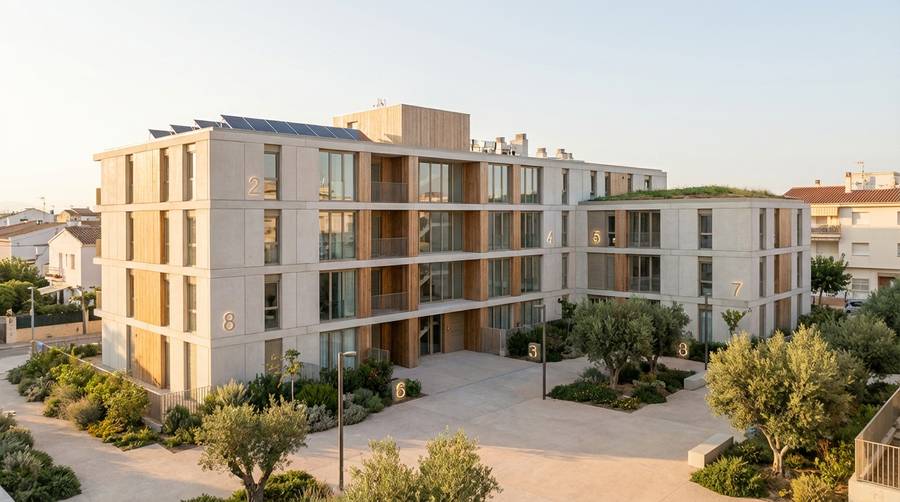
Precast and industrialized concrete: strength and thermal mass
Advantages:
- High structural resilience and fire resistance.
- Excellent thermal mass for stable indoor temperatures.
- Low long-term maintenance when properly detailed.
Considerations:
- Higher embodied carbon per m³ unless low-carbon mixes are specified.
- Heavier components increase transport and crane costs during assembly.
Light timber frame: speed and sustainability
Advantages:
- Very fast assembly and good thermal performance with natural materials.
- Lower embodied carbon when timber is sourced responsibly.
- Comfortable acoustic and indoor environment when detailed correctly.
Considerations:
- Requires careful detailing for moisture control and longevity.
- Perceptions of durability still influence insurers and some mortgage lenders.
Steel frame (steel stud / structural frame): flexibility and accuracy
Advantages:
- High strength-to-weight ratio and design freedom for open spans.
- Precision manufacturing for tight tolerances.
Considerations:
- Thermal bridging must be managed with continuous insulation systems.
- Embodied carbon can be higher unless recycled steel is prioritized.
Sustainability and energy efficiency in industrialized housing
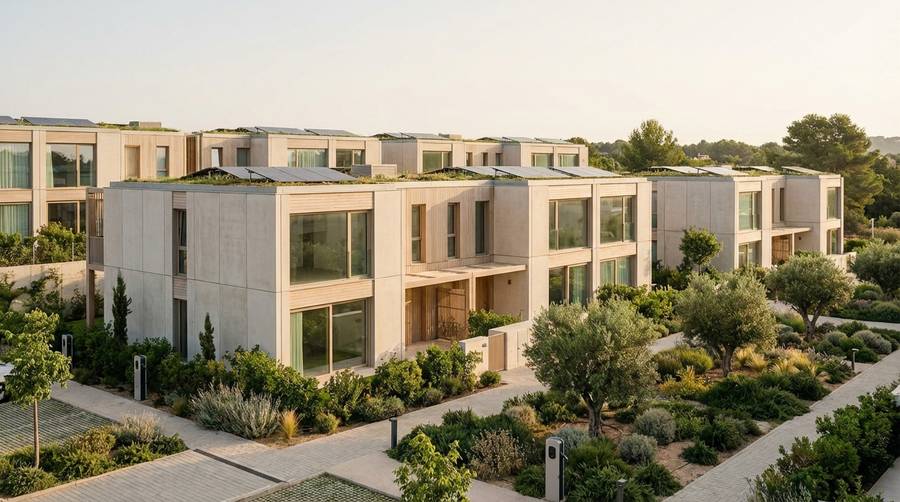
Industrialized methods can be a faster route to Passivhaus-standard performance. Prefabricated envelopes can be assembled to high levels of airtightness with factory-installed insulation and window systems.
Passivhaus and passive solutions: envelope and airtightness
Achieving Passivhaus in an industrialized house is often easier because components are tested in controlled conditions. The key elements are:
- Continuous thermal insulation.
- High-performance glazing.
- Controlled ventilation with heat recovery (MVHR).
Carbon footprint and material metrics
Comparative studies show that light timber systems typically deliver the lowest upfront CO2e per m², followed by well-specified steel frame systems using recycled content, with conventional concrete last — unless low-carbon concrete is used. Important metrics to request from suppliers:
- Declared Embodied Carbon (kg CO2e/m²).
- U-values of envelope elements.
- Expected operational energy (kWh/m²/year).
Operational efficiency: energy, comfort and lifetime costs
Lower operational energy directly reduces long-term costs and tenant exposure to energy price inflation. When combined with solar generation and smart controls, industrialized homes can reach net-zero ready status with smaller upgrade investments.
The turnkey process for self-builders: step by step
A clear, staged process reduces surprises. Turnkey industrialized housing often bundles design, factory production and on-site assembly into a single contract. Below is a practical roadmap for autopromotores in Spain.
From plot to permit: typical steps and approximate timelines
- Site assessment and geotechnical study: 2–6 weeks.
- Preliminary design and budget: 4–8 weeks.
- Planning approval and licenses: 1–6 months (depending on municipality).
Design phase, factory production and assembly
- Final design and factory drawings: 6–12 weeks.
- Factory production: 6–12 weeks (overlaps with permitting if managed early).
- On-site assembly and connections: 1–4 weeks for the shell; additional time for finishes and commissioning.
Handover, warranties and aftercare
Turnkey providers typically include a defects period and manufacturer warranties for systems and components. Verify scope: structural warranty, envelope performance guarantees, and MVHR commissioning records.
Financing and taxation for modular and self-build projects
Financing an industrialized home has nuances that autopromotores must understand to avoid cashflow gaps.
Self-build mortgages: structure and payment phases
Traditional self-build mortgages release funds in stages: land purchase, construction draws and final completion. For industrialized projects, lenders may adapt the schedule because much work occurs off-site. Common requirements:
- Detailed fixed-price contract from the industrialized housing provider.
- Program of values showing factory vs on-site work.
- Performance bonds or retention clauses protecting the borrower.
Credit lines and public support for industrialized housing
Public programs that incentivize industrialized methods occasionally provide low-interest credit lines or subsidies for energy-efficient homes. Check local and regional housing plans for relevant calls and eligibility.
Turnkey financing models and risk allocation
Turnkey models transfer much of the delivery risk to the provider but verify clauses for unforeseen groundworks and utility connection costs, which are often outside the turnkey scope.
How to decide: practical criteria and case studies
Decision frameworks help compare options objectively. Below is a compact checklist and two anonymized case summaries illustrating typical outcomes.
Decision checklist: cost, time, sustainability and quality control
- Budget certainty needed? → Choose industrialized routes for fixed-price comfort.
- High customization and last-minute design changes? → Traditional build offers more flexibility.
- Sustainability targets (Passivhaus)? → Industrialized solutions often simplify compliance.
- Site constraints (access, crane reach)? → Evaluate logistics carefully; heavy precast may be problematic.
Case study 1 — Family home, Andalusia (timelines and costs)
Project: 140 m² timber frame industrialized house. Timeline: 7 months total (design to handover). Final cost: similar to local traditional build when accounting for payment timing. Client satisfaction: high; main benefits cited were schedule certainty and lower on-site disruption.
Case study 2 — Social housing pilot, Valencia region (metrics)
Project: 12-unit block using prefabricated concrete panels. Assembly: on-site works completed in 3 months after factory delivery. Cost per unit: 8–12% lower than comparable traditional builds when calculated over program savings and shorter financing periods. Energy use: projected 40% lower due to sealed envelope and MVHR.
Final recommendations for self-builders and housing managers
- Obtain detailed technical and carbon declarations from suppliers before contract signature.
- Include clear scope definitions for site-specific works in the turnkey contract.
- Plan financing around factory production and on-site assembly phases.
- Prioritize suppliers with documented Passivhaus experience if energy targets matter.
Deciding between an industrialized housing route and a traditional build depends on priorities: if you seek time certainty, predictable costs and high energy performance, industrialized housing will often be the better choice. If you need maximum on-site customization or have complex site conditions, traditional methods may still win.
Ready to evaluate a specific plot or get comparable offers? Start by collecting three fixed-price proposals that include embodied carbon data and a phased payment schedule — that simple step will make differences visible and comparable.