Industrialized Housing Success: A Spanish Turnkey Case
From plot to home: the real story that shifted perceptions of industrialized housing
They arrived with a budget, a brownfield plot and a dream—then watched a modular home rise on time, within budget and with better energy performance than anyone expected. This case tells how industrialized housing became a reliable, high-quality alternative to traditional builds for an autopromoter family in Spain.
"We expected compromises. Instead, we gained months, predictable costs and a house that feels warmer in winter and cooler in summer." — Homeowner, Valencia region
Project context and protagonists: who they were and what they sought
The clients were a three-person family with experience in self-development but limited time. They sought a contemporary Mediterranean home with natural materials, Passivhaus-grade efficiency and a fixed-price delivery. Their priorities: speed to completion, predictable financing, and a finished home that fit the Spanish landscape.
Motivation: why choose industrialized housing over traditional construction
They chose industrialized housing because it promised a shorter on-site phase, fewer cost overruns, and higher quality control. Key motivators included:
- Fixed-price certainty: fewer surprises during construction.
- Shorter on-site disturbance: months instead of years of building noise.
- Improved energy performance: factory-controlled assembly enabled better thermal continuity.
Project summary: key data and initial objectives
Location, size and housing typology
The house sits on a 650 m² urban plot on the outskirts of a mid-sized Spanish city. The delivered dwelling is a two-story single-family home of 165 m² gross floor area, Mediterranean contemporary design, large south-facing glazing and compact, well-insulated volumes.
Objectives: schedule, budget, energy and urban impact
Initial objectives were precise: deliver a turnkey house in 10–12 months from contract signature, keep final cost within a ±5% envelope of the fixed price, reach a specific heating demand below 15 kWh/m²·year, and ensure the finished building respected local urban character.
Urban logistics and assembly: how everything was managed in a real context
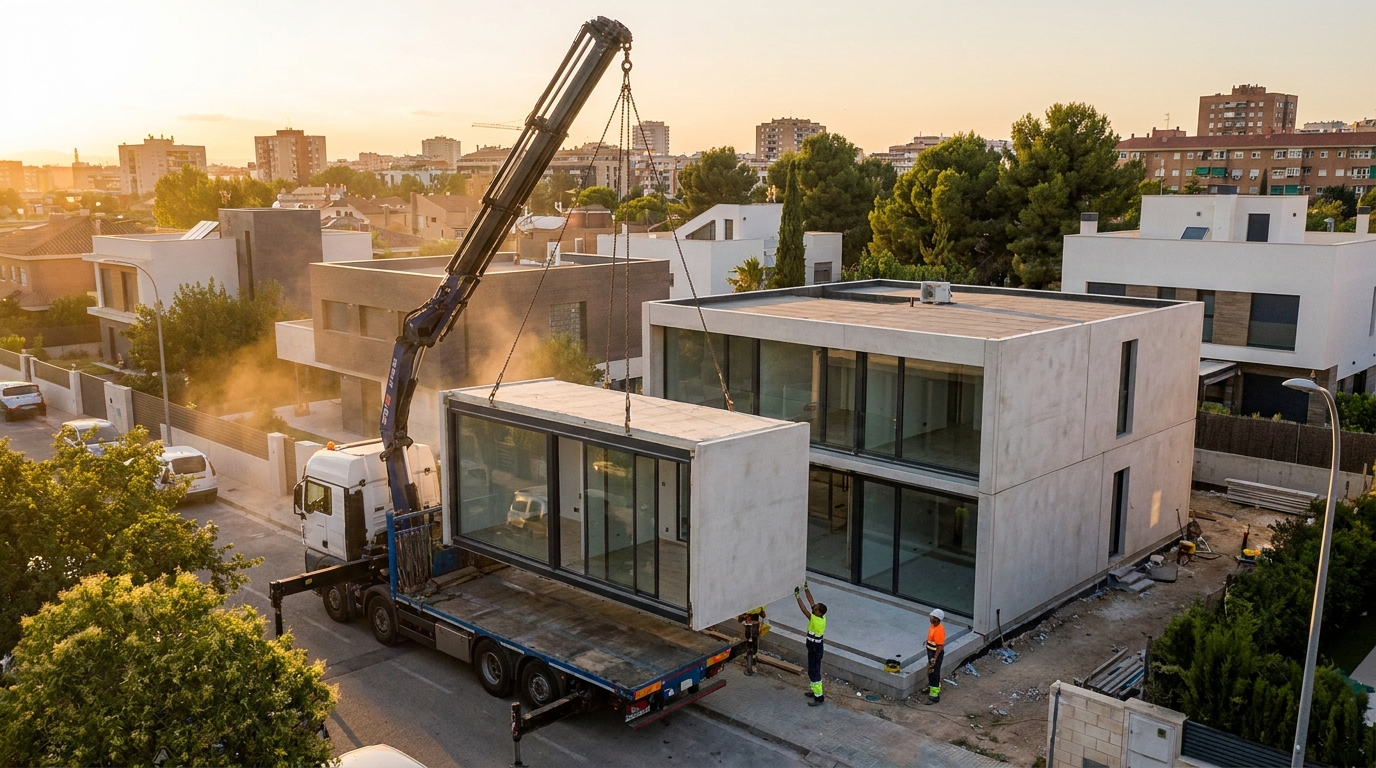
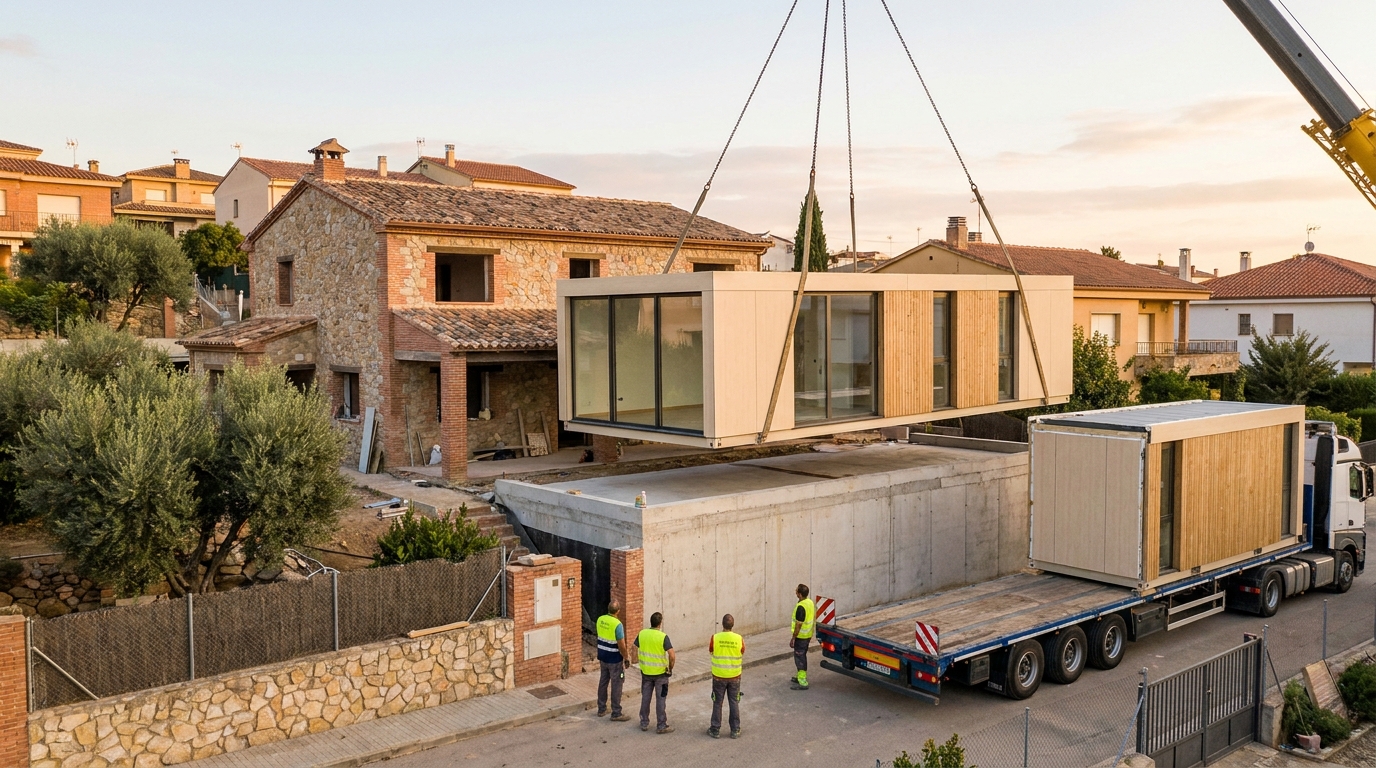
Staging materials, transport and on-site assembly phases
Successful logistics depended on front-loaded planning. The manufacturer assembled modules and panels in a controlled plant on a scheduled timeline. Key steps:
- Pre-assembly in factory: mechanical, insulation and window installs completed prior to transport.
- Just-in-time deliveries: structural modules and smaller components were scheduled to arrive on specific days to minimize storage needs on the plot.
- Two-week installation window: on-site crane operations and connection works were completed in consecutive, pre-approved slots to reduce neighbor disruption.
Permitting and coordination with municipal authorities
Permission coordination started early. The project team engaged the town hall during design development to confirm placement, access for cranes, and temporary occupation permits. This proactive approach reduced bureaucratic delays and avoided costly last-minute design changes.
Minimizing disruption to neighbors and optimizing time
To minimize impact, the team adopted these measures:
- Communications plan with neighbors: schedules, contact person, expected noise windows.
- Noise and dust mitigation strategies during foundation and connections.
- Clear signage and safe pedestrian routes around the site.
Materials, structural system and sustainable criteria
Choosing the system: industrialized concrete, light timber frame or steel frame—and why
The client selected a hybrid approach: load-bearing industrialized concrete for the basement and core, and light timber frame for the above-ground envelope. Why this mix?
- Concrete core: durability, thermal mass and acoustic separation for lower level.
- Timber frame envelope: speed of assembly, excellent thermal performance and a warm finish compatible with Mediterranean aesthetics.
- Connection logic: factory-grade joints reduced on-site adjustments and ensured airtightness targets were achievable.
Passivhaus strategies and carbon reduction measures
Key energy and sustainability measures implemented:
- Continuous insulation and optimized thermal bridges: factory-fitted insulation panels and thermally broken window sills.
- Airtightness target: n50 below 0.6 h-1 achieved through factory-sealed panel joints and gaskets.
- Mechanical ventilation with heat recovery (MVHR): right-sized system for 165 m² with demand-controlled airflow.
- Solar-ready roof and low-embodied-carbon finishes: façades with local timber cladding and lime-based renders.
Finishes and natural materials ensuring Mediterranean comfort and aesthetics
Finishes were selected to feel timeless and fit the region:
- Light-colored lime render, oak interior floors, and local stone accents.
- Large overhangs and pergolas to moderate solar gain.
- Deep-set windows with wooden frames to create depth and warm interior light.
The turnkey process: steps, real timelines and cost control
From searching the plot to final delivery: milestones and essential documents
The turnkey contract covered everything from site search support to final handover. Milestones and required documentation included:
- Pre-contract feasibility report: planning constraints, accessibility and utilities.
- Design pack and building permit drawings submitted to the town hall.
- Fixed-price turnkey agreement including a performance specification and schedule.
- Factory production schedule, delivery windows and installation plan.
- Testing and commissioning certificates (airtightness, MVHR balancing, thermal performance) at handover.
Real schedule from this case: factory time vs on-site work and critical points
Actual timeline achieved:
- Design and permitting: 4 months.
- Factory production of structural panels and modules: 10 weeks.
- Site foundations and utilities: overlapping with factory production, 6 weeks.
- On-site assembly and enclosure: 2 weeks intensive (crane operations, module union).
- Internal finishes, systems commissioning and handover: 6–8 weeks.
Total elapsed time from contract to keys: 10.5 months. The critical path was permitting plus utility connection timing; minimizing delays there preserved the fixed-price promise.
Financing and self-build mortgages: how the payment was structured
Financing combined a self-promotion mortgage with staged payments tied to contractual milestones. Typical structure in this case:
- Initial deposit at contract signature to reserve factory capacity.
- Mortgage tranche covering factory production, drawn when production started.
- Final tranche paid at practical completion on handover.
Staged draws reduced interest on unused capital and matched the turnkey fixed price, making budgeting predictable for the family.
Measured results and lessons learned: impact on time, cost and satisfaction
Real metrics: time saved, budget variance and achieved energy performance
Measured outcomes for the project:
- Time to delivery: 10.5 months vs an estimated 18–24 months for a comparable traditional build.
- Budget deviation: +2% final variance against the fixed price, due to a client-initiated change (upgraded flooring) managed as an extra work order.
- Energy performance: heating demand measured at 13.8 kWh/m²·year after commissioning—within Passivhaus-inspired targets.
- Airtightness: n50 = 0.45 h-1, verified by a blower-door test.
Client testimony and post-handover satisfaction
The homeowners reported high satisfaction in three dimensions:
- Comfort: consistently stable indoor temperatures and low utility bills.
- Time-to-handover: moving in earlier than expected reduced interim rental costs.
- Quality and finish: factory precision resulted in well-aligned finishes and fewer on-site corrections.
Key lessons and practical recommendations for autopromoters
Lessons extracted from this case that other autopromoters can apply:
- Engage local authorities early: resolve permitting questions before factory production starts.
- Prioritize system selection by whole-life value: consider embodied carbon, maintenance and resale value, not only upfront cost.
- Lock finishes and major changes before production: late changes drive costs and delays.
- Use turnkey contracts with clear milestone-linked payments: this aligns incentives and reduces financial risk.
Why this case matters: broader implications for industrialized housing in Spain
This project illustrates how industrialized housing can deliver Mediterranean, high-quality homes that are faster, more predictable and more energy-efficient than many traditional builds. For autopromoters, the model demonstrates:
- Scalable quality control: factory conditions improve thermal continuity and finish consistency.
- Faster urban assembly: short on-site windows reduce disruption and accelerate neighborhood activation.
- Better lifecycle outcomes: lower operational energy and potential for reduced carbon footprint.
Delivering a home on time and within a tight cost envelope without sacrificing design intent proves that industrialized housing is not a lesser alternative—it is a strategic option for modern autopromotion.
If you’re considering building in Spain, use this case as a checklist:
- Confirm permitting early and understand local constraints.
- Choose systems based on whole-life performance and site context.
- Require airtightness and MVHR commissioning in the contract.
- Structure your mortgage draws to match factory and site milestones.
Interested in a tailored feasibility review for your plot? Reach out to an industrialized housing specialist to map timelines, fixed-price options and achievable energy targets—so your next project becomes a measured success with predictable outcomes and lasting comfort.
Image brief for Findnido brand (for AI image generator):
Generate a high-quality architectural photograph in the style of Findnido: a finished Mediterranean contemporary single-family home in Spain at golden hour. Show a light façade combining lime render, local stone accents and timber cladding. Large windows with wooden frames face a landscaped terrace and low-maintenance garden. The scene must feel lived-in: a family bicycle by the door, warm interior light visible through glazing, and soft shadows. The home should appear premium, realistic and sustainable—no exposed structural systems, no modular container look, no tiny house. Framing: wide-angle, balanced composition, natural colors, warm mood, photographic realism suitable for an architectural magazine cover.