


Prefabricated House Guide: How to Build in Spain 2026
Hook: If you want a high-quality home in Spain delivered faster, with fewer surprises and a clear budget, a prefabricated house could be the smartest route. This guide explains, step by step, how to design, finance and complete a modern modular home project in 2026—grounded in real metrics, technical trade-offs and practical checklists.
Why choose a prefabricated house today in Spain: overview
2026 trends in industrialized housing and retail demand
Demand for industrialized housing in Spain continues to rise because buyers value predictability, energy performance and faster delivery. Municipalities and planners increasingly accept modular construction, and market data shows shorter lead times compared to traditional builds. Expect greater availability of finance products for modular projects in 2026 as lenders become comfortable with standardized production processes.
Key benefits versus traditional construction
- Speed: Significant on-site time reduction thanks to off-site fabrication.
- Price certainty: Fixed-price contracts reduce budget risk for self-builders.
- Quality control: Factory conditions enable consistent build quality and traceable materials.
- Energy performance: Easier compliance with Passivhaus-level targets through precision assembly.
What to expect: quality, timelines and transparency
A modern prefabricated house project should offer clear milestones: site preparation, factory production, transport and final assembly. **Insist on a transparent schedule and a detailed scope** in the contract. Factory tolerances and QA protocols typically result in fewer defects post-completion than traditional sites.
Well-executed industrialized housing reduces on-site surprises by up to 70% and can cut overall program time by half compared to traditional build methods.
Practical and economic advantages over traditional housing
Time efficiency: fixed timelines and fewer contingencies
Because components are manufactured concurrently with site works, total program length shortens. Typical data from recent Spanish projects:
- Design + permitting: 3–6 months
- Factory production: 6–10 weeks
- On-site assembly and finishes: 4–8 weeks
Compare that to a similar traditional build of 12–18 months. The modular approach reduces weather delays and labour coordination issues.
Predictable cost and fixed-price models
Fixed-price offers are common because factories control inputs and labour. To evaluate budgets, compare:
- Base package price (shell + primary systems)
- Optional upgrades (finishes, HVAC, solar)
- On-site costs (foundation, connections, permits)
Ask providers for a clear separation between factory scope and on-site scope to avoid cost overruns.
Quality and durability: industrial control and warranty
Factory production allows continuous inspections and documented quality checks. Look for providers offering multi-year structural warranties and third-party testing for airtightness and thermal performance.
Materials and modern systems: how to choose
Industrialized concrete: structural performance and finishes
Precast concrete systems provide robust structural performance, excellent acoustic separation, and premium finishes. They are ideal for foundations, slabs and vertical elements where mass and fire resistance matter. Choose industrial concrete when you prioritise permanence and low maintenance.
Light timber frame: sustainability and hygrothermal comfort
Timber frame systems shine for sustainability and indoor comfort. Benefits include lower embodied carbon, fast production and excellent thermal performance when combined with modern insulation and airtightness strategies. Wood systems are particularly compatible with Passivhaus objectives and deliver warm interior aesthetics.
Steel frame (steel frame): speed, flexibility and design freedom
Steel frame (steel frame) systems allow long spans and open-plan interiors with fast assembly times. They are compatible with a broad palette of claddings and are often used in hybrid solutions: a steel skeleton with timber infill or concrete cores for vertical stability.
How to design your industrialized house step by step (practical guide)
Define program and plot: orientation, regulations and feasibility
Start by confirming local planning constraints: maximum build area, setbacks, ridge height and permitted uses. Evaluate orientation for solar gains and natural ventilation. Create a program listing rooms, square metres and priority items to make sure the factory design aligns with your lifestyle.
Design and prefabrication: coordinate design with the factory
Design must be informed by manufacturing rules. Use a provider that integrates architect, factory and installer early. Key checkpoints:
- Module dimensions and transport limits
- Service distribution (HVAC, plumbing, electrics) and access panels
- Interface details between modules and on-site elements
Assembly, finishes and quality control before delivery
Before transporting modules, enforce a final factory inspection for airtightness, water tests and mechanical commissioning. Short on-site time means finishes are largely completed in the factory; still, verify finish sample boards and acceptance criteria in writing.
Turnkey and logistics: from plot to final handover
Services included in a turnkey contract
A robust turnkey contract typically includes:
- Project management and coordination
- Design documentation and manufacturing
- Transportation and on-site assembly
- Final commissioning, warranties and handover
Confirm exclusions such as landscaping, special permits or utility extension works.
Permits, foundation work and module transport
Permitting often runs in parallel with factory production. Foundations must be ready on the assembly date; that requires geotechnical input and precise elevation control. Transport logistics include oversized loads permits and route verification—confirm lead times for transport booking with the manufacturer.
Final inspections, commissioning and aftercare
Commission mechanical systems and verify airtightness and thermal performance on-site. Ask for operational manuals and spare parts list. A reliable provider will include a defined post-handover service window to fix defects and assist with system tuning.
Financing for self-builders: mortgages and alternatives
Mortgage options for industrialized housing and self-promotion
Many Spanish lenders now accept modular projects under standard mortgage frameworks. Options include:
- Traditional mortgage for land purchase
- Self-build mortgage disbursed in stages
- Mortgage post-completion based on appraisal
Compare interest rates, valuation approaches and required documentation. Lenders will want evidence of manufacturer solvency, building permits and a fixed-price contract.
Bridge credit lines, guarantees and financial planning
Bridge loans or short-term construction credit can fund foundations and site works while the factory builds. Consider performance bonds or advance payment guarantees to protect both parties in larger contracts.
Tips for negotiating terms and preparing documents
- Obtain a full cost breakdown (factory vs on-site)
- Gather manufacturer financials, certifications and references
- Prepare a phased drawdown plan linked to clear milestones
Real case studies and technical comparisons: numbers that matter
Case study 1: times, costs and customer satisfaction
Project A (Mediterranean single-family home, 140 m²):
- Material system: timber frame
- Total program: 8 months (design to handover)
- Factory production: 7 weeks
- On-site assembly & finishes: 6 weeks
- Cost: €1,450 / m² (turnkey, excluding land)
- Customer satisfaction: 9/10 (survey after 12 months)
Lessons: early coordination cut on-site duration by 60% and delivered an air-tightness result that reduced energy consumption significantly.
Case study 2: energy efficiency and Passivhaus certification
Project B (two-storey family home, 160 m²):
- System: hybrid—steel frame structure with timber infill and high-performance insulation
- Measured airtightness: 0.35 ACH @50Pa
- Energy demand: < 15 kWh/m²·yr (space heating)
- Certification: Passive-ready with mechanical ventilation heat recovery
- Payback indicators: reduced HVAC sizing and 40% lower heating bills versus baseline
Objective comparison: prefabricated vs traditional with key metrics
| Metric | Prefabricated | Traditional |
|---|---|---|
| Typical program | 6–10 months | 12–24 months |
| Predictability | High (fixed-price options) | Medium–Low |
| Airtightness | 0.3–1.0 ACH achievable | 1.0–3.0 ACH typical |
| On-site disruption | Low | High |
How to get started today: practical steps for your prefabricated project
Initial checklist: plot, budget and legal requirements
- Confirm land title, planning constraints and utilities access
- Estimate a realistic budget including site works and contingencies
- Order a topographic survey and geotechnical study
Choosing a provider: technical criteria, warranties and references
Evaluate suppliers based on:
- Manufacturing capacity and QA processes
- Reference projects and client testimonials
- Clear warranty terms and post-delivery service
For technical guidance, consider reading related introductory materials such as Casa prefabricada: futuro de la vivienda industrializada 2026 and Casa prefabricada: guía completa para autopromotores 2026.
Next steps: site visit, formal quote and scheduling
Arrange a site visit and request a formal, itemised quote. Ask the provider to produce a preliminary Gantt with critical dates for permits, factory start and on-site assembly. If you want a short primer on reasons to choose this route, see Top 4 razones para elegir una casa prefabricada en España.
Image brief for Findnido AI generator
Generate a high-resolution, architectural-photography style image representing a premium Mediterranean contemporary home delivered by a modular construction process, but shown as a finished, lived-in house. The scene should portray a two-storey house with light façades (stone and light wood accents), large windows and warm natural light at golden hour. Include a landscaped terrace or garden with Mediterranean plants and a family or couple enjoying the outdoor space to convey trust and comfort. Avoid showing construction, modules, trucks or exposed structural systems. The mood: aspirational, modern and sustainable. Photography quality should mimic architectural magazine shots with natural colors, balanced framing and soft daylight. Brand identity: premium, realistic Spanish residence—no container-like or boxy modules. Output: horizontal 16:9 image.
Conclusion
Building a prefabricated house in Spain today offers real advantages: speed, predictable budgets, better quality control and clear paths to high energy performance. The right choice of material system—concrete, timber frame or steel—depends on your priorities for durability, sustainability and design. Start with a realistic checklist, get a transparent turnkey offer and secure suitable financing to reduce risk.
Call to action: If you’re planning a self-build, request a site visit and a detailed quote from an experienced modular provider to compare timelines and total costs. Contact our team for a personalised assessment and next-step roadmap.
Artículos relacionados
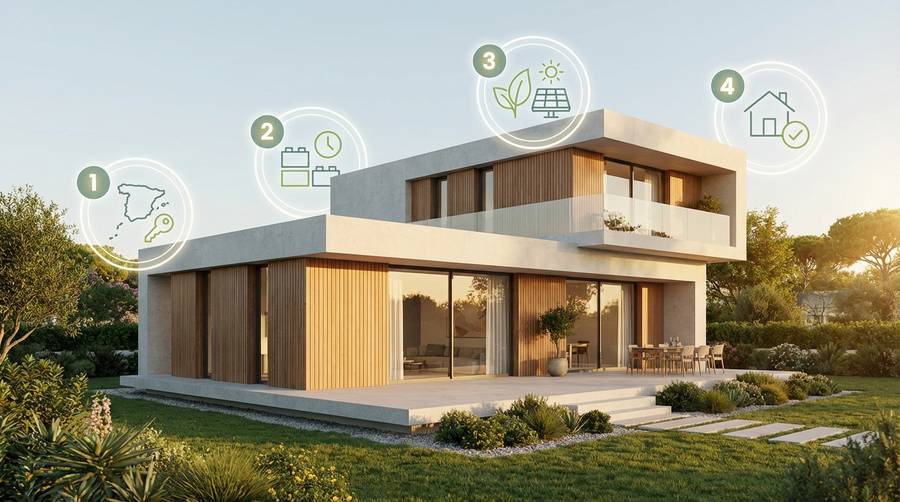
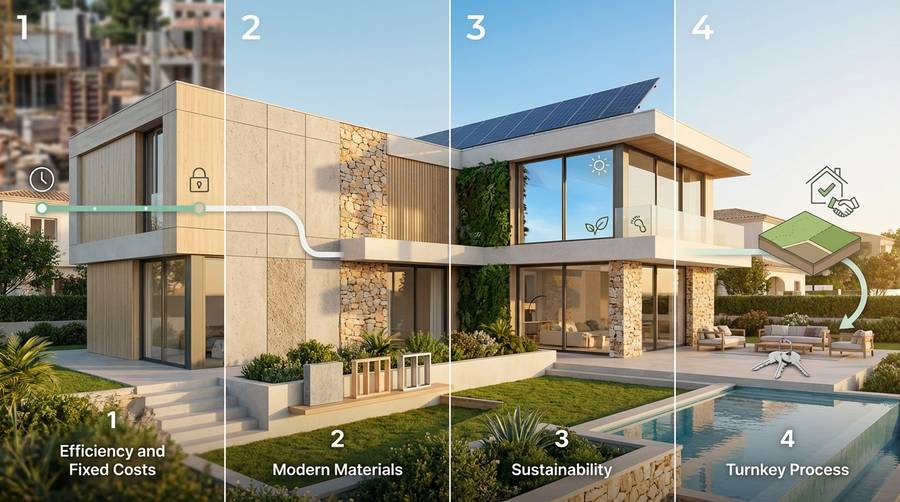
Top 4 Reasons to Choose a Prefabricated House in Spain
A concise, data-driven guide for self-builders in Spain: why prefabricated houses offer price certainty, shorter timelines, better energy performance and modern material choices — plus a practical turnkey roadmap and financing options.
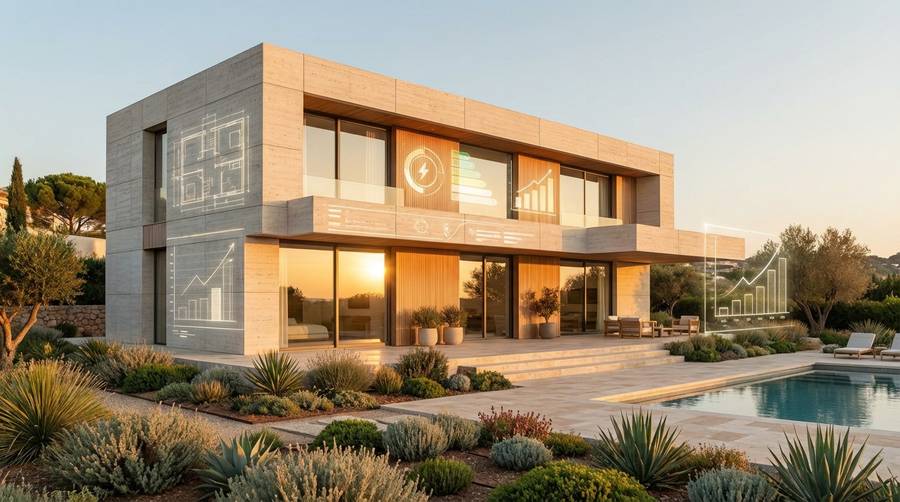
Prefabricated Houses Spain: Market Outlook 2026–2035
A forward-looking, data-driven analysis of how prefabricated houses will reshape Spain’s residential market from 2026 to 2035 — with technical comparisons, financing pathways, turnkey workflows and practical checklists for self-builders.