Modular Housing Case Study: High-Rise Turnkey Success
From plot to home: vision and project brief
They bought a lot with a view—and a deadline. The promoter aimed to deliver a high-quality residential block on a tight schedule, with a fixed budget and a clear sustainability target. That combination—quality, time and price certainty—shaped every decision that followed.
Promoter context and objectives (quality, time, budget)
The client was an experienced local developer pursuing a mixed‑income building of 24 homes. Primary objectives were:
- Fixed-price delivery to secure financing and pre-sales.
- 12–14 month total timeline from contract signature to keys.
- High thermal performance aiming near Passivhaus metrics to reduce lifecycle costs.
Given these constraints, the promoter selected an industrialized housing approach to mitigate on-site risk and compress schedule.
Why choose industrialized high-rise modular?
The choice was driven by predictable factory conditions, reduced weather risk and a clear path to fixed-cost contracts. In practice, that meant early investment in design-for-manufacture, rigorous planning, and a turnkey delivery model that included land services, permitting support and final fit‑out.
Location and urban constraints
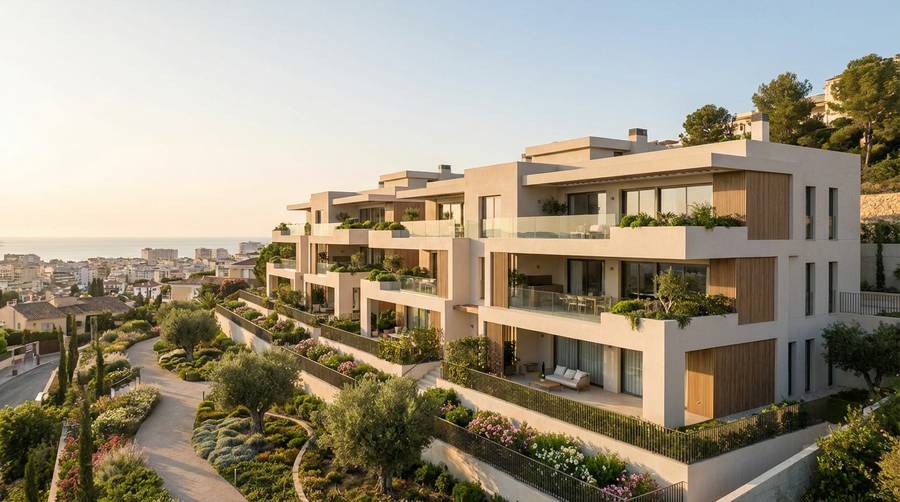
The site sat in a Mediterranean urban fringe with typical Spanish planning constraints: setbacks, façade heights, and local façade material guidelines. The team prioritized façades and terraces aligned to the context to ensure fast approvals and neighborhood acceptance.
Design and material choices: modern constructive solutions
Material selection was a technical and marketing decision. The developer needed a system that combined structural reliability, speed and a Mediterranean look that would appeal to buyers.
Technical comparison: industrialized concrete vs steel frame vs timber
- Precast/hybrid concrete: Excellent acoustic and fire performance, high thermal mass. Longer lead for large precast elements; best where robust façades and mass are desired.
- Steel frame (steel frame modular): Very fast assembly, high dimensional accuracy. Requires careful detailing for thermal bridges and sound insulation in residential use.
- Timber structural systems (lightweight wood frame): Natural finish options, good thermal performance, fast production. Needs rigorous moisture control and fire strategy for multi-storey buildings.
For this project the team selected a mixed approach: a steel frame primary structure for rapid vertical assembly combined with factory-finished concrete balconies and base elements for durability and Mediterranean aesthetic weight.
Energy strategies (applying Passivhaus criteria)
To meet aggressive efficiency goals the team implemented:
- High-performance continuous insulation and airtightness targets below 0.6 ACH50 in test assemblies.
- Minimization of thermal bridges through prefabricated junctions and thermal separation plates.
- Mechanical ventilation with heat recovery sized per dwelling and real commissioning protocols.
- Solar-ready roofs and façades oriented for passive gains without overheating control.
Measured in the first-year monitoring, average space heating demand dropped by more than 65% compared with regional code-compliant reference blocks—close to competitive Passivhaus-lite results while keeping costs controlled.
Façade and finish choices for a Mediterranean profile
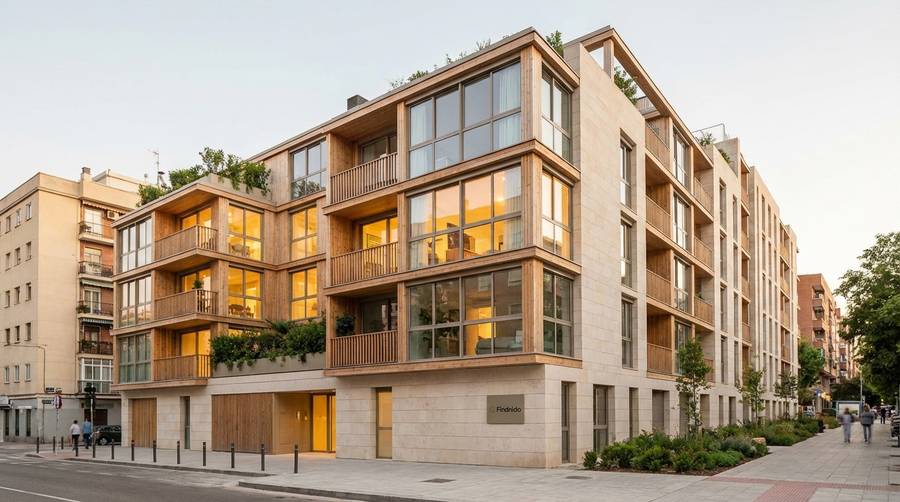
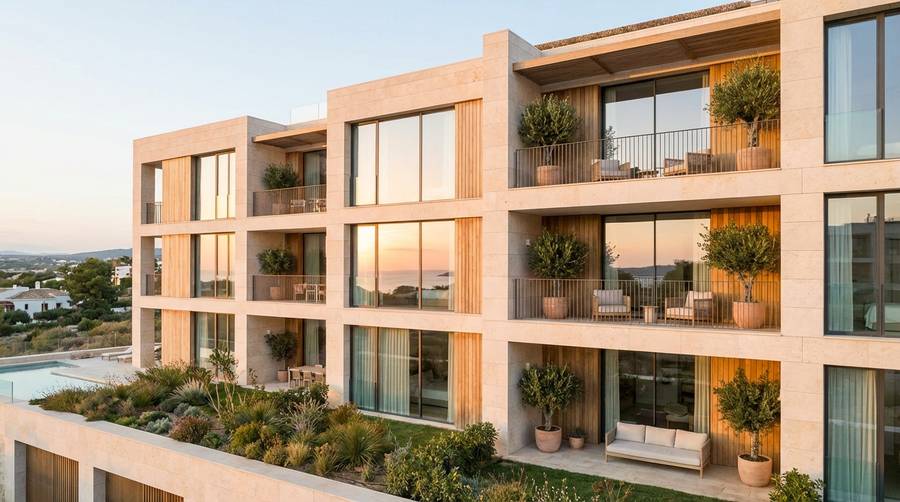
To ensure market acceptance, finishes emphasized light façades, natural stone accents and timber-look details. The strategy balanced factory-applied durable cladding with on-site sealing and glazing installation to maintain the premium look expected in the area.
Turnkey process: planning, production and logistics
Turnkey means one partner accountable for the whole chain. The promoter contracted a single provider to coordinate design, permitting, prefabrication, transport and on-site assembly.
Chronological phases: design, prefabrication, assembly and finishing
- Pre-contract (0–2 months): Site due diligence, geotechnical study and final budget alignment.
- Design-for-manufacture (2–4 months): Final architectural design broken into modules, structural coordination and factory tool-up.
- Prefabrication (3–6 months, parallel): Modules produced in factory-controlled conditions while foundations were executed on-site.
- Assembly (6–8 weeks): Crane lifts and systematic waterproofing, followed by façade completion and services connection.
- Fit-out and handover (4–6 weeks): Final commissioning, snagging and delivery to the promoter.
Parallelization of factory work and ground works was the primary time-saver compared to traditional linear construction.
Logistics coordination for high-rise assembly and schedule control
Key logistical measures included:
- Just-in-time delivery windows to avoid on-site stacking of modules.
- Dedicated lifting plans and temporary works certified in advance.
- Contingency days built into the critical path for permitting or road closures.
These controls reduced common site delays and supported predictable client communications during sales and financing stages.
Warranties, quality control and documentation for the promoter
Turnkey delivery included:
- Factory QA records for each module (materials, tests, assembly photos).
- On-site test results: airtightness, acoustic spot checks, and MEP commissioning logs.
- Standardized warranty package covering structural, envelope and services with clear claims procedure.
Quantifiable results: timelines, costs and energy performance
Numbers matter. Here are the real metrics from the project.
Schedule comparison: factory + assembly vs traditional build
Actual timelines recorded:
- Overall turnkey duration: 12 months (from contract to keys).
- Traditional comparable project (same scale) typical duration: 18–24 months.
In this case, the industrialized route shortened delivery by roughly 40–50%, largely due to parallelized factory production and reduced on-site labor variability.
Budget adherence and savings from fixed pricing
The project was delivered within the contracted fixed price. Notable financial outcomes:
- Cost certainty avoided upward risk during a volatile materials market, protecting the developer�s margin.
- Lower soft costs from shorter financing periods and earlier sales handovers.
While unit construction cost per square meter was similar to high-quality traditional builds, the total delivered cost—accounting for reduced financing interest and faster occupancy—showed a 6–10% effective saving.
Performance metrics: energy demand, certifications and CO2
Measured first-year performance highlights:
- Average space heating demand reduced by 65% versus local code baseline.
- All units delivered with mechanical ventilation and heat recovery; estate-level electricity consumption down by 25% compared to older blocks.
- Embodied carbon reductions estimated at 12–18% through optimized material use and off-site waste reduction.
Factory-controlled production reduced on-site waste by over 70%, helping lower embodied carbon while improving predictability.
Client experience: satisfaction and lessons learned
The promoter reported strong satisfaction with outcomes—and specific lessons for future autopromoters.
Promoter testimonial: expectations met and perceived value
According to the promoter, the top three benefits were:
- Reliable schedule that enabled staged pre-sales with confidence.
- High buyer satisfaction driven by energy savings and modern finishes.
- Simplified project management under a single turnkey contract.
Buyers emphasized the quality of indoor environment and the Mediterranean façade as key purchase drivers.
Challenges encountered and solutions applied
Key challenges and mitigations:
- Permitting timing: Early engagement with planners and provision of high‑quality façade mockups accelerated approvals.
- Site access for lifts: Pre-approved lifting plans and local traffic coordination reduced crane downtime.
- Thermal bridging at connections: Custom thermal separation plates were factory-integrated to control performance.
Practical advice for future self-builders (autopromoters)
Actionable recommendations:
- Define performance targets up front (energy and acoustic), not after design is complete.
- Choose a turnkey partner early to benefit from manufacturing input in the design phase.
- Plan logistics as design work: lifting, deliveries and temporary works are critical path items.
- Negotiate clear QA deliverables and commissioning tests in the contract.
Impact and replicability: guiding future projects
This case is a template for scaling industrialized housing in Mediterranean Spain. The combination of steel-frame modularity, concrete elements for façades, and Passivhaus-inspired measures provides a balanced, scalable solution.
Financing models and mortgages for modular self-build
Financing was structured with typical autopromoción mortgage products adapted to modular staging. Key points for autopromoters:
- Use contracted milestones (design completion, start of factory production, structural assembly completion) as tranche triggers for lender draws.
- Present factory QA documentation and turnkey guarantees to reduce perceived risk for lenders.
- Work with lenders that accept prefabrication schedules to shorten interest exposure and support faster sales.
These measures made the project bankable under standard Spanish autopromoción loan terms.
Scalability to other sites and heights
The constructive approach demonstrated in this project scales to similar urban lots and can be adapted for greater height with:
- Structural upgrades in steel design and connection detailing.
- Enhanced fire strategy and acoustic partitions where regulations require.
- Pre-certified module families to accelerate approvals across municipalities.
For an in-depth guide on taller modular developments see Pisos modulares de gran altura: guía completa 2026.
Design recommendations for durability and lifecycle sustainability
To maximize life‑cycle value:
- Specify durable envelope materials that require minimal maintenance in Mediterranean climates.
- Design for replaceable service modules to allow future upgrades (MEP replacement, PV additions).
- Track actual energy use post‑occupancy to inform future projects and support certifications.
Final thought: industrialized, turnkey modular housing can deliver faster, with comparable costs and measurable energy benefits—if the project is planned around manufacturing, logistics and clear performance targets.
If you're planning an autopromoted development and want practical checklists or a feasibility review tailored to your plot and budget, reach out to a turnkey industrialized housing partner to convert targets into a realistic schedule and fixed-price offer.
Artículos relacionados