High-Rise Modular Apartments: Complete 2026 Guide
Start with a vision: why high-rise modular apartments matter in Spain today
Imagine closing your planning and getting a finished residential block months later, not years. That speed is the central promise of high-rise modular apartments: industrialized processes, fixed budgets and predictable timelines that fit Spain’s urgent housing needs.
This guide gives a clear, technical and practical path for professionals and autopromoters who want to deliver medium- to high-rise modular residential buildings in 2026. It focuses on actionable decisions, measurable metrics and the typical pitfalls to avoid.
High-rise modular delivery can reduce on-site time by up to 60% and cut unpredictable cost overruns—if the process is managed end-to-end from site selection to turnkey handover.
What are high-rise modular apartments and why they matter
Definition and key characteristics of modular high-rise construction
High-rise modular apartments are residential buildings where significant volumetric elements (modules) are factory-produced, transported and assembled on-site into a multi-storey block. Modules are finished, serviced and quality-checked before transport to reduce on-site work.
Key traits:
- Factory-controlled production: consistent quality and traceable processes.
- Volumetric modules: fully-fitted bathrooms, kitchens, façades and MEP connections.
- Rapid on-site assembly: crane-lift insertion and fast sealing of the envelope.
- Turnkey integration: logistics, interfaces and commissioning coordinated by a single delivery team.
Advantages vs traditional construction: time, cost and quality control
In practice, high-rise modular apartments deliver measurable advantages:
- Time: factory production runs in parallel with site work (foundations, basements). Typical on-site assembly for a 6–12 storey block can be 8–16 weeks.
- Cost predictability: fixed-price factory contracts reduce exposure to labor shortages and weather delays.
- Quality: repeatable assembly lines and QA checks lower defect rates and rework.
These benefits require tight integration between design, production and logistics teams—fragmentation erodes the advantages.
Regulatory context and market demand in Spain (2026)
Spanish urban codes now include clearer acceptance paths for modular construction, but local building control remains varied across municipalities. Key considerations:
- Early engagement with local planning offices to confirm module transport routes and crane zones.
- Compliance with seismic, fire and acoustic regulations at building-level—modules must be detailed for vertical load paths and fire-stopping at connections.
- Growing market demand for affordable, energy-efficient apartments near city centers supports modular solutions.
Materials and construction systems recommended
Industrialized concrete: durability and execution speed
Precast concrete cores and slabs provide robust vertical loads and fire resilience for taller modular blocks. Common strategy:
- Precast basement walls and core elements (stair and lift) founded on pile or raft foundations.
- Concrete podiums that host stacked timber or steel-framed modules above a certain height.
This hybrid approach uses concrete where structural continuity and fire resistance are critical, while preserving factory benefits for habitable modules.
Light wood frame and steel frame: thermal performance and flexibility
Entramado ligero de madera (light timber frame) and steel frame modules excel in thermal performance and weight efficiency. Comparison points:
- Timber modules: excellent embodied carbon profile and comfortable interior climates. Require rigorous moisture control in the factory and at the joint interfaces.
- Steel modules: higher strength-to-weight ratio, very predictable tolerances for stacking and slender façades.
Technical comparison: insulation, strength and maintenance
When selecting materials, compare by three measurable metrics:
- U-values: timber and composite walls can reach 0.15–0.20 W/m²K with high-performance insulation; concrete cores need thermal breaks to avoid thermal bridges.
- Acoustic performance: aim for Rw ≥ 55 dB between dwellings in urban settings—composite floor slabs or floating screeds often required.
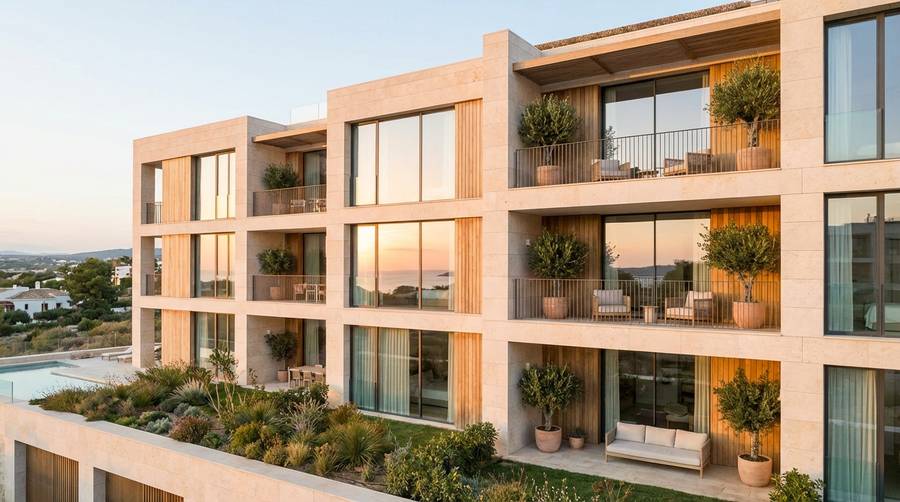
- Maintenance: façades with natural materials (stone, wood accents) deliver longevity when detailed for drainage; avoid exposed metal at connections.
Architectural design and energy efficiency
Applying Passivhaus principles to modular high-rise
Modularity and Passivhaus align well. Key actions:
- Design airtight modules with factory-controlled sealing—target n50 ≤ 0.6 h−1 in final testing.
- Use high-performance glazing and low thermal-bridging connections between modules.
- Plan balanced MVHR (mechanical ventilation with heat recovery) systems per core to optimize efficiency and maintenance.
Passive and active strategies: envelope, ventilation and renewables
Combine passive design with on-site renewables to reduce operational costs and carbon footprint:
- Optimized orientation, external shading and balconies to moderate solar gains.
- High-efficiency MVHR and district heating/cooling where available.
- Photovoltaic arrays on podium roofs and façades integrated into the architectural composition.
Carbon measurement and recommended certifications
Track embodied and operational carbon with clear baselines. Recommended certifications:
- Passivhaus or PHI Low Energy verification for energy targets.
- National EPC labeling and voluntary BREEAM/LEED for broader sustainability claims.
- Life Cycle Assessment (LCA) at RIBA stage 2–3 to inform material choices.
Turnkey process: step-by-step for delivering modular blocks
From parcel search and planning to technical project
Early stages set the rhythm for the project. Practical steps:
- Parcel feasibility: assess access for long-load transports, crane radius and foundation constraints.
- Urban compliance: secure constructive envelopes and buildable area with the local ayuntamiento.
- Integrated project brief: define module types, unit layouts, façade palette and energy targets before tendering factories.
Factory production, logistics and on-site assembly: typical schedule
A realistic phased timeline for a 8–12 storey residential block:
- Weeks 1–16: foundations, basement and precast core installation.
- Weeks 6–22: module production in the factory (overlaps with site works).
- Weeks 18–26: module deliveries and rapid vertical assembly (3–6 modules/day typical depending on size).
- Weeks 22–34: facade works, MEP final connections and commissioning.
Contingencies: allow for 10–15% unforeseeable shifts for logistics, crane permits and weather.
Quality control, deliverables and commissioning for the promoter
Define clear deliverables and factory acceptance tests (FAT):
- Factory QA reports, material certificates and waterproofing tests.
- On-site connection checklists: structural, MEP and airtightness.
- Commissioning (Cx) package: as-built drawings, maintenance manuals and warranty handover.
Financing and mortgage options for autopromoters
Types of loans and mortgages for self-developers in Spain
Common financing instruments:
- Construction loans: funds disbursed by milestones (foundations, structure, shell, finishes).
- Wrap mortgages: long-term mortgage replaced once the building is completed and sold or refinanced.
- Bridge finance: short-term funding for land purchase until modular production begins.
Structuring cashflow: milestone payments and guarantees
Banks expect a robust payment schedule and security:
- Use factory fixed-price contracts to reduce budget risk; present these to lenders to negotiate lower contingencies.
- Payments tied to verifiable milestones (FAT, module delivery, waterproofing) help align lender release with real progress.
- Supply bank guarantees or insurance-backed performance bonds where feasible.
Bank requirements and key documentation
Prepare these documents early:
- Detailed technical project and modular production plan.
- Factory contracts with delivery and warranty clauses.
- Cashflow model showing conservative sales/rental assumptions and contingency buffers.
Real case studies: metrics on time, cost and client satisfaction
Project A – Urban infill block (Madrid suburb)
Summary metrics:
- Size: 7 storeys, 48 units.
- On-site duration: 12 weeks for stacking and envelope; total project 10 months from groundworks to handover.
- Cost variance vs traditional: approximately 8% lower lifetime cost when factoring shorter financing period and lower site overheads.
- Client satisfaction: post-handover NPS 74; common praise for speed, minimal site disruption and internal finish quality.
Project B – Coastal mid-rise (Mediterranean coast)
Summary metrics:
- Size: 9 storeys, 64 units.
- Energy: achieved PHI-compatible operational envelope with rooftop PV and MVHR; measured primary energy 35% lower than baseline.
- Cost lessons: additional investment in façade detailing and acoustics was needed to meet seaside exposure—planned as premium in sales mix.
Takeaways and client testimonies
Common learnings:
- Early coordination between structural core and module geometry prevents on-site clashes.
- Transport logistics are a critical line item—route surveys and permits must be secured early.
- Clients valued predictability and reduced nuisance during construction.
Practical checklist to start your high-rise modular project
Initial checklist: team, permits and selection criteria
- Assemble an integrated team: architect with modular experience, structural engineer, factory production partner and logistics planner.
- Confirm access: heavy-load road permits, crane location and delivery windows.
- Define selection criteria for industrialized housing: production capacity, QA regime, warranty terms and references.
Common mistakes and how to avoid them in turnkey delivery
- Avoid late design changes after factory start—lock down module interfaces and MEP risers early.
- Do not underestimate vertical fire compartmentation—get a fire-engineering review at concept stage.
- Plan for long-lead façade items and statutory inspections that can block deliveries.
Useful resources: suppliers, public support and planning tools
Start with:
- Factory audits and site visits to shortlisted manufacturers.
- Local urban planning portals for municipal guidance and permitting checklists.
- Financial advisors who have structured modular project loans in Spain.
- For high-rise modular systems applied to taller developments see Pisos modulares de gran altura: guía completa 2026 for extended technical references.
Ready to move from concept to delivery? High-rise modular apartments offer a realistic path to faster, more predictable and more sustainable residential developments in Spain. The right early decisions—materials, factory partner, financing structure and rigorous QA—convert modular potential into a successful, bankable project.
If you have a site or a sketch, gather your core team and create a short feasibility package (site access, target storeys, programme and rough budget) to start concrete factory conversations. That package is the most powerful tool to secure finance and to reduce risk before committing to full design.
Artículos relacionados
Modular Housing Case Study: High-Rise Turnkey Success
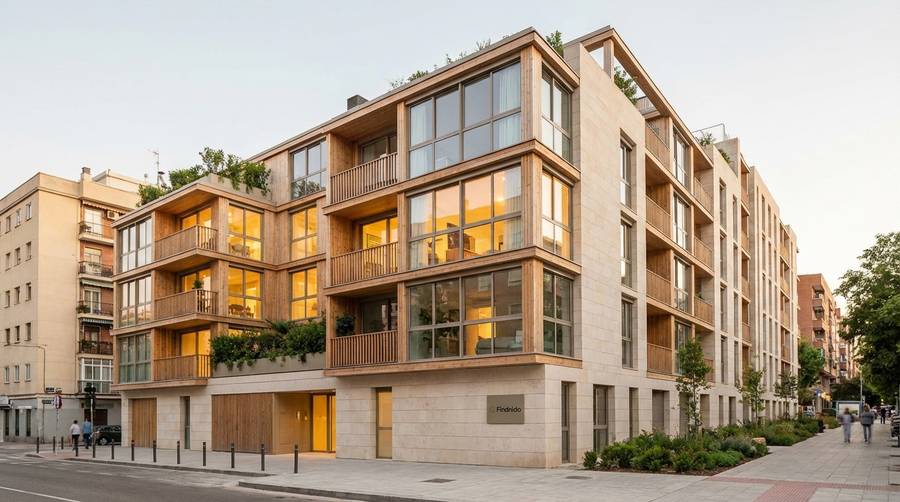
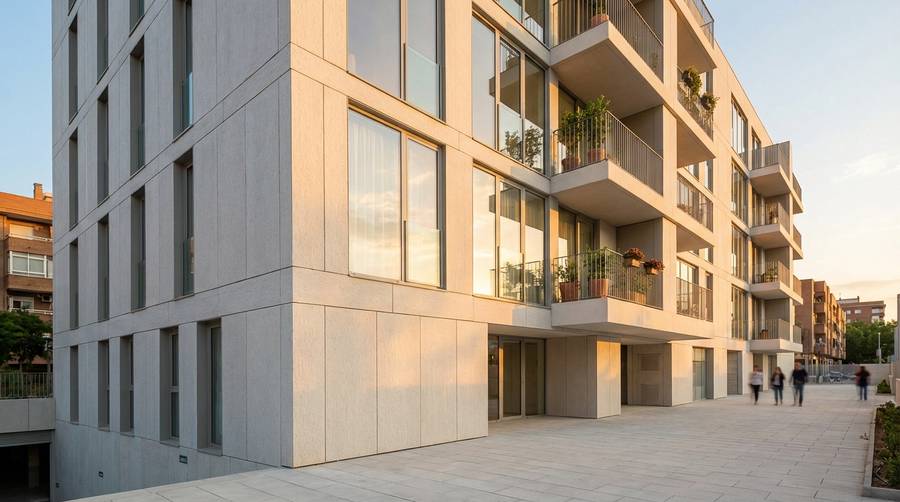
A Spanish developer chose modular construction for a high-rise turnkey project. This case study details choices in materials, a strict schedule, real cost metrics and measurable energy savings—plus practical advice for future autopromoters.