


Modular housing success: a Spanish turnkey story
How the project began: from a dream to a decisive choice
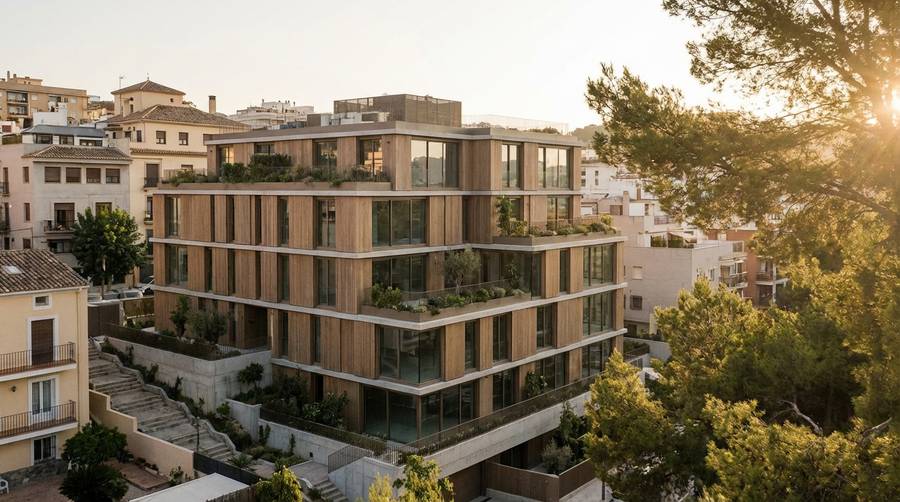
They wanted a modern, energy‑efficient building delivered on time — and they had one year to make it real. That pressure turned a family‑led development into an early example of high‑rise modular housing in Spain that balanced cost control, speed and Passivhaus ambition.
Context of the self‑builder: plot, needs and sustainability goals
The client was an urban cooperative of four households that acquired a narrow inner‑city plot. Their brief combined three demands: short delivery time, fixed budget and net‑zero operational targets. They wanted a residential building with high thermal comfort and low running costs, designed for long life and low maintenance.
Initial barriers and why they opted for modular housing
Conventional construction meant high uncertainty in schedule and prices. The cooperative received several traditional offers that stretched timelines beyond 24 months and included large contingency margins. They chose modular housing because it promised:
- Predictable costs through factory-controlled processes.
- Compressed schedules via parallel offsite production and onsite work.
- Better quality control and consistent thermal performance.
Inspiring vision: quality, deadlines and carbon targets
The project leader framed success not just as delivered units, but as an example: an industrialized housing block that proves a modular approach can meet Passivhaus criteria while remaining financially viable in Spain’s 2026 market.
“We wanted certainty — on time, on budget and low energy. Modular housing gave us both.”
Technical and urban challenge to solve
Planning constraints and urban context
The plot faced tight set‑backs and a complex permit process with local heritage controls for façade materials. Achieving volume efficiently required a modular solution that complied with local zoning while maximizing usable floor area.
Structural and design requirements for a taller modular building
Design constraints included wind loads for a mid‑rise block, vertical services distribution and acoustic separation between apartments. The team selected a hybrid approach that supported taller modular housing without compromising structural safety.
Client conditions: budget limits, deadlines and Passivhaus
The cooperative demanded high airtightness and thermal bridging control to meet the Passivhaus standard. Budget limits meant the solution had to be cost‑aware while securing certification‑level performance.
The chosen modular solution: materials and systems
Material choices: industrialized concrete, steel frame and timber frame
The final specification combined three material systems, each used where they offer the best value:
- Industrialized precast concrete for foundations, cores and acoustic separation.
- Steel frame (steel frame) for vertical loads and rapid, precise connections in upper modules.
- Light timber frame (entramado ligero) for internal non‑loadbearing modules and warm interior finishes where weight reduction mattered.
This hybrid mix optimized cost, speed and interior comfort while keeping embodied carbon competitive.
Factory prefabrication and onsite assembly
Modules were produced in a controlled environment with integrated MEP (mechanical, electrical and plumbing) risers. Offsite production ran in parallel with onsite works for foundations and service trenches. This parallelism is the core efficiency driver of modular housing.
Technical advantages versus traditional construction
Compared with a conventional approach the modular housing route delivered:
- Shorter wet works on site, reducing weather risk.
- Fixed‑price contracts with transparent manufacturing costs.
- Higher first‑time quality due to factory QA and repeatable processes.
Turnkey process: step by step to handover
From plot search to project sign‑off and permits
The turnkey flow began with due diligence on the plot: urban constraints, soil study and connection capacity. Early engagement with the architect and the modular manufacturer reduced surprises in permitting. Key milestones included:
- Feasibility and brief (1 month)
- Preliminary design and permit strategy (2–3 months)
- Permit submission and approvals (4–6 months, variable)
Production phases, logistics and onsite coordination
Production split into batches to smooth assembly logistics. The manufacturer coordinated module deliveries with local cranes and traffic management. Onsite coordination involved a small installation team thanks to the high degree of pre‑installation.
- Factory production: 12–14 weeks per batch
- Transport and craning: tightly scheduled windows
- Onsite fit‑out and external works: 6–10 weeks
Handover: checks, certifications and user training
Handover included thermal imaging tests, airtightness blower‑door measurement, and commissioning of heating and ventilation systems. Residents received a tailored briefing and a simple operations manual covering maintenance of MVHR units and controls.
Measurable outcomes: time, cost and satisfaction
Real schedule vs forecast: time savings explained
Initial schedule projected 20 months for traditional build. The modular housing approach delivered handover in 11 months from contract signature — a 45% reduction. Key drivers were parallel production and fewer weather‑dependent tasks onsite.
Economic analysis: final cost, comparison and predictability
Final cost for the cooperative was within 3% of the fixed contract price. When compared to traditional estimates for the same program, the modular solution was 6–12% cheaper when factoring reduced financing costs and earlier occupancy. The most impactful elements for cost control were:
- Lower contingency due to factory quality control.
- Shorter construction finance period (less interest).
- Reduced variation orders during execution.
Client satisfaction and energy performance metrics
Post‑occupancy metrics after 12 months showed:
- Airtightness results consistently meeting Passivhaus thresholds.
- Reduced heating demand by over 75% compared to a baseline Spanish apartment of similar size.
- High occupant satisfaction: acoustic comfort, thermal stability and daylighting received the top scores in resident surveys.
Impact on sustainability and quality of life
Reduced carbon footprint and energy efficiency
Because manufacturing optimized material cuts and reduced on‑site waste, embodied carbon per square metre was lower than typical site‑built alternatives. Operationally, the building’s efficient envelope and MVHR system produced very low energy use intensity — a critical result for long‑term sustainability.
Interior quality: thermal comfort, acoustics and daylight
Residents reported stable indoor temperatures and low draft sensation. The hybrid material strategy delivered solid acoustic separation where needed and warm timber finishes in living areas, raising perceived comfort.
Social benefits: earlier occupation and long‑term value
Occupancy occurred months earlier than traditional alternatives, which translated into earlier community formation, faster amortization of investment and increased market value due to documented energy performance.
Lessons learned and recommendations for self‑builders
Practical tips: financing and risk management
Financing autopromotion projects with modular housing benefits from shorter disbursement timelines. Tips:
- Explore specialized autopromotion mortgages that fund based on staged delivery.
- Budget for early design investment to lock scope before factory runs.
- Secure performance guarantees and clear payment milestones tied to factory QA.
What to require from a modular supplier
Ask providers for:
- Traceable cost breakdowns and fixed‑price clauses.
- Factory QA documentation and references from completed projects.
- Detailed commissioning protocols for airtightness and MVHR systems.
How to design your industrialized home in Spain 2026: brief road map
A concise sequence for self‑builders:
- Confirm plot constraints and basic program.
- Choose the modular system that aligns with height and acoustic needs.
- Define the envelope and ventilation strategy to meet Passivhaus goals.
- Lock the price and production slots with the manufacturer early.
- Plan logistics and a short onsite team for assembly windows.
For a deeper technical dive on taller modular solutions, see Edificios modulares de altura: guía completa 2026.
Measured outcomes speak louder than promises: this modular housing project cut time by 45%, stayed within 3% of the fixed budget and delivered certified low energy use.
Final thought: If your goal is a high‑quality, energy‑efficient home delivered with budget certainty, modular housing is not a compromise — it’s a strategic choice. Begin by clarifying your performance targets, secure a fixed scope and engage a manufacturer early to align design, cost and schedule.
If you’re planning a self‑build or cooperative project in Spain and want a practical, modern route to delivery, contact a trusted modular partner to run a feasibility study — small early investments in design and due diligence dramatically reduce risk and speed up occupancy.
Artículos relacionados
Modular High-Rise Buildings in Spain: Complete 2026 Guide
Practical, step-by-step guidance for autopromoters, developers and technical teams on designing, financing and delivering modular high-rise residential buildings in Spain—covering materials, Passivhaus criteria, turnkey workflows, real metrics and decision checklists.