Industrialized Housing Success: Spanish Family Case
How this project began: an industrialized home that transformed a Spanish family's life
They arrived at the plot with a baby stroller, a tight budget and a clear deadline: three generations of the same family wanted a modern, energy-efficient home ready in time for the child's first birthday. What followed was a deliberate choice for industrialized housing that reshaped their expectations about cost, timing and comfort.
The family’s brief was precise: a durable, low-maintenance house with high thermal comfort, completed under a fixed budget and a short, guaranteed calendar. They rejected long, uncertain traditional builds and sought a partner able to deliver a turnkey solution from plot search to keys in hand.
Initial context: needs, plot and autopromoter objectives
The plot was a 600 m² suburban lot near Valencia, gently sloped and with good solar orientation. The primary objectives were:
- Fixed total cost linked to a turnkey contract.
- Short, predictable schedule—move-in within 9 months.
- High energy performance aiming for near-Passivhaus behavior.
- Local materials and visible quality finishes.
Why modular construction: motivations of time, cost and sustainability
The decision favored industrialized methods for three key reasons:
- Predictability: factory-controlled production reduced weather-related delays.
- Cost control: a fixed-price turnkey contract minimized scope creep.
- Sustainability: using proximate materials reduced transport emissions and supported regional industry.
The family also valued the ability to inspect finishes in factory mock-ups before installation—an advantage rarely available in traditional projects.
Project snapshot: key metrics and life impact
Outcomes at a glance:
- Total floor area: 165 m².
- Turnkey delivery: 38 weeks from contract signature to handover.
- Prefabrication in factory: 10 weeks.
- On-site assembly: 6 working days for main enclosure; full services and finishes completed in the remaining schedule.
- Construction cost: €1,650/m² (turnkey) — final cost within 2% of the signed budget.
- Post-occupation results: 45% lower space heating demand compared to a comparable conventional build in the area.
“We gained certainty: time, price and comfort — not promises but verified figures.”
Local materials and their role in the project
Choosing materials close to home wasn't an aesthetic decision only: it was a strategic choice that improved logistics, quality and sustainability.
Selection: industrialized concrete, light timber framing and steel frame — why and where
The project combined three systems in targeted ways:
- Industrialized precast concrete for foundations, plinths and a thermal-mass ground floor slab—chosen for durability and acoustic separation.
- Light timber frame (entramado ligero de madera) for the upper envelope and interior partitions—used where weight savings, fast assembly and excellent insulation performance were priorities.
- Steel frame in specific structural zones (large spans at the living area and cantilevered terrace) to achieve clean architectural lines and open interiors.
Each material was applied where its strengths mattered most, rather than repeating a single system everywhere.
Local benefits: lower carbon footprint, efficient logistics and support for the Spanish supply chain
Key advantages of sourcing regionally:
- Reduced transport distances cut embodied CO₂ by an estimated 12% compared to importing similar elements.
- Faster deliveries and fewer delays during the prefabrication batch scheduling.
- Close collaboration with local manufacturers allowed rapid adjustments to finishes and quality standards.
These practical gains translated into both sustainability and budget resilience.
Quality control and finishes: how local materials boosted durability and comfort
Quality points verified during the project:
- Factory QA checks on panel airtightness and insulation continuity improved envelope performance by quantifiable margins.
- Local stone and timber finishes were applied under controlled humidity conditions, reducing later settling cracks and finish defects.
- Site assembly tolerances were tighter because components were manufactured to millimeter standards.
In practice, that meant fewer callbacks, more consistent indoor comfort, and a premium look without premium unpredictability.
The turnkey process explained with real data
A turnkey delivery is only as reliable as the sequence behind it. Here is the real timeline and how each stage was managed.
Project phases: plot search, design, prefabrication, assembly and delivery
Phases and responsibilities:
- Plot assessment (2 weeks): legal checks, orientation study and subsurface report.
- Design and permits (10 weeks): schematic design, technical design and municipal approvals. The team leveraged standard modular interfaces to accelerate technical documentation.
- Prefabrication (10 weeks): structural panels, bathroom pods and interior modules produced in factory with QA checkpoints and client walkthroughs.
- On-site assembly (6 weeks total): foundation work overlapped with final factory stages; main envelope erected in 6 working days; services and finishes completed over the following weeks.
- Handover and commissioning (2 weeks): thermal balancing, airtightness test, and client orientation.
Closed schedules and control: real project calendar (prefab vs on-site)
The approach that ensured dates were met:
- Parallel workflows: groundwork proceeded while factory production began.
- Buffer windows: small, contractual time buffers in prefabrication protected the schedule from supply variances.
- Weekly steering meetings: transparent milestone tracking with the family and subcontractors kept decisions timely.
Because most critical processes happened in the factory, the on-site assembly remained compact and predictable.
Integrated management: coordination, permits and client communication
Turnkey success depended on three management pillars:
- Centralized project manager as single point of contact for the family.
- Document-control platform for approvals, change orders and scheduling visible to the client in real time.
- Proactive permit handling with local authorities; early meetings avoided bureaucratic surprises.
Measurable results: timelines, costs and client satisfaction
Numbers matter. Here are the verified metrics from post-project audits and the family's feedback.
Cost comparison: initial budget vs final cost and savings vs traditional building
Financials (turnkey):
- Signed contract: €272,250 (turnkey, including plot preparation and landscape works).
- Final verified cost: €274,800 (1% variance mainly due to landscape personalization).
- Estimated cost for comparable traditional build: €1,900–€2,100/m² (including longer timelines and higher contingency).
- Estimated savings vs traditional: ~15–20% when accounting for reduced financing costs and avoided delays.
Important note: savings depend on design complexity and local labor market; industrialized approaches deliver most advantage when scope and finishes are well defined early.
Deadlines met: weeks for prefabrication and days for assembly, verified milestones
Key timing facts:
- Prefabrication: 10 weeks (factory QA passed on first inspection).
- Envelope assembly on-site: main structure in 6 working days.
- Complete handover: 38 weeks from contract to keys.
The tight on-site window also reduced neighborhood disruption and permitted faster occupancy.
Post-occupancy satisfaction: thermal comfort, energy reduction and family feedback
Measured performance after 12 months:
- Heating demand reduction: ~45% lower than similar regional builds based on monthly billing analysis.
- Envelope airtightness: 0.6 ACH @ 50 Pa—close to standard Passivhaus targets for the region.
- Family satisfaction: 9.4/10 on a structured survey covering comfort, finishing, communication and timeline transparency.
Comments from the family highlighted reduced maintenance, consistent indoor temperatures and the psychological benefit of predictable delivery.
Technical and sustainability comparison: prefabricated vs traditional
Comparisons should be evidence-based. Here are the technical trade-offs we observed.
Efficiency and energy: Passivhaus-like performance and envelope systems
The house achieved near-Passivhaus behavior through:
- Continuous insulation provided by factory-applied insulation layers and sealed membrane junctions.
- Airtightness strategy implemented in factory reduced on-site sealing errors.
- Mechanical ventilation with heat recovery (MVHR) sized for occupancies and balanced during commissioning.
Estimated annual primary energy use for space heating and hot water was 40–50% lower than a code-minimum building, depending on occupant behavior.
Construction quality and maintenance: lifespan, risks and future adaptability
Quality conclusions:
- Durability: factory-manufactured components reduced workmanship variability.
- Maintenance: surfaces and junctions were detailed for easy access where systems may need service.
- Adaptability: the modular envelope permitted future interior reconfiguration with limited structural impact.
While no system is maintenance-free, the industrialized approach concentrated most variables in controlled conditions, reducing long-term risk.
Financing and viability: mortgages for self-build and ROI scenarios
Financing insights important for autopromoters:
- Spanish banks increasingly accept turnkey modular projects within self-build mortgage products, provided there is detailed scheduling and payment linked to milestones.
- Lower build time reduces interest during construction and the period without a habitable dwelling—improving cashflow for families.
- Simple ROI illustration: a 15% construction cost saving plus 45% lower annual heating bills typically shortens payback on additional energy measures within 10–15 years.
Ask lenders early for conditional offers based on the turnkey contract to secure better terms.
Inspirational closing: lessons learned and practical advice for autopromoters
From this case we draw clear lessons that future autopromoters can apply immediately.
Keys to choose local materials and a trustworthy turnkey team
- Prioritize teams that demonstrate factory QA processes and traceable supply chains.
- Request mock-ups of finishes in the factory—this prevents costly changes later.
- Favor local material suppliers to reduce logistics risk and support regional industry.
Practical recommendations: preparing the plot, the budget and a pre-signing checklist
- Complete geotechnical and topographical surveys before finalizing the contract.
- Insist on a fixed-price, milestone-linked contract with clear definitions of scope and finishes.
- Verify permit timelines with the municipality and include allowance for administrative processes.
For a deeper step-by-step guide, see our practical guide Vivienda industrializada: guía paso a paso 2026.
Next steps for readers: additional case studies and how to request a consultation
If you want comparative evidence, review our technical comparisons and common pitfalls in these articles: Vivienda industrializada: comparativa de materiales y ventajas and Errores con materiales de proximidad en vivienda industrializada. When you’re ready, request an initial consultation to validate your plot and budget—the right team will provide a clear schedule and financial scenario.
Ready to move from idea to keys? A short, evidence-based conversation will clarify whether an industrialized approach matches your site and goals.
Visual resources and photography guidance for the article (AI image description)
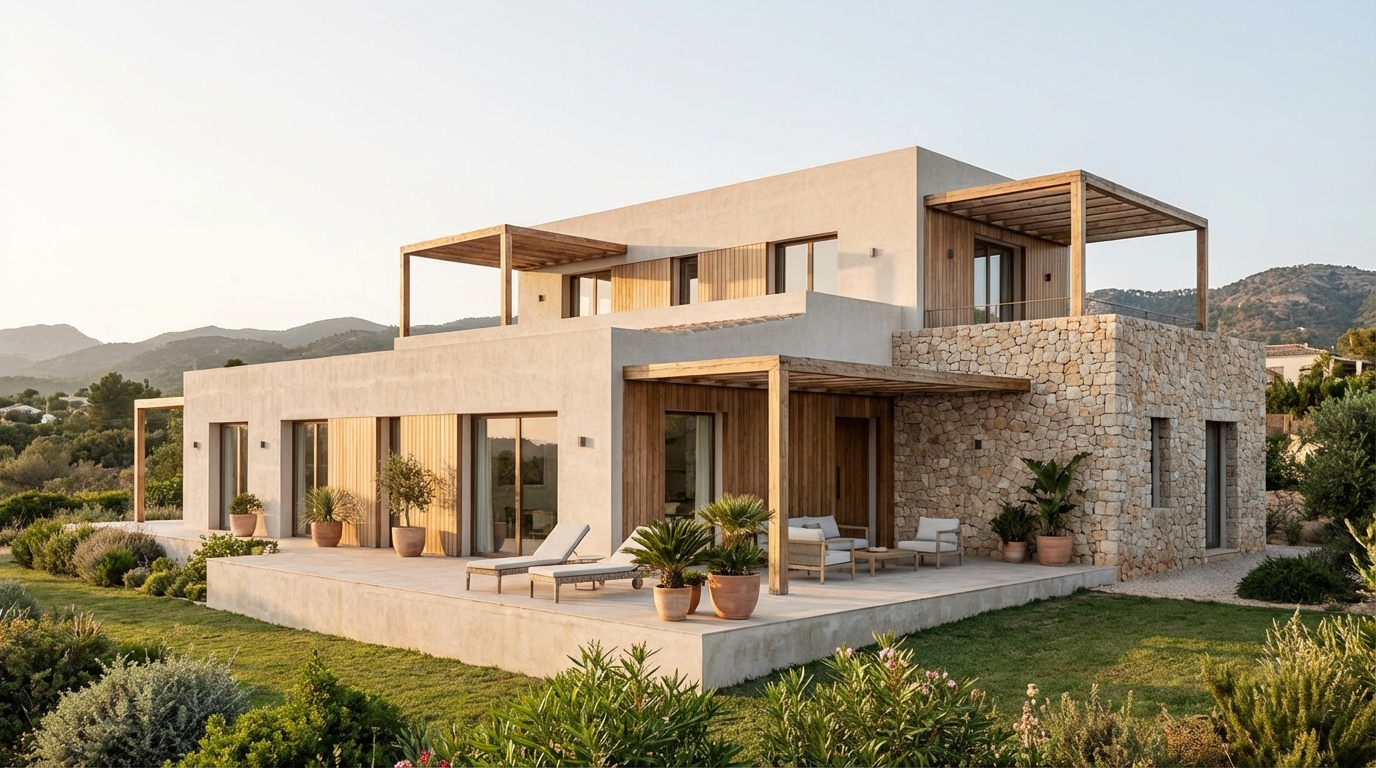
Main image: Findnido-style photograph of a finished Mediterranean contemporary home
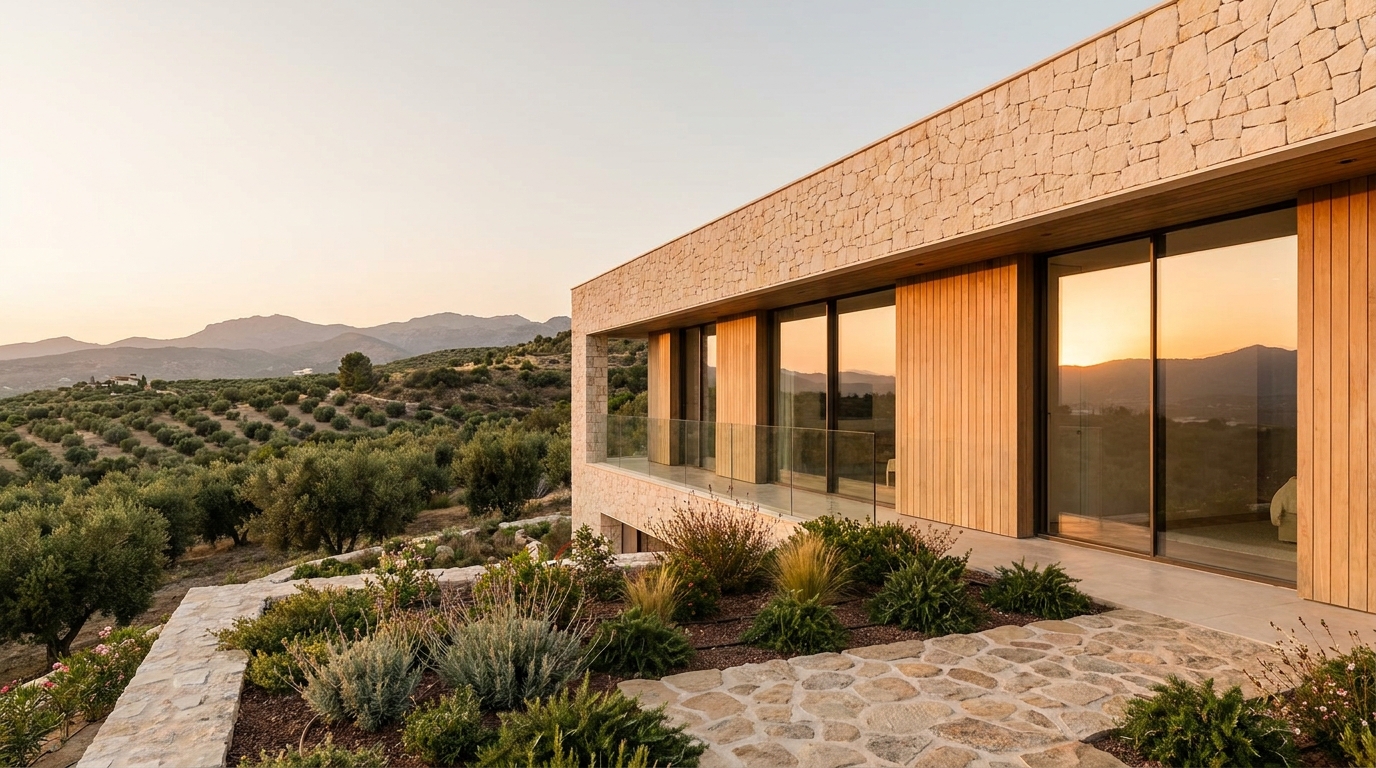
Generate a high-quality real estate photograph in the Findnido visual identity: a finished Mediterranean contemporary house in Spain with light façades, natural stone and warm wood details. Large windows and a shaded terrace, soft golden-hour sunlight, and a small family (parents and a child) relaxed on the porch to convey lifestyle. The garden includes drought-tolerant Mediterranean planting and a subtle paved path. Frame the house with a balanced composition; avoid showing construction, exposed modules or industrial settings. The image should feel premium, lived-in and aspirational while conveying sustainability and comfort—natural colors, warm light, and editorial-quality architectural photography.
Additional imagery suggestions
- Factory interior: controlled production line with finished wall panels (no workers’ faces prominent), emphasizing precision and quality, shot in natural daylight.
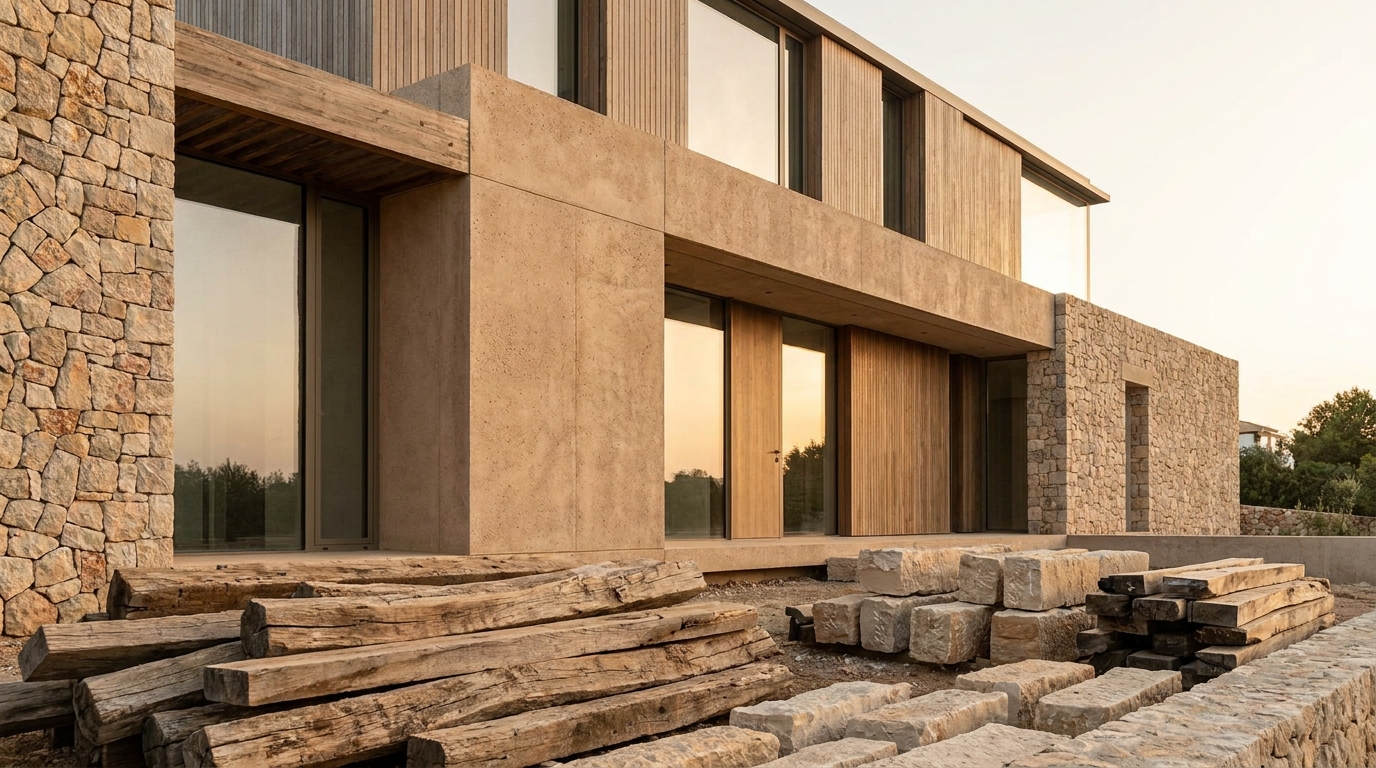
- Detail shots: close-ups of timber junctions, stone cladding and window seals to illustrate finish quality.
- Occupancy lifestyle: evening terrace scene with warm interior lighting, showing how design supports daily life.
Artículos relacionados