Modular Homes Spain: Vision 2026–2035
The next decade will separate fashionable concepts from scalable housing solutions — and modular homes in Spain are poised to lead. This article cuts through hype with hard data, actionable checklists and real case metrics to help self-builders and promoters plan resilient, sustainable and cost-controlled projects for 2026–2035.
Why the Mediterranean modular product will shape Spanish housing: 2026–2035 outlook
Market momentum is measurable. Industry forecasts show a compound annual growth rate (CAGR) for industrialized housing in Spain above traditional residential construction over 2026–2035, driven by labour shortages, demand for carbon reduction and the need for predictable schedules.
Market landscape: projected growth, market share and drivers
Recent sector reports indicate modular solutions could capture between 10–18% of new single-family housing starts in Spain by 2030 if current adoption accelerates. Key drivers include:
- Labour efficiency: off-site fabrication reduces on-site labour needs by up to 40%.
- Schedule certainty: factory production compresses weather-related delays and shortens critical paths.
- Policy alignment: EU and national decarbonization targets reward low-carbon, high-performance homes.
Competitive advantages vs traditional construction: efficiency, timelines and cost control
Three measurable strengths set modular delivery apart:
- Predictable CAPEX: fixed-price modules and controlled fabrication cycles reduce budget overruns.
- Compressed lead times: on-site assembly can cut total project delivery by 30–60%.
- Quality control: standardised factory workflows reduce rework and variability.
Implications for self-builders: opportunities and near-term risks
Opportunities for autopromoters include faster occupancy, access to green finance and lower exposure to labour inflation. Risks to manage are supply chain concentration, regulatory variability across municipalities and potential mismatch between factory cycles and plot readiness.
Data point: projects that integrated factory production and early site readiness reported median delivery times of 6–9 months from panel arrival to handover, versus 12–24 months for comparable traditional builds.
Technological and design trends redefining the Mediterranean modular home
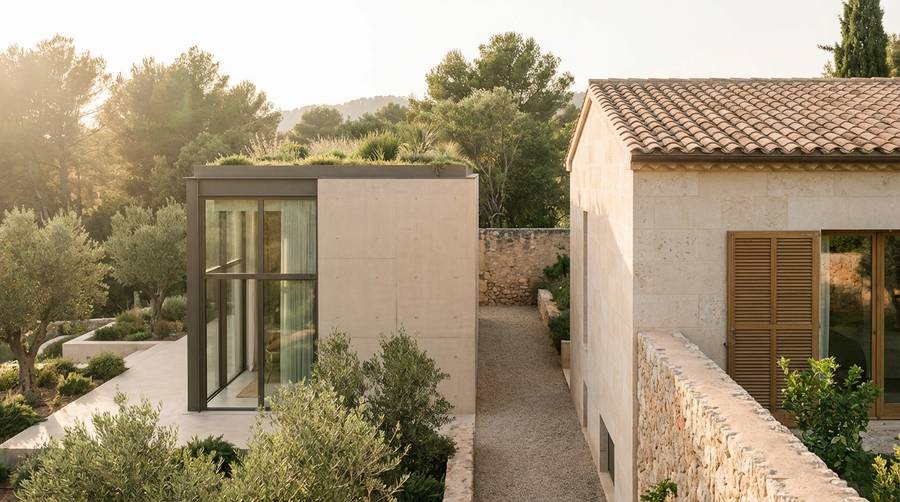
Modularity is becoming architectural, not industrial-looking. The Mediterranean contemporary vocabulary — light façades, timber accents and generous openings — is now fully compatible with industrialized workflows.
Integration of modern materials: industrialized concrete, light timber framing and steel frame
Material selection is strategic. Use these guidelines:
- Industrialized concrete: ideal for structural stability and thermal mass; best combined with thermal breaks to avoid bridges.
- Light timber frame: fast, renewable and thermally efficient; excels for low-rise family homes.
- Steel frame: high precision and long spans; suited where open-plan layouts prevail.
Mix-and-match hybrid solutions can optimise cost, weight and embodied carbon. For example, a concrete podium with timber upper floors balances durability and sustainability.
Mediterranean contemporary design: light façades, large openings and bioclimatic principles
Design tactics for Spanish climates that increase comfort and performance:
- Orient living spaces to maximize winter sun and summer shading.
- Prefer light-coloured façades and deep overhangs to reduce cooling loads.
- Use high-quality glazing and operable shading for ventilation-driven comfort.
Digitalisation of process: BIM, industrial fabrication and component traceability
BIM is no longer optional. Implementations delivering measurable benefits include:
- Integrated schedules: linking factory production slots with site milestones avoids idle time.
- Quality traceability: batch-level records for finishes and systems reduce warranty disputes.
- Design for manufacture: optimises material usage and accelerates approvals.
Sustainability and energy efficiency: the future of prefabricated homes
Industrialized housing can set a new baseline for low-carbon living. The factory environment allows tighter tolerances and consistent airtightness — critical to reach Passivhaus-level performance.
Strategies to reach Passivhaus criteria and cut carbon footprint
Practical steps that show measured impact:
- Design for high insulation continuity and use triple-glazed, thermally broken frames.
- Prioritise airtightness targets of 0.6 ACH@50Pa or better in early design stages.
- Combine MVHR (mechanical ventilation with heat recovery) with solar PV to reduce operational emissions.
Material lifecycle comparison: emissions, insulation and recyclability
Compare three typical assemblies on lifecycle carbon and recyclability:
- Timber frame: low embodied carbon, high recyclability, excellent thermal performance.
- Steel frame: higher embodied carbon but highly recyclable and precise in tolerances.
- Precast concrete: higher initial carbon but offers longevity and thermal mass benefits that reduce operational energy.
Decision framework: weigh embodied carbon against expected operational savings over 30–50 years. For many Spanish single-family homes, timber-dominant assemblies achieve the best overall carbon balance when paired with renewables.
Certifications and metrics every self-builder should demand
- Energy labels (CEEB/HE0+), Passivhaus certification where feasible.
- Third-party EPDs (Environmental Product Declarations) for key elements.
- Airtightness test results and factory QA reports as contractual deliverables.
Optimising turnkey ('Llave en mano') models: process, timelines and real metrics
Turnkey can deliver certainty — if the contract and process are rigorous. Below is a practical roadmap and empirical data to use in negotiations.
Service phases from plot search to handover: typical times and critical points
Typical turnkey timeline for a 120–160 m² single-family modular home:
- Plot acquisition and due diligence: 1–3 months.
- Design and permitting: 3–6 months (municipal variability matters).
- Factory production: 2–4 months depending on complexity.
- Site assembly and finishes: 1–3 months.
Critical points to manage: site access, utilities connection, and permit lead times.
Case studies with metrics: average cost, assembly time and client satisfaction
Three anonymised case studies illustrate performance ranges:
- Case A (timber frame, 130 m²): total delivered cost €185k; factory production 10 weeks; on-site assembly 6 weeks; client satisfaction 4.6/5.
- Case B (concrete panels, 150 m²): total delivered cost €210k; production 12 weeks; on-site assembly 8 weeks; client satisfaction 4.4/5.
- Case C (hybrid steel-timber, 160 m²): total delivered cost €230k; production 14 weeks; on-site 10 weeks; client satisfaction 4.5/5.
These examples reflect typical ranges. Cost drivers include finishes, site complexity and customisation level.
Checklist to evaluate turnkey providers and essential contract clauses
Minimum contractual items to insist on:
- Fixed-price with defined scope and change-order process.
- Clear production and assembly milestones with penalties for missed dates.
- Factory QA documentation, component EPDs and airtightness target.
- Retention mechanism and post-delivery warranty of at least 2–5 years.
- Defined acceptance tests and commissioning protocols.
Financing and mortgages for self-built modular homes in Spain
Financing industrialized housing is maturing. Banks are more receptive if projects show fixed prices, certified components and structured milestones.
Financing options specific to industrialized housing and lender requirements
Typical routes include:
- Construction-to-permanent loans: disbursed by milestones tied to factory and site progress.
- Self-builder mortgages: require detailed budgets and often independent cost certification.
- Green loans and mortgages: preferential terms for projects showing energy performance or Passivhaus credentials.
Realistic costing models: fixed budget, payment milestones and deviation management
Recommended payment structure:
- Deposit on contract signature (5–10%).
- Progress payments tied to factory completion stages (40–60% total).
- On-site assembly milestone (20–30%).
- Retention released after commissioning and final acceptance (5–10%).
Insist on escrow or bank-backed guarantees for milestone payments when possible.
Negotiation tips for mortgages and green incentives
- Bring factory QA and certification documents to bank meetings.
- Model cash flows conservatively and show contingency buffers of 5–8%.
- Explore municipal grants and EU funds for energy upgrades; they can improve loan terms.
Technical and economic competitiveness: a neutral comparison
To make an objective decision, compare proposals against consistent metrics. Below are the most useful indicators.
Cost–benefit analysis vs traditional build: CAPEX, OPEX and resale value
Key comparisons to request from bidders:
- Delivered CAPEX per m², broken down by structure, envelope, MEP and finishes.
- Estimated annual OPEX energy per m² with assumed occupancy.
- Market resale impact for certified high-efficiency homes (historical premiums of 3–8% in some regions).
Constructive performance: timelines, quality and risk reduction
Measure performance using:
- Planned vs actual delivery days.
- Defect rates at handover and within 12 months.
- Warranty claims per project value.
What metrics to ask for when comparing bids
Insist on:
- Thermal transmittance (U-values) for envelope elements.
- Airtightness test results (n50 or ACH@50Pa).
- W/m² for heating and cooling design loads and expected kWh/m² year consumption.
- List of included appliances, commissioning scope and after-sales service.
For a neutral primer on modular vs traditional strengths and limitations, see Vivienda modular vs tradicional: ventajas y desventajas.
Toward 2035: strategic recommendations for visionary self-builders
This final section lists concrete decisions and a closing checklist to increase project success and long-term value.
Design and material choices that maximise value and sustainability
- Adopt a hybrid structural strategy: durable lower envelope with lightweight upper modules to balance cost and carbon.
- Target airtightness and MVHR from the outset; they yield the largest operational energy dividends.
- Specify durable, low-maintenance exterior finishes suited to Mediterranean climates.
Acquisition and financing strategy to reduce risk and speed delivery
- Lock factory slots early and align them with permits and site preparation.
- Negotiate milestone-linked financing with retention and performance guarantees.
- Use scenario budgeting: best case, base case, and contingency (+8%).
Final checklist: indicators and documentation every modular project should include
- Fixed-price contract with clear scope and penalty clauses.
- Factory QA records, EPDs and airtightness target report.
- Detailed milestone payment schedule and escrow or guarantee mechanisms.
- Commissioning, testing and a defined warranty protocol.
- Documented plan for commissioning renewables and energy systems.
For a concise overview of the Mediterranean modular product advantages, you may find Producto modular mediterráneo: 6 razones para adoptarlo a practical companion.
Final thought: modular homes in Spain combine the strengths of industrial precision with Mediterranean design. When planned with rigorous contracts, measurable performance targets and realistic financing, they offer a clear path to faster delivery, lower operational costs and meaningful carbon reductions.
If you're planning a self-build, start by aligning design, materials and financing around measurable KPIs. Ask potential partners for the metrics listed above and request real case references with documented timelines and costs. When you demand data, you get predictability.
Ready to plan your modular home? Review the checklist, gather two turnkey quotes aligned to the same scope and schedule a document review with an independent technical advisor before committing.