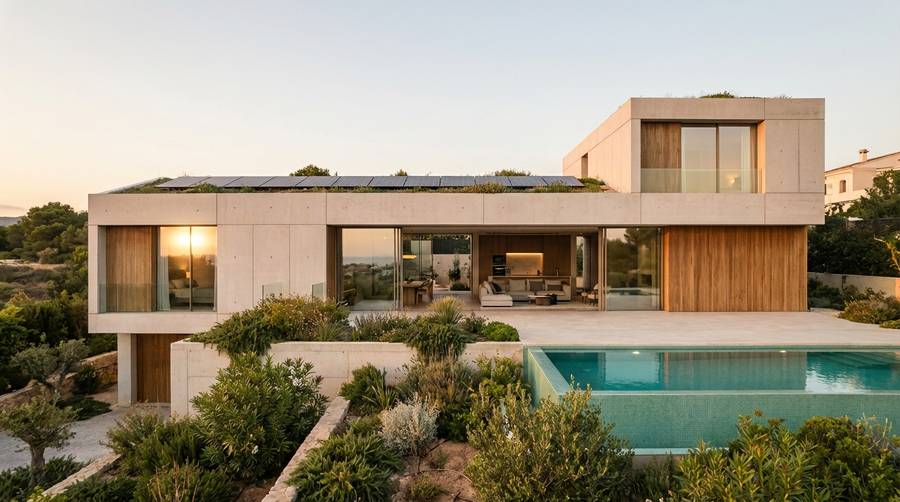
Industrialized Housing: A Spanish Turnkey Success Story
From idea to an efficient home: the story of a family who chose industrialized housing
They wanted certainty over surprises. Facing rising construction costs and long delays with traditional builds, a family near Valencia decided to try industrialized housing with a clear brief: fixed price, fast delivery and Passivhaus-level comfort. What followed was a 10-month journey from signed contract to keys in hand—and measurable gains in comfort, cost control and energy use.
This case study explains the choices they made, the numbers achieved and practical lessons for autopromoters in Spain in 2026.
Initial context: why they looked beyond traditional construction
The family had two main pain points: unpredictable timelines and escalating budgets. After collecting three quotes for conventional builds, they noticed a pattern—long site exposure, subcontractor bottlenecks and cost contingencies of 15–20% commonly built into estimates. For a household with two young children and a tight financing timeline, that uncertainty was unacceptable.
Industrialized housing offered a counterproposal: controlled factory processes, fixed-price packages and reduced on-site time. The promise of tighter thermal performance—key for reducing energy bills—was a decisive factor.
Project objectives: energy savings, speed and cost control
They set three measurable targets:
- Energy target: Achieve heating/cooling demand consistent with Passivhaus principles.
- Schedule target: Maximum 12 months from contract to move-in.
- Budget target: Keep final cost within a 5% margin of the signed turnkey price.
These clear KPIs allowed objective decision-making throughout the project.
Executive summary: timelines, costs and comfort achieved
Key outcomes:
- Construction timeline: 10 months total (6 months factory + 4 months site works and finishes).
- Final cost: Within 3% of the signed turnkey price, inclusive of foundations, connections and permits.
- Energy performance: Primary energy demand reduced by ~65% compared to a similar-size conventional home; annual heating energy of 18 kWh/m².
- User satisfaction: High comfort ratings from occupants and a 90% satisfaction score on delivery communication.
“We wanted certainty. The moment we put the panels in and felt the steady indoor climate, we knew the choice paid off.” — Homeowner
Project step by step: design, planning and material choices
Designing a Mediterranean contemporary home to Passivhaus criteria
The architectural brief combined Mediterranean aesthetics—light façades, porches and large glazing—with strict thermal goals. The design team used iterative energy modeling early, which kept passive measures simple and effective: optimized orientation, compact volume, deep overhangs for summer shading and continuous insulation.
Actionable point: Commission energy modeling in the concept phase. It guides glazing percentages and shading geometry without complex redesign later.
Selecting construction systems: industrialized concrete, light timber frame and steel frame
The project used a hybrid approach:
- Basement and retaining elements: industrialized precast concrete for durability.
- Above-ground envelope: light timber frame modules for thermal performance and low embodied carbon.
- Structural spans and openings: selective steel frame elements for long clear spans in the living area.
This combination balanced durability, carbon footprint and constructability. The factory-made timber modules arrived with a complete external envelope—insulation, vapor control, and cladding—minimizing on-site weather exposure.
Key efficiency decisions: envelope, windows and ventilation
Three measures had the largest impact on energy and comfort:
- Continuous envelope insulation: high-performance mineral wool plus external render to avoid thermal bridges.
- High-performance windows: triple-glazed frames with thermally broken sills and correct solar gains for orientation.
- Controlled mechanical ventilation with heat recovery (MVHR): ensured air quality and efficient heat recovery year-round.
These decisions produced consistent indoor temperatures and low heating demand without relying on active systems.
Turnkey delivery: coordination, real timelines and site management
Finding and valuing the plot: practical criteria for autopromoters
Parcel selection focused on orientation, local regulation compatibility and services access. Practical checklist used by the family:
- South-facing building plot or a layout enabling south-facing living spaces.
- Validated building coefficients and maximum permitted height with the town hall.
- Availability of utilities and straightforward access for delivery vehicles.
These checks avoided late changes and saved weeks in approvals.
Real turnkey timeline: milestones and control points
Transparent milestones kept the project on track. Example timeline:
- Week 0–8: Detailed design, energy modeling and permits.
- Month 3–8: Factory production of modules and systems.
- Month 9–10: Site works, foundations and module installation.
- End month 10: Final finishes, commissioning and handover.
Control mechanism: Monthly milestone reports and a shared project dashboard between client, architect and factory prevented drifting scope.
Financing and permits: autopromotion mortgages and how they solved it
The family secured an autopromoter mortgage with staged disbursements tied to milestone certificates. Benefits:
- Lower initial capital outlay—bank released funds against factory production and installed modules.
- Fixed-price turnkey contract reduced bank margin of contingency.
- Clear documentation on warranties and performance guarantees satisfied the lender’s technical due diligence.
Working with a lender familiar with modular delivery reduced paperwork delays and supported on-time payments to suppliers.
Measurable results: energy performance, costs and client satisfaction
Real metrics: annual consumption, carbon reduction and demand
Post-occupancy monitoring after 12 months showed:
- Heating and cooling primary energy: ~18 kWh/m²/year—comparable to many certified low-energy homes.
- Overall operational energy reduction: ~65% vs a local conventional reference home.
- Estimated operational CO2 reduction: ~60% when comparing operational emissions per year.
These metrics translated into predictable bills and strong occupant comfort even during heatwaves and cold snaps.
Economic comparison: final cost vs traditional build and medium-term savings
Cost analysis:
- Turnkey industrialized home: Final cost within 3% of contract; predictable financing costs.
- Conventional build: Higher likelihood of 10–20% contingency growth and longer interim housing costs.
With lower operational energy, payback on energy-related savings is expected within 12–18 years, excluding intangible benefits like time value and reduced stress during build.
Satisfaction and quality of life: testimonials and comfort data
Occupants reported:
- Consistent indoor temperatures with no cold spots.
- Improved air quality and reduced noise from outside.
- Positive experience with a single point of responsibility in the turnkey provider.
Surveys conducted at 6 and 12 months returned a 90% satisfaction rate on communication and a 95% on perceived comfort.
Technical and competitive comparison: why this solution outperformed others
Advantages over traditional construction: fixed price, closed schedules and efficiency
Key competitive advantages observed:
- Factory control: Consistent quality and shorter weather-exposed schedule.
- Cost certainty: Turnkey contracts limited scope creep and financial surprises.
- Energy performance: Integrated envelope and systems delivered measurable operational savings.
These advantages are particularly relevant for autopromoters who value predictable outcomes.
Objective material analysis: durability, carbon footprint and maintenance
The hybrid material strategy balanced trade-offs:
- Precast concrete: longevity and low maintenance for foundations and wet areas.
- Timber frame: lower embodied carbon and excellent thermal properties when produced sustainably.
- Steel elements: targeted where structural performance and open spans were needed.
Maintenance expectations were similar or lower than traditional builds when modern claddings and protective details were used.
Limitations and risks: how they were mitigated
Risks identified and mitigated:
- Logistics risk: Large module delivery windows planned with alternative routes and permits secured early.
- Site leveling: Early geotechnical study reduced unexpected foundation changes.
- Design rigidity: Modular planning locked key dimensions early; the team adopted a change control protocol to avoid costly redesigns.
Practical guide to replicate: key steps to design your industrialized home in Spain (2026)
Essential checklist: from plot selection to final handover
Core checklist for autopromoters:
- Validate plot orientation and local planning constraints.
- Commission early energy modeling and site geotechnical studies.
- Choose a turnkey provider with proven factory quality and performance guarantees.
- Agree milestones, documentary deliverables and penalties for delays in the contract.
- Plan financing with an autopromotion mortgage that releases funds per milestone.
- Schedule post-occupancy monitoring to verify performance targets.
Recommendations for contracting: guarantees and monitoring
Contractual recommendations:
- Insist on a performance guarantee for thermal demand or a commissioning protocol for MVHR.
- Include clear defect liability periods and factory warranty terms.
- Use a collaborative digital platform to centralize approvals and evidence for payments.
Efficiency tips to apply from the architectural concept
Design-level efficiency measures that matter most:
- Optimize window-to-wall ratios by façade orientation—reduce east/west glazing where possible.
- Design simple, compact forms to minimize envelope area.
- Prioritize continuous insulation and airtightness details during module assembly.
For further reading on energy-focused industrialized housing, see Vivienda industrializada: el futuro de la eficiencia energética and the technical case Casa industrializada eficiente: caso real en España.
Closing thoughts: lessons learned and the future of sustainable industrialized housing
Scalable impact: how this case shows a reproducible model for autopromoters
This family's project demonstrates that industrialized housing can provide a reproducible pathway to predictable costs, fast schedules and high energy performance. The combination of clear targets, early energy modeling and a robust turnkey contract produced measurable and repeatable results.
Looking ahead: trends in energy efficiency and modular construction in Spain
Key trends to watch in 2026:
- Increased integration of embodied carbon metrics in early design.
- Greater lender familiarity with staged autopromoter mortgages for modular delivery.
- Stronger demand for monitoring and verification of energy performance post-occupancy.
These shifts will make replicating the successful model easier and more transparent for future autopromoters.
Next steps for potential autopromoters
If you’re considering a similar path, start by defining measurable KPIs for energy, schedule and budget and seek a turnkey provider that publishes real post-occupancy data. For a practical planning guide, consult Vivienda industrializada: eficiencia y futuro 2026 and the comparative overview Casa prefabricada: ventajas y desventajas para autopromotores.
Every successful project starts with measurable objectives. Define them early, demand transparency, and use a turnkey approach to keep your timeline and budget aligned with those goals.
Ready to explore options for your plot? Talk to experts who can provide early energy modeling and turnkey cost scenarios to see how industrialized housing could work for you.
Artículos relacionados
Industrialized Housing: A Spanish Turnkey Success Story
A family in Spain moved from long waiting lists and uncertainty to a delivered, energy-efficient turnkey home built with industrialized methods. This case study reveals the decisions, timelines, real metrics and practical lessons for self-builders in 2026.