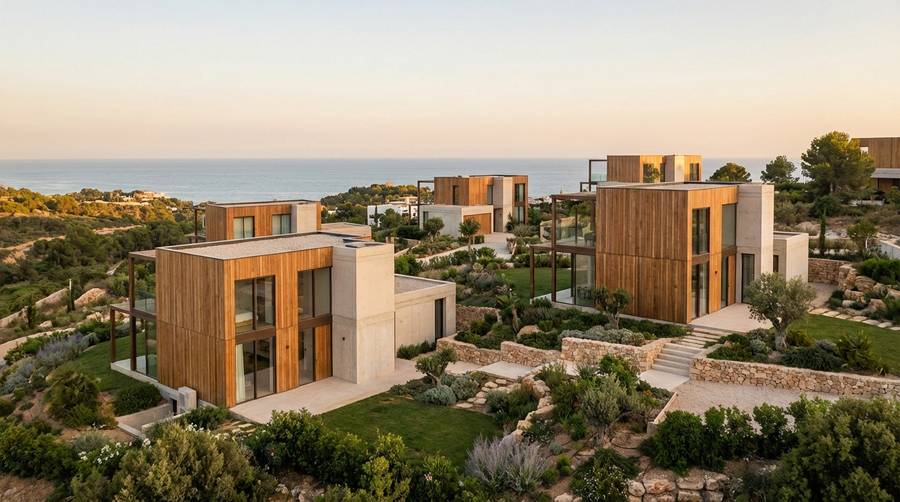
Modular Mass Delivery for Self-Builders in Spain
Why modular mass delivery matters for self-builders in Spain
When deadlines, budgets and sustainability all matter, modular mass delivery changes the equation. In 2026 the Spanish market offers more plots, stricter energy rules and stronger buyer expectations — and industrialized housing answers these demands with repeatable processes and measurable outcomes.
This article breaks down why mass modular delivery is relevant for autopromotores (self-builders), which projects benefit most, and how to start with a clear roadmap.
Modular mass delivery reduces on-site uncertainty: typical build-phase time is cut by up to 50% while keeping warranties and energy performance comparable to high-end traditional builds.
Market context 2026: demand, land and opportunity
Demand is concentrated in peri-urban and coastal zones. Municipalities are opening plots for sustainable developments, and finance products for self-builders are improving. For families and small developers, modular systems offer speed and predictability that match these market windows.
How mass delivery answers speed, cost and quality needs
Repeatable factory processes deliver consistent quality. Standardized units, controlled curing (for concrete) and pre-assembled envelopes reduce variability. That lowers defect rates and shortens warranty remediation time.
Who should consider modular mass delivery?
- Families with a fixed plot budget wanting a modern, efficient home without open-ended construction risk.
- Small-scale promoters seeking predictable timelines to sell or rent units quickly.
- Local authorities running social or affordable housing programs prioritizing speed and energy targets.
1) Fixed, predictable delivery times
Delivering on time is the baseline benefit. For self-builders, time is money: reduced rental overlap, quicker mortgage activation, faster occupancy.
Standard phases that reduce temporal uncertainty
- Design freeze: finalized dimensions and technical specs before production.
- Factory production: panels, modules or structural frames built in parallel to site prep.
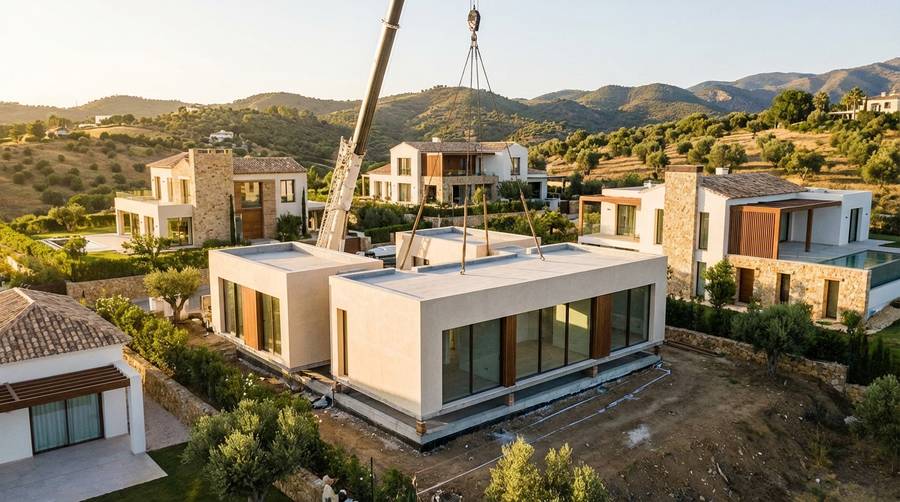
- On-site assembly: mechanical, electrical and finishing tying into foundations over days or weeks, not months.
Comparative timelines: modular vs traditional (illustrative)
- Typical traditional build: 12–24 months from groundworks to occupancy.
- Modular mass delivery: 6–12 months standard for single-family homes of 120–220 m².
Case metric: a recent series of six turnkey modular homes in Valencia completed structure and envelope in 4–6 weeks on site, with full handover at 7 months — vs estimated 14 months for a comparable traditional project.
Financial planning and plot coordination
With known milestones, cash calls and mortgage draws become simpler. Lenders can verify factory progress reports, which often makes staged financing smoother for self-promotion mortgages.
2) Fixed price and stronger cost control
Transparent scope and repeatable procurement reduce surprises. Turnkey modular contracts typically list inclusions clearly: structure, envelope, major MEP (mechanical, electrical, plumbing), basic finishes and commissioning.
What a turnkey budget typically includes
- Factory fabrication and logistics to site
- Foundation and anchoring works
- Assembly, interior finishes and basic landscaping
- Technical commissioning and energy certification
Reduced risks compared to traditional site-led builds
Key risk reductions: weather delays, supply chain spikes for on-site trades, and on-site coordination failures. That lowers the likelihood of cost overruns commonly seen in bespoke projects.
Financing options and transparency for mortgages
For autopromotores, clear invoicing from factory and assembly milestones supports mortgage draws. Many banks accept staged documentation from modular providers as evidence of progress. Make sure contracts are itemized and include defect liability periods.
3) Sustainability and energy performance as competitive advantages
Industrialized processes enable better thermal control and material optimization. When executed well, modular homes outperform typical new builds in airtightness and thermal continuity.
Implementing Passivhaus strategies in modular systems
- Factory-sealed joints and controlled membrane installation improve airtightness.
- Optimized insulation layers integrated at fabrication reduce thermal bridges.
- Coordinated mechanical ventilation with heat recovery (MVHR) can be pre-planned and partially factory-installed.
Lowering carbon footprint: materials, process and transport
Choose materials with lifecycle thinking. Concrete industrialized elements that use recycled aggregates, cross-laminated timber or certified sustainably-sourced light timber frames and efficient steel frames each have trade-offs. Mass production reduces waste, and shorter site timing reduces vehicle movements and on-site energy use.
User benefits: comfort, bills and resale value
Measured gains: expected heating demand reductions of 40–70% compared to conventional code-compliant homes when Passivhaus-level strategies are applied; occupant surveys show higher perceived comfort and fewer maintenance calls in the first two years.
4) Modern materials and quality: concrete, timber frames and steel
Material selection is strategic — not aesthetic only. Each system suits different plots, budgets and finishes.
Industrialized concrete: robustness and finish quality
Advantages: high thermal mass, excellent acoustic performance and premium exposed finishes. Ideal for coastal or urban plots where durability matters.
Light timber framing: speed and thermal efficiency
Advantages: high insulation-to-weight ratio, fast assembly and warm interior finishes. Trained crews can achieve tight tolerances that reduce on-site rectifications.
Steel frame: flexibility and fast structural erection
Advantages: thin profiles with large spans, easy integration of large glazing and compatibility with high-end finishes. Steel systems pair well with off-site panelisation.
5) Turnkey delivery: from plot search to lived-in home
A true turnkey provider bundles services to reduce friction for self-builders. The objective is a single accountable partner from feasibility to handover.
Services commonly included in full turnkey offers
- Plot search assistance and feasibility analysis
- Urbanistic and permit management
- Groundworks, foundations, and logistics
- Assembly, finishes, landscaping and commissioning
- Comprehensive handover documentation and initial warranty cover
Coordination of assembly, logistics and quality control
Key controls: factory QA records, on-site acceptance tests, airtightness and thermal imaging checks prior to handover. These reduce post-handover issues and speed up final certification.
Handover and aftercare
Look for providers that include defined post-occupancy checks. A 12–24 month service plan with scheduled performance measures (airtightness re-test, MVHR balancing) protects clients and documents actual performance for resale or financing purposes.
6) How to start: a practical checklist for self-builders
Start with clarity: plot constraints, budget ceiling and timeline. Below is a condensed step-by-step that real autopromotores can follow.
Initial checklist
- Confirm plot buildability and urban parameters (coverage, height, setbacks).
- Set a realistic gross budget including land, infrastructure, VAT and contingency.
- Decide target energy performance (near-Passivhaus, NZEB, etc.).
- Assemble a technical brief: bedroom count, gross floor area, special needs.
Choosing a modular provider: metrics and red flags
Ask for:
- Actual delivery times on recent projects and factory capacity.
- Detailed turnkey inclusions and exclusions.
- Reference projects and contactable client testimonials.
- Measured performance reports (airtightness, energy use) from past homes.
Red flags: vague schedules, unwillingness to show real projects, or contracts that lack clear milestone invoicing.
Next steps: funding, design and decisions calendar
- Secure conditional mortgage approval or construction financing aligned to staged draws.
- Freeze architectural decisions before factory production starts.
- Create a 12-month decision calendar for finishes, MEP choices and site appointments.
Closing: cumulative advantages and why choose modular mass delivery in 2026
Modular mass delivery aligns speed, cost control and sustainability in a single, auditable workflow. For self-builders in Spain, that translates into reduced financial risk, faster occupancy and better long-term performance.
Executive summary of key benefits
- Predictable timelines: assembly measured in weeks, handover in months.
- Budget certainty: clearer turnkey scopes and lower variance.
- Energy and carbon advantages: factory precision enables high airtightness and optimized insulation.
- Material flexibility: concrete, timber and steel options to suit site and budget.
Common questions from self-builders
- Can I customize the layout? Yes — within the production platform’s modular grid. Early-stage customization is cheaper than late changes.
- Are long-term warranties comparable? Typically yes — major providers offer multi-year structural and envelope guarantees plus defined defect liability periods.
- How visible is the factory process? Ask for factory visits or documented QA records to verify build quality.
Practical next step
If you have a plot or a budget range, request a feasibility study that compares traditional vs modular scenarios with timelines, cost brackets and projected energy performance. A short, data-driven study reduces uncertainty and helps you choose confidently.
Ready to evaluate your plot? A concise feasibility report will show how modular mass delivery performs for your site and budget — and what fixed-price, turnkey solution looks like for your family or project.