Industrialized Housing Guide: Design & Build in Spain 2026
Why choose industrialized housing over traditional construction
Imagine shaving months off your project schedule while locking in a fixed price and improving energy performance. That reality is what many autopromoters in Spain experience when they opt for industrialized housing. This section explains the tangible advantages and the conditions where modular or prefabricated solutions outperform conventional builds.
Efficiency and reduced timelines: closed timelines and site control
Industrialized housing moves most work to a controlled factory environment. The immediate benefits are:
- Parallel workflows: site preparation and factory fabrication run simultaneously.
- Weather-independent progress: fewer delays from rain or seasonal cycles.
- Shorter on-site duration: many projects achieve structural assembly in days and completion in weeks rather than months.
Concrete example: a 150 m² single-family home using a mixed system (concrete base + timber upper modules) can reach envelope closure in under 4 weeks on site, versus 3–6 months with traditional methods.
Predictable cost and fixed-price models
Industrial processes and repeatable components reduce surprises. Look for proposals that present:
- Itemised fixed-price packages with clear exclusions.
- Change-order rules and a cap for client-driven modifications.
- Transparent supply chain clauses for material price escalation.
Tip: insist on a payment schedule tied to objective milestones (factory completion, delivery, on-site assembly, final inspection) to mitigate bank and contractor risk.
Quality control and fewer deviations
Factory production enables repeated quality checks, digital templates and calibrated assembly jigs. The result:
- Reduced construction defects.
- Better airtightness and assembly precision—key for Passivhaus-level performance.
- Consistent finishes and documented tolerances for warranty claims.
Factories remove much of the variability of on-site craft. For self-builders, that means fewer surprises and a more predictable delivery.
Modern materials and systems for public housing
Choosing the right structural system determines cost, speed and sustainability. Below are three mainstream options used across Spanish industrialized housing projects.
Industrialized concrete: durability and thermal performance
Precast and panelized concrete offer long service life and excellent thermal mass. Use cases include ground floors, foundations and load-bearing façades. Key benefits:
- Fire resistance and acoustic performance—often superior to light-frame systems.
- Integration with insulation and ventilated façades to optimize U-values.
- Standardised panels that speed on-site assembly when combined with crane logistics.
Cost note: initial material cost may be higher but lifecycle savings in maintenance and energy often offset the premium.
Light timber frame: speed, flexibility and sustainability
Timber framing is ideal for rapid upper-storey builds and low-carbon targets. Benefits include:
- Lower embodied carbon versus steel and concrete.
- Design flexibility for complex geometries and interior layouts.
- Fast factory assembly with dry connections and minimal curing time.
Practical tip: combine timber frames with robust moisture management and mechanical ventilation to avoid long-term issues.
Steel frame and hybrid systems: structural advantages
Steel frame systems offer high structural capacity with small section sizes. They are often used in hybrid solutions:
- Steel + concrete: for basements and cores.
- Steel + timber: for light superstructures with long spans.
- Prefabricated steel panels that simplify mechanical runs and façade integration.
Choose steel when you need larger column-free spaces or for multi-storey modular buildings where repeatability matters.
Design and energy efficiency: reaching Passivhaus standards in modular projects
High-performance industrialized homes can achieve Passivhaus-like metrics with the right design and systems. The following section outlines the core passive and active strategies you must apply.
Passive strategies: envelope, airtightness and thermal bridges
Start with the building fabric:
- Continuous insulation: avoid layer interruptions at junctions.
- Thermal bridge detailing: use thermal break connectors and detailed junction designs in factory templates.
- Airtightness: target n50 values compatible with Passivhaus (≤ 0.6 h‑1) through factory-sealed panels and verified site penetrations.
Factory conditions make it easier to control these factors than traditional on-site builds.
Efficient active systems: ventilation, heating and renewables
To complement the envelope, specify:
- MVHR (mechanical ventilation with heat recovery) sized to real occupancy.
- Compact heat pumps or district connections where available.
- On-roof PV sized to offset electrical demand and considered in the payback analysis.
Balance capital cost and lifecycle savings; in many Spanish climates, combining good insulation with modest renewables yields the best ROI.
Certification and metrics: measuring carbon and energy reduction
Define measurable targets early:
- Primary energy demand (kWh/m²·year)
- Heating load (W/m²)
- Operational carbon and embodied carbon baselines
Use these metrics in tender documents to compare suppliers on performance, not just price. For more on comparative decision-making, see Vivienda industrializada: comparativa práctica y decisiones clave.
Turnkey process for self-builders in Spain: step by step
Delivering a turnkey industrialized home requires coordination across land purchase, design, factory production and on-site works. Below is a practical roadmap.
Parcel search and appraisal: regulation, feasibility and urbanism
Key checks before committing to land:
- Zoning and allowable occupancy (buildability per m² and maximum height).
- Utilities access and sewer/drainage requirements.
- Local climatic considerations that affect façade orientation and solar gains.
Must-have: a pre-feasibility study detailing permitted gross floor area, setback constraints and an initial topography-based foundation concept.
Design, manufacture and coordination between factory and site
Organise the project into clear phases:
- Architectural brief and performance targets (energy, acoustic, budget).
- Detailed factory design and panel/modular engineering.
- Procurement and production schedule aligned with site readiness.
- Delivery and rapid on-site assembly with just-in-time logistics.
Coordination tip: appoint a single technical coordinator to own tolerance control at junctions between factory-made elements and site-built components.
Handover, commissioning and after-sales: warranties and paperwork
Ensure the contract includes:
- Commissioning protocols for MVHR, heating and renewables.
- Warranty periods for structural systems and finishes (clearly dated from handover).
- As-built documentation, operation manuals and maintenance schedules.
A smooth handover reduces disputes and improves occupant satisfaction.
Financing and mortgages for self-build and modular housing
Financing an industrialized home often follows different rules than a standard mortgage. Here’s how to approach lenders and structure funding.
Financing options: self-builder mortgage vs construction loan
Two common paths:
- Self-builder (autopromotor) mortgage: progressive disbursements tied to project milestones and often requiring completion guarantees.
- Construction loan: short-term bridging finance that converts to a mortgage on completion.
Industrialized projects can be attractive to banks because factory progress is verifiable and on-site risk is lower, but prepare robust documentation.
Valuation and requirements for industrialized homes
Lenders typically assess:
- Legal title to the parcel and building permits.
- Supplier track record and factory quality control evidence.
- Clear payment schedule and retention mechanisms.
Negotiation tip: present factory production photos, QA reports and an independent progress survey to speed approvals.
Negotiating timing and drawdowns with banks
Bank disbursements should match objective milestones. Common tranches:
- Land purchase
- Factory start / material procurement
- Factory completion / transport
- On-site assembly / final certification
Request minimal bank holdbacks that are replaced by a short-term retention by the contractor to preserve liquidity.
Real case studies: time, cost and client satisfaction metrics
Below are anonymised case studies with practical metrics to guide expectations.
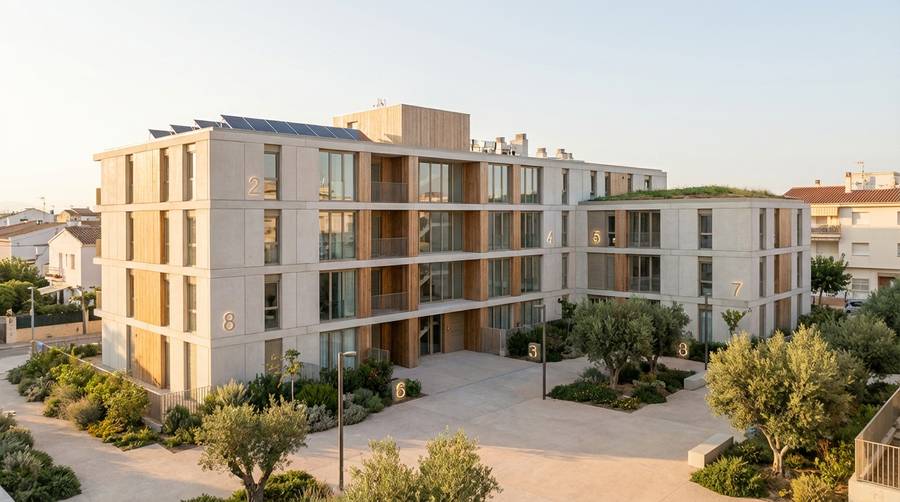
Public housing block with industrialized concrete: time and savings
Project snapshot: 24-unit block using precast concrete panels.
- Site-to-completion time: 10 months (vs estimated 18 months conventionally).
- Cost variance: actual within 2% of fixed contract.
- Energy: average reduction of 35% in heating demand compared to local baseline.
Key success factor: standardisation of panel interfaces and early coordination with façade suppliers.
Timber frame residential cluster: cost per m² and efficiency
Project snapshot: 8 single-family homes in light timber frame.
- Average build cost: competitive with traditional masonry when considering reduced site overheads.
- On-site assembly: 2 weeks per house for structural closure.
- Occupant satisfaction: >90% rated acoustic comfort and thermal stability positively at 12-month review.
Insight: investing slightly more in airtightness and MVHR increased perceived comfort and lowered operational costs.
Lessons learned and testimonials from self-builders
Common lessons include the importance of clear scope, early engagement of the bank and rigorous site logistics planning. Satisfied autopromoters consistently highlight predictability and reduced stress as primary benefits.
How to compare offers and choose a provider without mistakes
Selecting the right industrialized housing supplier is a technical and contractual exercise. Below is a practical checklist and decision framework.
Technical and contractual checklist: what to review in proposals
- Detailed scope and list of included items (finishes, systems, landscaping).
- Performance guarantees for airtightness, U-values and MVHR efficiency.
- Factory QA procedures and third-party testing records.
- Logistics plan for delivery and crane operations.
- Clear warranty and post-delivery support terms.
Objective comparisons: energy performance, timelines and warranties
Create a comparison table that normalises:
- Price per m² including fixed extras.
- Guaranteed completion dates and penalties for delay.
- Energy model outputs and expected annual costs.
Always ask for references and visit completed homes when possible.
Questions to test transparency and industrial capacity
Ask suppliers to provide:
- Factory visit availability and production capacity numbers.
- Track record of similar projects and client references.
- Supply chain contingencies for key components (windows, insulation, HVAC).
Final thought: industrialized housing in Spain combines speed, predictability and improved energy performance when planned and procured correctly. If you are considering a self-build project, start by securing a thorough feasibility study and a supplier that accepts measurable performance targets.
Ready to plan your project? Begin with a certified site feasibility and an energy brief—small upfront investment that saves time and cost across the whole process. Contact a specialised technical coordinator or request an initial study to compare scenarios and lenders, and take the next step toward a predictable, high-performance home.