Advanced Concrete Modular Homes Guide
Essential guide: why choose advanced concrete for your modular home
Imagine completing a high-quality Mediterranean home in months—not years—while keeping the budget fixed and energy bills low. That’s the core promise of advanced industrialized concrete systems. This guide explains when and how concrete-based modular solutions outperform traditional building methods for Spanish self-builders.
Advantages vs. traditional housing: efficiency, fixed timelines and budgets
Predictability is the biggest difference. Factory production controls variables that on-site builds cannot: quality, schedule and cost. Concrete panels and modules are produced under controlled conditions, reducing weather delays and on-site variability.
- Shorter delivery times: on-site assembly can cut construction timelines by 40–60% compared to conventional builds.
- Fixed-price contracting: industrialized production allows clearer scope and fewer surprises.
- Durability and low maintenance: advanced concrete systems resist moisture, pests and fire better than many lightweight alternatives.
Characteristics of industrialized concrete: durability, precision and thermal performance
Modern precast and insulated concrete panels combine structural performance with thermal envelope quality. When specified correctly they offer:
- High dimensional precision: better fit and less on-site rework.
- Thermal mass: concrete’s inertia smooths indoor temperature swings—valuable in Mediterranean climates.
- Integrated layers: factory-applied insulation, vapor control and finishes speed assembly and improve airtightness.
Countering prejudice: quality, Mediterranean aesthetics and public perception
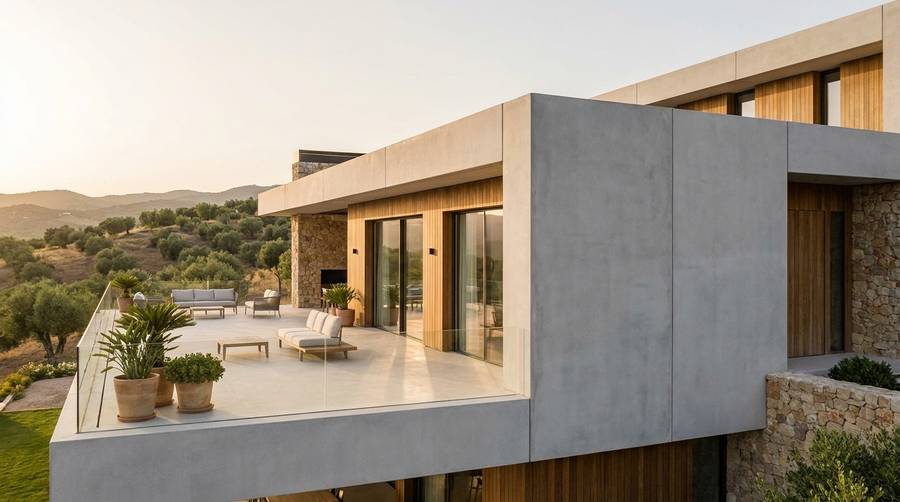
There is a misconception that prefabrication equals low aesthetic value. The reality is different: modern systems allow textured façades, natural material cladding and large openings typical of Mediterranean architecture. Well-detailed concrete can look warm and premium.
Companies that integrate concrete with wood or stone finishes achieve both the robustness of industrialized systems and the natural, lived-in look Spanish families want.
Design and planning step by step with advanced concrete
Designing a modular concrete home requires aligning program, regulations and manufacturing logic from the start. Below are the practical stages.
Define program, plot and regulatory constraints in Spain (2026)
Start with three foundational checks:
- Plot analysis: orientation, slope, access, soil type and utilities. These determine foundation type and panelization strategy.
- Planning and local code: consult municipal rules on façades, height, setbacks and energy requirements—these guide the envelope design.
- Budget envelope: set an overall target including land, design fees, construction turnkey cost and contingency (5–8%).
Typology and aesthetics: integrating concrete with timber and natural finishes
For Mediterranean appeal, combine concrete structure with warm finishes:
- Timber porches, pergolas or interior linings soften concrete.
- Natural stone or light stucco façades applied over insulated panels match local vernacular.
- Large glazing frames set into engineered concrete reveals keep the look contemporary.
Technical coordination: structure, thermal envelope and construction details
Coordinate structural layout with panel joints and service routes. Key actions:
- Create a modular grid compatible with factory dimensions to minimize cutting on site.
- Detail airtightness and vapor control at panel joints; use factory-installed gaskets and on-site sealing protocols.
- Plan for mechanical routes (MVHR, ducts, conduits) to avoid late clashes.
Turnkey construction process with advanced concrete
A turnkey contract bundles responsibilities and reduces management burden for the self-builder. Here’s a realistic timeline and who does what.
Phases from plot search to delivery: calendar and responsibilities
- Pre-design (4–8 weeks): plot due diligence, initial program, site surveys.
- Design & permits (10–20 weeks): detailed design adapted to factory modules and local permits.
- Factory production (8–16 weeks): panel/module fabrication while groundwork proceeds.
- On-site assembly (2–6 weeks): rapid erection, connections and finishes.
- Commissioning & handover (2–4 weeks): systems testing, airtightness verification and client walk-through.
Under a turnkey agreement, the provider typically handles coordination, manufacture and quality control; the client monitors milestones and acceptance gates.
Quality control in factory and on site: prefabrication, assembly and airtightness
Quality is split between the factory and the site:
- Factory: geometric tolerances, embedded connections and factory-applied membranes.
- Site: foundations, panel erection accuracy, joint sealing and interface detailing.
- Airtightness testing (blower door) should be performed at final stage and after finishes to validate Passivhaus targets.
Managing schedules and communication: minimize risks and ensure fixed times
Use structured milestones and transparent reporting:
- Weekly progress updates during design and production.
- Critical path tracking: foundation, module delivery, envelope closure.
- Defined remedies for delays in contract to protect the client.
Energy efficiency and sustainability in concrete projects
Contrary to assumptions, concrete can be part of high-performance, low-carbon homes when combined with insulation strategy and renewable systems.
How to meet Passivhaus standards and reduce carbon footprint
Key measures to target Passivhaus or low-energy standards:
- Airtightness: factory precision plus meticulous on-site sealing often delivers excellent results.
- High-performance insulation: continuous external insulation on panels avoids thermal bridges.
- Mechanical ventilation with heat recovery (MVHR): essential for ventilation efficiency.
- Renewables: rooftop PV and efficient heat pumps reduce operational emissions.
Insulation, thermal bridges and leveraging concrete’s thermal mass
Design to exploit concrete’s strengths and mitigate weaknesses:
- Place insulation outside structural concrete where possible to keep mass within the conditioned envelope.
- Detail panel joints to avoid linear thermal bridges at corners and openings.
- Use thermal simulations to size mass versus insulation for comfort in Mediterranean climates.
Complementary materials and recyclability: solutions for greener homes
Combine concrete with recyclable materials and low-impact finishes:
- Use recycled aggregates or low-carbon binders when available.
- Specify timber finishes from certified sources for interiors.
- Design for disassembly where possible to improve end-of-life outcomes.
Technical comparison: concrete vs other industrialized systems
Choosing the right system depends on program, budget and performance priorities. Here’s a direct technical comparison.
Structural, acoustic and thermal performance vs timber and steel frame
- Structural: concrete offers higher stiffness and mass; steel and timber are lighter and faster to adapt on-site.
- Acoustic: concrete typically outperforms lightweight systems for airborne and impact noise.
- Thermal: concrete’s mass aids passive comfort; lightweight systems need more insulation to match performance.
Real costs and lead times: analysis by component with practical examples
Example breakdown (indicative):
- Foundations and site works: 12–18% of total.
- Factory panels/modules (structure + envelope): 40–55%.
- Mechanical systems and finishes: 20–30%.
- Professional fees, permits and contingency: 10–15%.
Concrete systems may have higher upfront manufacturing cost than lightweight timber but lower lifecycle maintenance and better acoustic performance—factors important in value comparisons.
When to choose concrete or hybrid systems
Choose concrete for:
- Acoustic prioritization (close neighbors, busy roads).
- Desire for thermal mass and robustness.
Choose hybrids when you want timber aesthetics inside, faster iterations or lighter foundations: combine concrete cores with timber infill for best of both worlds.
Financing and permits for self-builders using advanced concrete
Financing autopromotion projects requires a clear package of costs and phased drawdowns. Lenders in Spain are increasingly familiar with modular housing.
Mortgage options for self-builders and credits for modular housing
Typical options:
- Self-build mortgage: staged disbursements linked to construction milestones.
- Green loans: preferential rates for energy-efficient homes when certification (e.g., energy performance) is present.
- Bridge finance: for land purchase prior to construction loans.
Documentation, permits and certificates required in Spain
Prepare a compact dossier for lenders and authorities:
- Topographic and geotechnical reports.
- Detailed turnkey proposal with schedule and fixed price.
- Energy model and projected EPC (and Passivhaus documentation if pursued).
Strategies to align budget: key items and smart savings
- Standardize module dimensions to reduce custom work.
- Decide finishes clearly early to avoid late changes.
- Bundle contracts in the turnkey package to reduce management fees.
Case studies and real metrics: advanced concrete projects
Real metrics help set expectations. The following anonymized examples reflect typical outcomes.
Project A: schedule, final cost and client satisfaction
30-family Mediterranean single-family prototype:
- Site to handover: 34 weeks.
- Final cost variance vs budget: +3% (mainly for upgraded finishes).
- Client satisfaction: 9.2/10—highlighted predictability and acoustic comfort.
Project B: energy performance and post-occupancy comparison
Detached house with external insulated precast panels:
- Measured annual heating demand: 18 kWh/m²·year after MVHR and heat pump—comparable to low-energy standards.
- Airtightness at handover: n50 = 0.6 h-1 (near Passivhaus targets after final sealing).
Lessons learned and recommendations for new self-builders
- Invest in early coordination between architect and factory.
- Keep design decisions fixed before production starts to avoid costly changes.
- Validate manufacturers’ QA processes and request sample panels.
How to start today: a practical checklist for your concrete modular project
Take these immediate steps to move from idea to delivery.
Essential first steps: plot, budget and technical team
- Secure the plot with topography and geotech reports.
- Set a realistic total budget including land, VAT and contingencies.
- Appoint an architect experienced in industrialized systems and shortlist manufacturers.
Key questions for your modular concrete provider
- What are your factory tolerances and delivery lead times?
- How do you guarantee airtightness at joints and interfaces?
- Can you provide references, sample panels and on-site test reports?
Resources and next actions: visits, planning and comparisons
- Visit a completed project to assess finishes and acoustic performance.
- Compare at least three turnkey offers with identical scopes.
- Schedule a pre-contract meeting to align milestone payments and penalties.
Final decisive summary: choosing the best path for your industrialized home
Advanced concrete modular homes combine predictability, durability and the potential for high energy performance. For Spanish self-builders seeking Mediterranean aesthetics, good acoustics and fixed schedules, concrete-based modular systems are a strong option—especially when paired with careful early coordination and factory-quality control.
Summary of benefits and manageable risks
- Benefits: schedule certainty, acoustic performance, longevity and thermal mass.
- Risks: late design changes and poor interface detailing—both avoidable.
Choosing a provider and ensuring turnkey quality
Select providers who offer transparent milestone reporting, perform airtightness testing and provide warranties covering both factory components and on-site assembly.
Final inspiration: Mediterranean, sustainable and livable designs
Advanced concrete systems can deliver light, sun-filled Mediterranean homes with natural finishes and low operating costs—achievable within predictable timelines and budgets.
If you’re ready to evaluate plots, compare turnkey offers or visit a finished home, start with a short checklist and schedule a factory visit—those two actions will clarify options and reduce uncertainty.