Passivhaus Modular Home Guide Spain
Why a Passivhaus modular home improves indoor health: an essential overview
The best homes protect health as well as comfort. In Spain, choosing a Passivhaus modular home means prioritizing stable temperatures, controlled humidity and consistently filtered fresh air—in short, a measurable improvement in indoor air quality from day one.
This guide explains how Passivhaus principles applied to industrialized housing deliver tangible health benefits, shorter delivery windows and clearer budgets for self-builders.
Principles of Passivhaus that directly affect indoor air quality
- High thermal insulation reduces temperature swings that stress the body and can promote mold growth.
- Airtight building envelope prevents uncontrolled infiltration of pollutants and outdoor moisture.
- Mechanical ventilation with heat recovery (MVHR) provides continuous filtered fresh air while keeping energy use minimal.
- Thermal bridge-free detailing avoids cold spots where condensation and microbial growth start.
Health benefits: stable temperature, controlled humidity and fewer allergens
Stable indoor temperatures and humidity between 40–60% reduce respiratory irritation and limit dust mite proliferation. MVHR systems with high-efficiency filters remove particulates and pollen—critical for allergy sufferers. In practice, families report fewer respiratory episodes and better sleep quality after moving into a certified Passivhaus modular home.
Evidence and metrics: what to measure and expected outcomes
Track these metrics to evaluate indoor health:
- CO2 levels: aim for <1000 ppm in living areas during occupancy peaks.
- Relative humidity: keep between 40–60% year-round.
- Surface temperatures: avoid drops below dew point to prevent condensation.
- Particulate matter (PM2.5): MVHR with F7–F9 filters can cut indoor PM2.5 markedly.
Homes built to Passivhaus standards routinely show CO2 reductions and humidity control that translate into measurable improvements for occupants’ respiratory health.
Design and architecture for indoor health in industrialized homes
Design choices set the baseline for indoor comfort. In modular Passivhaus projects, design decisions made early in the factory line define how well the finished house performs.
Orientation, natural ventilation and daylight for comfort
- Solar orientation: maximize winter solar gain on main living façades; limit overheating in summer with shading devices and glazing selection.
- Daylight strategies: large south-facing windows with deep reveals reduce the need for artificial light and support circadian rhythms.
- Controlled natural ventilation: combine operable windows with MVHR to allow occasional cross ventilation while maintaining filtration and heat recovery.
Interior zoning to minimize contaminants
Separate wet/heavy-use areas (kitchen, laundry, garage) from bedrooms using buffer zones and dedicated extract ventilation. This reduces transfer of odors, moisture and VOCs into sleeping spaces.
Integrating aesthetics and function: materials you see and feel
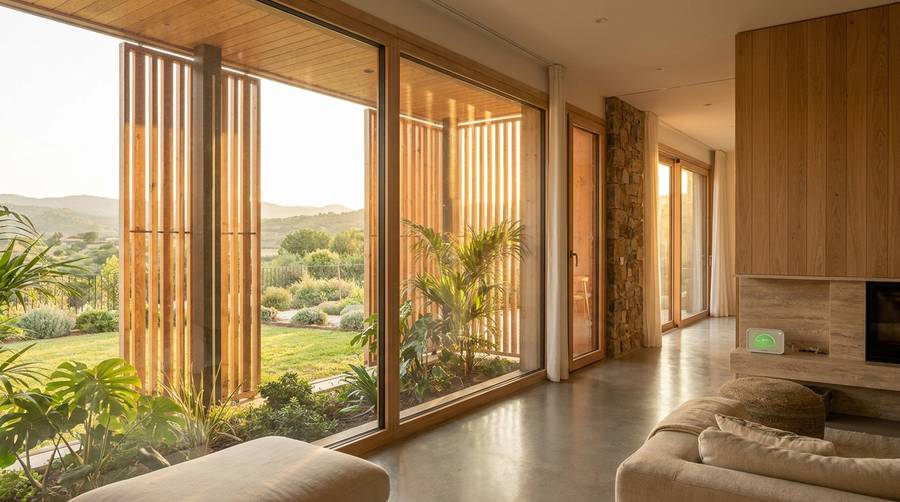
Choose finishes that look and feel like a home—wood veneers, natural stone or quality paints—while ensuring they meet low-VOC criteria. Visible materials must deliver both comfort and emotional warmth to help occupants feel at home immediately.
Materials and structural systems compatible with Passivhaus and healthy indoor air
Material selection balances performance, durability and indoor air safety. Below is a practical comparison focused on health, energy and buildability.
Comparing industrialized concrete, light timber frame and steel frame
- Industrialized concrete: excellent thermal mass, long service life, good airtightness when factory-finished. Watch for embodied carbon but pair with recycled aggregates and low-carbon mixes.
- Light timber frame (timber frame): fast factory assembly, natural hygrothermal behavior and a strong fit for low-VOC interiors. Requires careful detailing for airtightness and fire safety.
- Steel frame (steel frame): dimensional precision and longevity; combine with thermal breaks to avoid cold bridges and use appropriate insulation to control condensation.
Selecting healthy materials: low-VOC and natural options
Specify paints, sealants and adhesives certified as low-VOC. Prefer natural insulation (wood fiber, mineral wool) where possible, and avoid products with high formaldehyde emissions. Ask suppliers for emission test reports or ECO labels.
Ventilation systems: MVHR with filtration and sensible heat recovery
Choose MVHR units sized to the dwelling’s ventilation rate and fitted with at least G4/F7 filters for effective pollen and particulate removal. Ensure commissioning includes filter pressure-drop checks and balanced flows for each room.
Turnkey process for a Passivhaus industrialized home
Turnkey delivery simplifies decisions for self-builders. A well-organized industrialized approach reduces risk and compresses timelines without sacrificing quality.
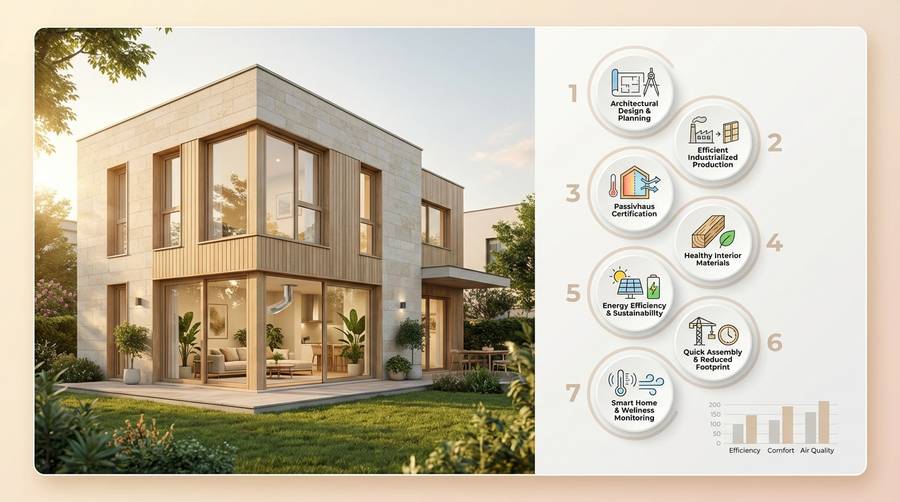
Phases: plot search, design, prefabrication, assembly and handover
- Plot & feasibility: orientation study, shadow analysis, soil conditions and local planning checks.
- Design & certification: Passivhaus planning package (PHPP), architectural plans, MEP coordination.
- Factory manufacturing: modules or panels produced in controlled conditions; finishes and airtightness components installed prior to shipping.
- On-site assembly: crane placement, connections, external finishes and utilities tie-in.
- Commissioning & handover: airtightness test, MVHR balancing, occupant briefing and delivery of maintenance guides.
Quality control and on-site testing: airtightness, thermography and IAQ
Require in-contract tests: blower door for n50 (target ≤0.6–1.0 h-1 depending on cert level), thermographic inspections to spot thermal bridges, and post-occupancy IAQ measurements (CO2, humidity, PM2.5) to validate performance.
Fixed timelines and coordination: how industrialization reduces uncertainty
Factory production brings predictable lead times. Typical on-site assembly for a single-family modular Passivhaus in Spain averages from 2–6 weeks, depending on size and complexity. The larger time items are approvals, foundations and services—manage these in parallel to keep the project on a fixed schedule.
Financing and costs: self-builder mortgages and economic viability
Financing a Passivhaus modular project requires realistic budgeting and lender engagement early. The industrialized model helps by offering fixed-price packages and clearer timelines.
Financing options tailored to modular housing and self-builders
- Standard mortgage top-ups for new-builds once foundations or guarantees are in place.
- Specific self-build mortgages released in tranches tied to milestones: plot purchase, foundations, frame set, and completion.
- Alternative financing: green mortgages that offer better rates for certified energy-efficient homes.
Realistic cost analysis: initial spend vs energy savings and resale value
While Passivhaus modular homes can carry a modest premium over low-spec traditional builds, energy savings (heating/cooling reduction of 70–90%) and increased resale value frequently offset initial outlays within 10–20 years. Factor in lower maintenance due to factory quality control as an added saving.
Incentives and grants in Spain for Passivhaus and energy efficiency
Investigate local and national grants for energy retrofits and efficient new builds. Regional programs often support heat-pump installations and envelope upgrades; combine these with low-interest green loans to improve upfront affordability.
Case study: Passivhaus industrialized home in Spain — measured outcomes
Real metrics illustrate what to expect. This anonymized case summarizes a 150 m² two-storey family home built with a timber-frame modular system in northern Spain.
Project data: delivery time, total cost and annual energy savings
- Factory production and site assembly: 9 weeks total (design to handover including foundations took 6 months).
- Total delivered cost (turnkey): €220,000 including VAT and landscaping (regional variations apply).
- Measured heating energy: 5 kWh/m²·year — a saving of ~85% vs local new-build baseline.
Indoor health results: CO2, humidity and occupant satisfaction
- Average daytime CO2 in open-plan living: 700–900 ppm with MVHR operating at nominal flows.
- Relative humidity: 45–55% year-round; no surface condensation recorded in thermographic checks.
- Occupant feedback: rated overall satisfaction 9/10 for thermal comfort and 8.5/10 for perceived air quality after 12 months.
Lessons learned and practical recommendations
- Invest in commissioning: MVHR balancing and airtightness remediation paid immediate dividends in performance.
- Choose windows with proven solar/thermal performance for your microclimate.
- Plan mechanical services early to avoid late design changes that increase costs.
How to start your own project: actionable steps and final checklist
Start with clarity: the right early decisions avoid costly revisions later. Use this checklist to move from idea to delivery.
Initial checklist for self-builders
- Confirm plot suitability: orientation, access, ground conditions, and town planning rules.
- Assemble your core team: architect experienced in Passivhaus, certified Passivhaus designer, structural engineer and a factory-based manufacturer.
- Budget realistically: include contingencies for site works and utility connections.
- Set performance targets in writing: airtightness n50 target, heating demand target (kWh/m²·year), and MVHR specification.
Questions to ask potential suppliers and quality checks
- Request blower door and MVHR commissioning reports from previous projects.
- Ask for detailed PHPP outputs and evidence of on-site test results.
- Confirm warranty terms and responsibility split for on-site trades and factory components.
Next steps: visits, contract templates and learning resources
Visit completed homes, request maintenance guides and verify what handover training the supplier offers. For indoor-health-focused design guidance, consult resources such as Vivienda industrializada saludable: 7 pasos clave for complementary steps on indoor health measures.
Ready to take the next step? Arrange a plot assessment or a factory visit with an experienced modular Passivhaus team to convert your concept into a fixed-price, health-focused home.