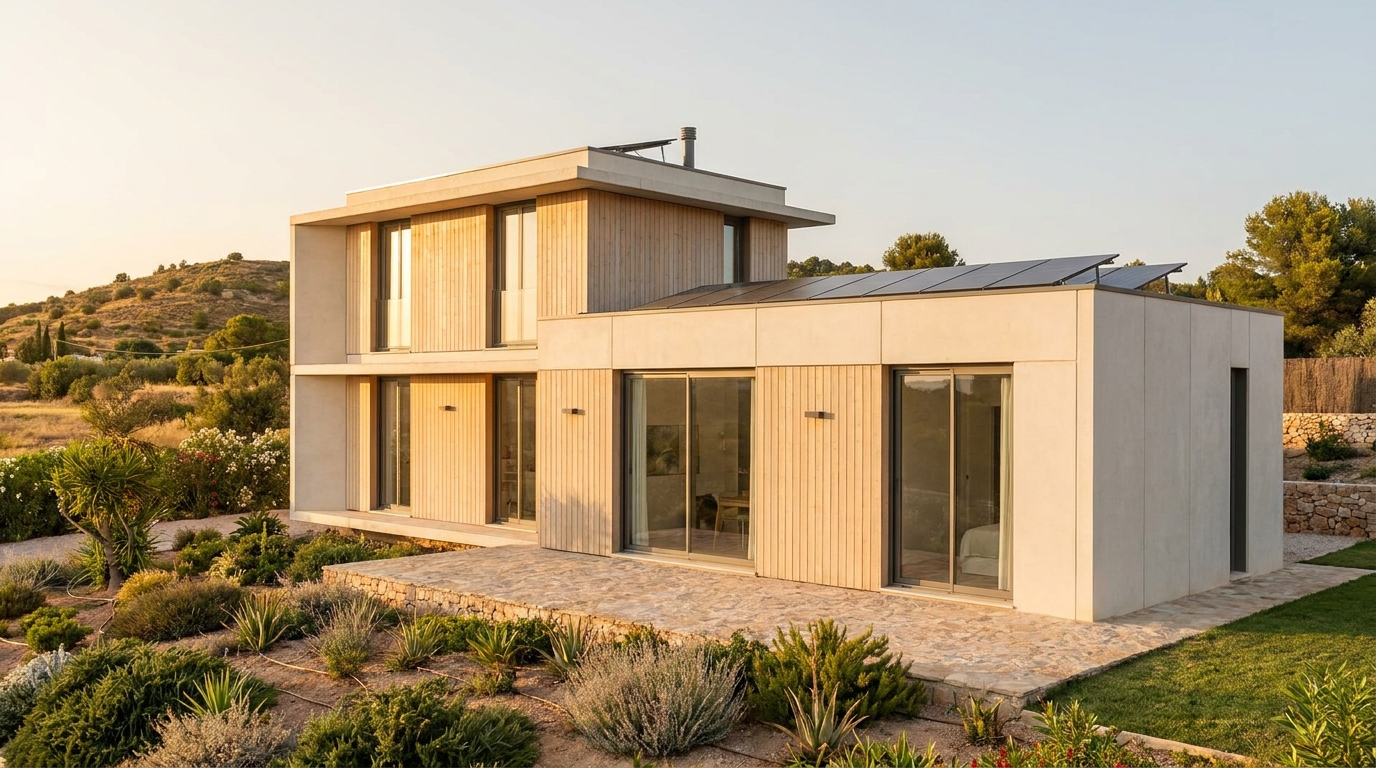
Industrialized House: Complete Guide for Spain 2026
Quick guide: what industrialized compact houses are and why they convince in 2026
When time, certainty and sustainability matter, industrialized houses are changing the way people build in Spain. This guide cuts through marketing and gives you the exact steps, trade-offs and metrics to plan a compact industrialized house that fits a realistic budget and schedule.
Definition and key features of compact industrialized housing
An industrialized house is a dwelling whose main elements — structure, envelope, façades and interior modules — are produced in a controlled factory environment and assembled on site. Key characteristics:
- Factory-controlled quality with repeatable manufacturing processes.
- Short on-site assembly compared with traditional builds.
- Clear scope and fixed-price contracts that limit cost overruns.
- Optimized design for transport and assembly — compact footprints and modular spans.
Advantages versus traditional construction: time, cost and quality control
Compared to conventional builds, an industrialized house typically delivers:
- Construction time reduced by 40–70% from groundworks to handover.
- Lower risk of budget drift because most costs are fixed at contract.
- Predictable quality due to standardized production and factory QA.
Ideal self-builder profile in Spain and realistic expectations
The best candidate for an industrialized house is a self-builder who wants control without daily site management: a person or family with a chosen plot, realistic budget, and willingness to work with a turnkey provider. Expect to be involved in key decisions (layout, finishes, certification) but not in shop-floor details.
Why choose a compact industrialized house: practical and sustainable benefits
Time efficiency: fixed schedules and reduced on-site risk
One of the strongest arguments for an industrialized house is time certainty. Typical timeline for a compact house:
- Design and permits: 3–5 months
- Factory production: 6–10 weeks
- Site foundation and assembly: 3–6 weeks
- Internal finishes and commissioning: 2–6 weeks
Compared to traditional builds, you minimize weather-related delays and subcontractor scheduling conflicts.
Cost and predictability: fixed price and control of deviations
Turnkey contracts for industrialized houses usually break down costs into site work, manufacturing, transport/assembly and finishes. This transparency helps you:
- Lock a large portion of the cost before production starts.
- Limit late-stage change orders that blow budgets.
- Estimate financing needs more accurately for bank approval.
Sustainability and energy efficiency: lowering carbon with Passivhaus criteria
Industrialized systems are well suited to high-performance envelopes. Benefits include:
- Lower embodied carbon per square meter using optimized material volumes.
- Better airtightness and insulation thanks to factory-installed continuous systems.
- Easier certification to standards such as Passivhaus, with predictable thermal bridges and measured performance.
Factories reduce waste streams and rework — a direct contribution to lower carbon intensity and higher construction predictability.
Materials and construction systems: compare to decide
Material choice shapes cost, thermal performance and build rhythm. Below are three widely used systems for industrialized, compact houses.
Industrialized concrete: durability, insulation and performance
Precast and industrialized concrete panels deliver high thermal mass, robustness to moisture and long service life. Typical strengths:
- Excellent fire resistance and acoustic performance.
- Good integration with in-factory insulation layers and finishes.
- Heavier transport and potentially higher foundation cost.
Use-case: compact family homes in coastal or humid areas where durability and low maintenance matter.
Light timber frame: speed, comfort and sustainability
Timber frame (entramado ligero) is fast, lightweight and has a favorable embodied carbon profile. Benefits:
- Rapid factory assembly with prefitted services and insulation.
- High thermal performance per thickness; comfortable indoor conditions.
- Sourcing and design must consider fire strategy and moisture management.
Use-case: suburban and rural plots where a warm, natural aesthetic is desired.
Steel frame (steel frame): structural freedom and design flexibility
Steel frame systems give large clear spans and slender profiles. Practical notes:
- Great for open-plan layouts and multi-story compact homes.
- Requires thermal breaks and careful detailing to avoid thermal bridging.
- High precision in prefabrication enables complex geometries.
Design, regulations and site preparation: step-by-step project setup
Choosing a plot and feasibility study: use, access and orientation
Before committing, evaluate:
- Zoning and permitted uses: Check municipal plans and building ratios.
- Access: Road width and turning radii for transport and crane access.
- Orientation: Maximize solar gain and daylight for passive performance.
- Topography: Flat sites simplify foundations and reduce cost.
Local rules and permits: key administrative steps in Spain
Typical permits and approvals:
- Urban planning certificate (certificado de urbanismo) to confirm land use.
- Building licence (licencia de obras) or prior communication depending on municipality.
- Connection agreements for water, electricity and wastewater.
Work with an architect familiar with prefabricated systems — they will translate factory options into compliant plans.
Functional design: optimize area, light and energy
Design priorities for compact industrialized homes:
- Plan efficient circulation to reduce wasted square meters.
- Place living spaces to the south (in Spain) to exploit sun in winter.
- Standardize module widths to reduce bespoke manufacturing costs.
- Integrate mechanical ventilation with heat recovery (MVHR) early in the layout.
The turnkey process explained: from plot to handover
Project phases: design, manufacture, transport and assembly
Typical turnkey workflow:
- Pre-design and feasibility: site surveys, geotechnical report, brief and budget.
- Design and permit: architectural drawings, structural engineering and license application.
- Factory production: manufacturing of modules, panels and systems under QA.
- Site works and foundations: groundworks and services prepared for assembly.
- Transport and assembly: modules delivered and craned into place.
- Finishes and commissioning: services connected, testing and client walkthrough.
Quality control and schedule: milestones, partial deliveries and final acceptance
Insist on a clear timeline with milestones and acceptance criteria for each stage:
- Factory inspection points (QA records).
- On-site milestones: foundation completion, module erection, envelope closed.
- Handover tests: airtightness (blower door), thermal commissioning, electrical inspection.
Guarantees, certifications and after-sales service
A robust package should include:
- Construction warranty and manufacturer guarantees on components.
- Performance documentation (thermal calculations, airtightness results).
- Clear after-sales procedures and response times for defect rectification.
Financing and economic models for self-builders
Financing options: self-build mortgages and modular loans
Spanish banks offer specialized loans for self-builders and, increasingly, for industrialized houses. Typical structures:
- Stage-pay self-build mortgage: funds released by milestones (foundations, structure, finishes).
- Turnkey mortgage: a single loan to cover land purchase and turnkey contract, released at final deed.
- Modular financing: loans tied to manufacturer invoices for secured disbursements.
Documentation and bank requirements for industrialized housing
Prepare these documents to speed approval:
- Land deed and planning certificate.
- Turnkey contract with production schedule and guarantees.
- Cost breakdown and insurance policies for the works.
Cost optimization strategies: payment phases, grants and energy savings
Strategies to reduce net cost:
- Negotiate phased payments tied to verifiable milestones.
- Check regional and national energy grants for efficient homes (varies by Comunidad Autónoma).
- Design to Passivhaus or near-Passivhaus levels to reduce lifecycle energy costs.
Case studies and technical comparisons: real data to help decide
Case study 1: compact urban plot — times, cost and client satisfaction
Project snapshot (typical):
- Plot: 250 m² urban infill, single-family compact house 120 m².
- System: light timber frame, MVHR, high-performance glazing.
- Timeline: permits 4 months; factory 8 weeks; assembly and finishes 6 weeks — total 7 months to handover.
- Cost: fixed turnkey price approximately €1,500–€1,800/m² depending on finishes.
- Outcome: measured airtightness 0.45 ACH @50 Pa; client satisfaction high due to speed and transparency.
Case study 2: Passivhaus modular home — energy savings and metrics
Project snapshot (typical):
- Area: 150 m² family home built with panelized timber + thick external insulation.
- Performance: heating demand <15 kWh/m²·year; primary energy <60 kWh/m²·year.
- Costs: premium of 8–12% over a standard industrialized solution but payback via energy savings and grants.
Technical comparison versus traditional builds and lessons learned
Key differences:
- Time: industrialized builds finish in months, not years.
- Cost certainty: fewer surprises when brief and contract are fixed.
- Performance: factory processes help achieve consistent airtightness and insulation results.
Lesson: invest early in clear specifications. The more you define before production, the fewer costly changes later.
Inspirational close: take the next step toward your industrialized house
Checklist to start: priority decisions before contracting
- Confirm your plot and obtain an urban planning certificate.
- Decide on the primary construction system (concrete, timber, steel).
- Set a realistic budget margin for land, works and finishes.
- Ask for references and measurable performance data from manufacturers.
Questions to ask your manufacturer or integrated platform
- What are guaranteed lead times and penalties for delays?
- Can you provide airtightness and thermal test results from completed projects?
- How are change orders priced after contract signature?
- What warranty periods exist for structure, envelope and services?
Resources and next steps: tools, visits and contacts
Good next steps:
- Request a full turnkey quote with milestone payments and QA records.
- Visit at least one completed industrialized house to assess finishes and performance.
- Talk to your bank early to clarify financing requirements for modular or self-build loans.
Ready to move forward? Start by compiling your site documents and preparing a short brief with your priorities — size, budget, performance target. That brief lets providers give precise, comparable offers and helps you pick the right system for a comfortable, energy-efficient home.