


Industrialized Housing in Spain 2026: Market & Roadmap
Why industrialized housing will set Spain's market pace in 2026
Imagine closing a construction schedule in months, not years, while locking cost and quality — that shift is already under way in Spain's suburbs and peri-urban plots. Developers, local authorities and self-builders are moving from experiments to scalable pilot projects that prove industrialized housing is not a niche but a structural change.
Market evidence: growth, demand and recent pilot projects
Since 2022, national and regional pilot programmes, small-volume developers and a growing cohort of autopromoters have commissioned industrialized units to speed delivery. Independent trackers report a year-on-year growth in modular starts of 18–30% in selected provinces where permitting has been streamlined.
Concrete indicators:
- Shorter permit-to-delivery cycles in pilot zones (average reduction: 25–40%).
- Higher acceptance among buyers for factory-built homes when shown finished, context-rich examples.
- Emerging mortgage products for self-build modular projects (limited but expanding).
Projects closing construction in 6–9 months with fixed-price contracts are shifting buyer expectations — speed and predictability are the new value drivers.
Comparative advantages vs traditional construction (time, cost, quality)
Industrialized housing concentrates value in three measurable axes:
- Time certainty: Off-site production reduces weather and subcontractor variability.
- Price transparency: Factory processes let builders offer fixed-price turnkey packages.
- Quality control: Repeated processes deliver repeatable quality with factory QA and certification paths.
Real pilots show typical on-site assembly of a single-family 120–160 m² house in 2–4 weeks after foundation completion, versus months for traditional jobs. Total timeline from project start to handover often falls in the 6–10 month window.
Barriers and levers for mass adoption
Key barriers remain:
- Regulatory fragmentation by municipality.
- Perception gaps associating prefabrication with low quality.
- Limited standardized mortgage products for autopromotion projects.
Levers to scale adoption:
- Clearer permitting templates and local pilot directives.
- Certified product databases proving lifecycle performance.
- Banking products tailored to phased financing for modular self-builds.
Technologies and materials reshaping industrialized homes
Material choice is no longer binary. The modern industrialized approach mixes systems to match design, budget and sustainability targets.
Industrialized concrete: performance, durability and typical uses
Precast and industrialized concrete elements bring structural robustness and thermal mass. Best uses include basements, load-bearing cores and ventilated façades. Benefits observed in pilot projects:
- High long-term durability and low maintenance.
- Excellent acoustic and fire performance, useful in multi-family schemes.
- Can be combined with thermal insulation layers to meet high-efficiency envelopes.
Light wood framing and steel frame: speed, sustainability and cost
Light timber frame (entramaado ligero) and steel frame deliver the fastest assembly. Comparative points:
- Timelines: Panels or frames arrive ready; on-site assembly is rapid.
- Carbon profile: Wood offers embedded carbon benefits when sourced sustainably.
- Cost: Competitive with traditional masonry when supply chains are optimized; steel can be marginally more expensive but enables larger spans and slimmer profiles.
Finish innovations and integrated comfort systems
Integrated solutions that reduce on-site trades accelerate delivery and improve predictability:
- Factory-installed MVHR (mechanical ventilation with heat recovery) units tuned for airtight envelopes.
- Pre-installed finishes and wet areas (bathrooms/kitchens) delivered as plug-and-play modules.
- Smart home readiness and factory-installed renewable energy interfaces.
Sustainability and energy efficiency: toward Passivhaus and minimal carbon
Industrialized processes help meet stringent energy targets by controlling envelope performance and material choices from day one.
Design strategies and thermal envelope for Passivhaus compliance
Achieving Passivhaus-level performance requires an airtight, highly insulated envelope, optimized solar gains and controlled ventilation. Industrialized construction excels at:
- Factory-tight junctions and continuous insulation layers.
- Precision installation of thermal breaks and window interfaces.
- Reduced site errors that commonly cause heat loss in traditional builds.
Projects aiming for Passivhaus in Spain typically pair high-performance glazing (Uw ≤ 0.9 W/m²K), continuous insulation (U-values matching or exceeding standards) and MVHR units sized per certified criteria.
Materials and techniques that cut lifecycle carbon
Key levers to reduce lifecycle emissions:
- Use of responsibly sourced timber in non-structural and structural elements.
- Low-carbon concrete mixes and optimized precast element design to reduce cement content.
- Design for disassembly to reuse elements and reduce future embodied carbon.
Pilot metrics: consumption, savings and ROI
Measured results from representative pilots show:
- Primary energy demand reductions of 60–80% vs conventional Spanish baseline when combining high-performance envelope and renewables.
- Operational cost savings that often repay the incremental envelope cost inside 8–12 years, depending on energy prices.
- Lower maintenance forecasts due to controlled factory finishes.
Turnkey processes: evolving from plot to handover
The most successful models integrate parcel selection, design, production and assembly under one operational rhythm. This reduces friction and shifts client risk from coordination to a single accountable provider.
Efficient operational models: coordinating land, design, production and assembly
Operational best-practices for turnkey delivery include:
- Early feasibility checks integrating plot constraints into module design.
- Digital design-to-factory pipelines (BIM or equivalent) to avoid rework.
- Dedicated site teams for foundations and sealing the building envelope prior to module arrival.
These steps compress the critical path and protect clients from common delays.
Real project schedules: closed timelines and risk control
Representative timeline from recent pilots:
- Feasibility and permit alignment: 6–12 weeks (municipality dependent).
- Design and factory detailing: 8–14 weeks.
- Site preparation and foundations: 4–8 weeks.
- Assembly and commissioning: 2–6 weeks.
- Total typical delivery: 5–9 months.
Risk control mechanisms used by providers: fixed-price turn-key contracts, milestone-based payments and third-party QA audits at factory and site.
Quality, warranty and client satisfaction on turnkey delivery
Satisfaction correlates strongly with three deliverables:
- Predictable timetable and transparent cost breakdowns.
- On-delivery quality checks and clear post-handover warranty terms.
- Customer engagement during finish selection and commissioning stages.
Financing and solutions for autopromoters in modular housing
Access to finance remains pivotal. The market is evolving, with specific products targeting self-build modular projects in 2026.
Mortgage options and products for autopromotion
Available structures include:
- Phased construction loans that release funds against factory milestones.
- Specialist lenders offering mortgages post-assembly for turnkey homes with certified energy ratings.
- Refinancing options for autopromoters who wish to switch from a short-term construction loan to a long-term mortgage after handover.
Early engagement with lenders familiar with modular systems speeds approvals and can lower perceived risk premiums.
Cost structures and financial examples
Example illustrative structure for a 150 m² turnkey home (figures indicative, vary by region):
- Land acquisition: 25–35% of total project cost.
- Turnkey industrialized build: 45–55% (including factory work, transport and installation).
- Soft costs and contingencies (permits, connections, taxes): 10–20%.
Because factories reduce on-site uncertainty, contingency lines can be smaller than traditional projects, improving capital efficiency.
How to prepare a scalable financial dossier
Practical recommendations:
- Prepare a phased budget linked to factory milestones and include a clear timeline.
- Secure pre-approval for construction and mortgage bridging early.
- Document energy targets and certifications (Passivhaus or equivalent) as they can lower operating-cost assumptions in lender models.
Case studies: pilot projects with metrics and replicable lessons
Real metrics matter more than marketing claims. Below are anonymized, representative pilots showing what works.
Project A: schedule, final cost and client satisfaction
Profile: single-family, 140 m², light timber frame, turnkey.
- Timeline: 7 months from contract to handover.
- Final cost variance vs budget: +2.5% (largely due to optional finish upgrades).
- Client satisfaction (post-handover survey): 92% satisfied with timeline and quality.
Lesson: tight early decision-making on finishes reduces cost creep during final stages.
Project B: energy performance and emissions reduction
Profile: semi-detached pair, mixed concrete core and timber envelope, targeting near-Passivhaus.
- Measured primary energy reduction vs local baseline: 72%.
- Estimated lifecycle embodied carbon reduction by design choices: ~18% vs typical masonry.
- Payback on envelope investment: projected 9 years at current energy prices.
Lesson: combining material mixes and a factory-controlled envelope unlocks both operational and embodied savings.
Key lessons for replication across Spanish territories
- Standardize module interfaces to reduce adaptation time for different plots.
- Secure local permitting guidance early; municipal alignment is the fastest way to reduce delays.
- Integrate financing and insurance language into turnkey contracts to reassure lenders.
Five-year outlook: opportunities, risks and a practical roadmap for autopromoters
Adoption scenarios over the next five years depend on three levers: regulation, finance and demonstrable performance. Reasonable baseline: industrialized market share grows steadily in peri-urban single-family and social housing segments.
Adoption scenarios and impacts on price and availability
Scenarios:
- Conservative: 10–15% market share in targeted segments — modest supply relief, stable prices.
- Accelerated: 20–30% market share where enabling policy and finance align — greater availability and more competitive pricing due to scale.
Regulatory risks and mitigation strategies
Mitigate risk by:
- Designing for local code flexibility and future-proofing energy performance.
- Engaging early with municipalities for pilot permits and clear inspections plans.
- Maintaining transferable documentation for warranties and certifications.
Practical steps for autopromoters to seize the transition
Actionable roadmap:
- Start with a feasibility study that ties plot constraints to a modular typology.
- Choose a proven material mix aligned to your energy and budget targets.
- Map financing early and present lenders with a milestone-tied plan and energy certification targets.
- Visit finished projects and insist on measured pilot metrics before committing.
For further practical design steps see Cómo diseñar una vivienda industrializada: guía 2026 and for decision drivers read Viviendas industrializadas: 6 razones para autopromotores 2026.
Industrialized housing is not just a faster way to build — it is a system-level shift that aligns predictability, sustainability and cost control for the new generation of self-builders.
Next step: If you are planning a self-build in Spain, begin with a feasibility package that ties plot rules to a modular solution and a lender-ready financial plan. That single step reduces risk and unlocks faster, greener delivery.
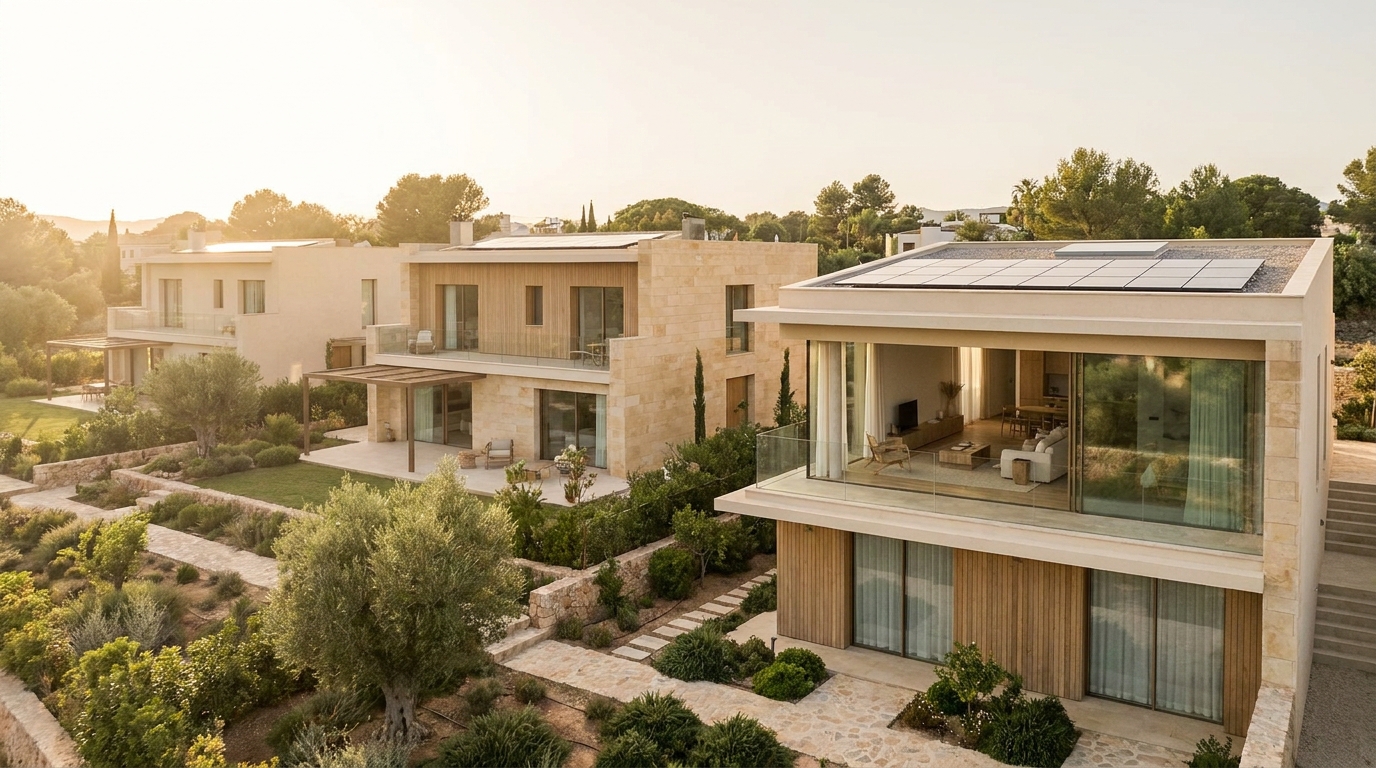
Image prompt for Findnido's visual team and AI generation: High-quality architectural photograph of a finished Mediterranean contemporary home in Spain at golden hour. The house should read premium and real — light façades with natural materials (wood, stone, gentle exposed concrete), large windows and an inviting terrace with Mediterranean plants. Show a small family or couple enjoying the exterior in a subtle, lifestyle-driven pose. The setting must be residential, warm and sustainable-looking; avoid any exposed construction, modular-looking joints, container aesthetics or industrial backdrops. Lighting and composition should match architectural magazine quality with natural colors, conveying trust, comfort and achievable modern living under the Findnido brand identity.
Artículos relacionados
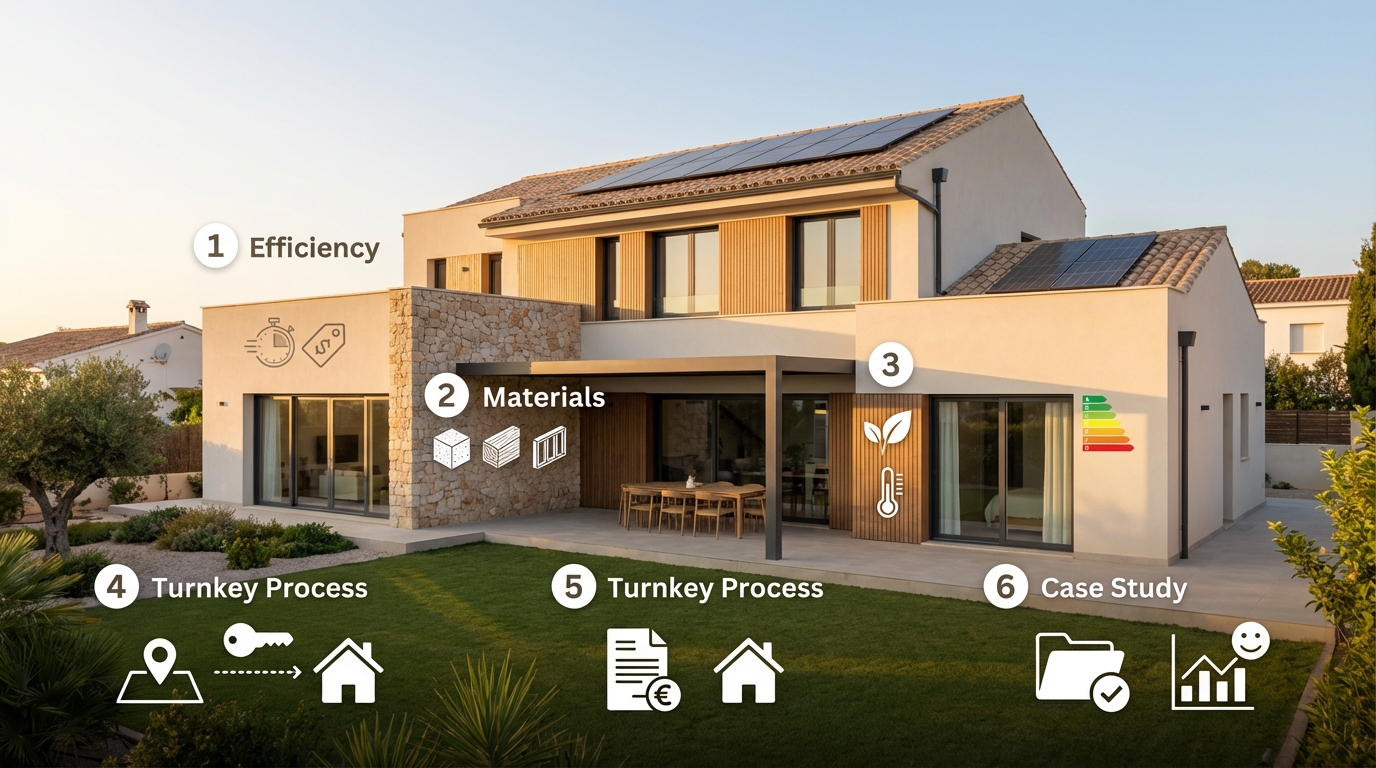
6 Reasons to Choose Industrialized Housing in Spain 2026
A concise, data-driven guide for self-builders in Spain explaining why industrialized housing delivers predictable timelines, fixed budgets, modern materials and measurable energy savings — plus a practical checklist to start a pilot project.