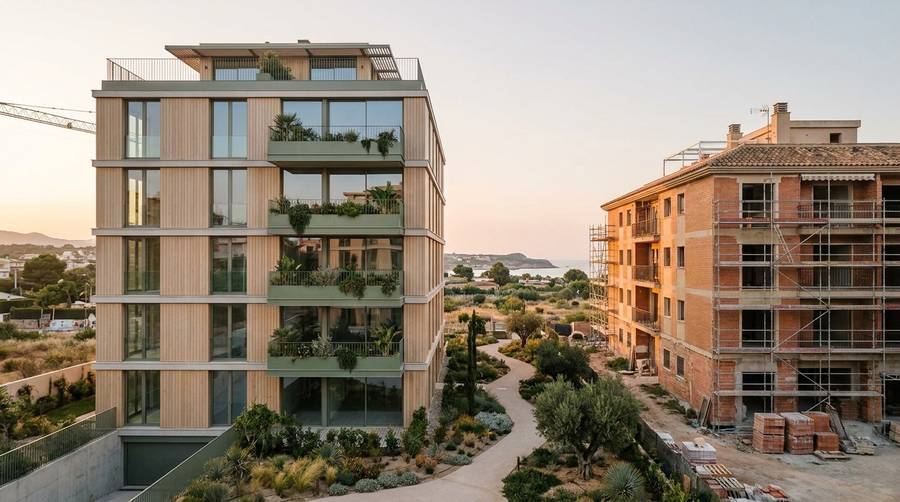
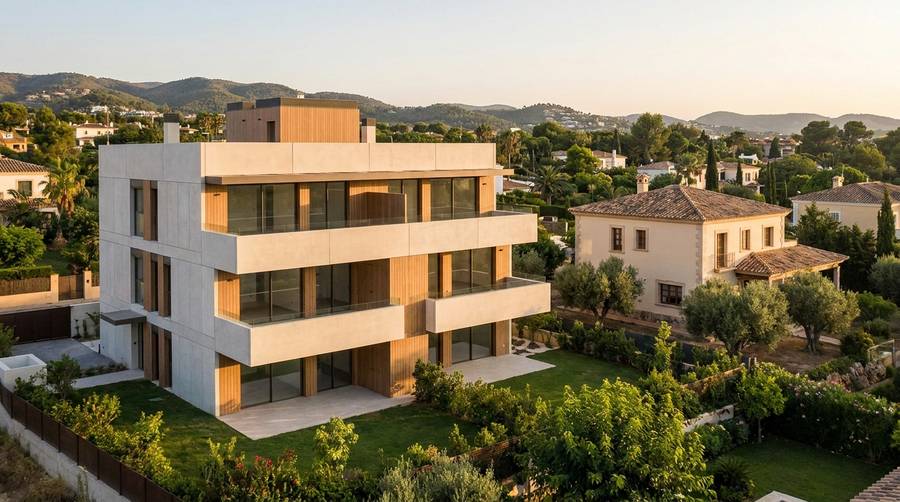
Modular Housing Success: A High-Rise Case Study
Start: the challenge and the vision behind the modular mid-rise project
When the developer first walked the compact urban parcel, they imagined a quick, sustainable, and cost-predictable building—but the reality of regulations, neighbors and a tight budget threatened to derail the plan. That tension became the engine for choosing an industrialized approach: deliver a high-quality building faster, with a fixed price and measurable environmental targets.
Context of the plot and promoter needs
The site was a 600 m² inner-city infill lot in a secondary Spanish city, zoned for residential use with limits on height and footprint. The autopromoter needed a mid-rise solution (3–4 floors) to maximize yield while keeping a human scale.
- Constraints: strict façade rules, limited on-site storage, narrow access for deliveries.
- Requirements: 8–10 dwellings, communal outdoor space, compact parking solution, and Passivhaus-grade envelope.
Objectives: deadlines, budget and sustainability criteria
The promoter set three non-negotiable targets:
- Complete delivery within 10 months from permitted project stage.
- Capex within a fixed price envelope agreed up front.
- Energy target equivalent or better than national near-zero standards (approaching Passivhaus performance).
These objectives favored a factory-driven, repeatable construction process over a bespoke on-site build.
Why industrialization: choosing modular mid-rise
Modular housing offered three decisive advantages for this project: predictable timelines from parallel factory and site work; reduced exposure to weather and labour shortages; and improved quality control through repeated production. The decision was pragmatic: industrialization aligned with the promoter’s need for speed and financial certainty without sacrificing design quality.
Design and material choices: combining industrialized concrete, steel frame and timber
Design aimed to be both robust and warm: concrete elements for structural continuity, steel frames where speed and slenderness mattered, and timber finishes to deliver comfort and a Mediterranean aesthetic.
Technical and aesthetic criteria applied
Design priorities were clear: long-term durability, airtightness for energy performance, and facades that fit local character. The team selected a hybrid approach to meet these criteria efficiently.
- Structural logic: precast reinforced concrete cores and slabs to anchor the building and provide acoustic mass.
- Modular superstructure: steel frames for repeatable volumetric modules—lightweight and precise for factory fabrication.
- Warm finishes: timber-lined terraces and locally-sourced stone details to blend with Mediterranean surroundings.
Selection of systems: envelopes, finishes and energy performance
The envelope combined high-performance insulated timber or steel-panel façades with thermal bridges minimised by factory installation. Triple-glazed windows with thermally broken frames were standard; mechanical ventilation with heat recovery (MVHR) ensured fresh air and low heating demand.
Crucially, factory installation of insulation and airtight layers reduced on-site variability and improved the odds of meeting Passivhaus-like metrics.
How design reduced time and cost without cutting quality
Design decisions targeted repeatability: module dimensions aligned with factory jigs, MEP risers were standardised across units, and finishes were specified in packages to avoid late changes. This approach lowered on-site assembly time and procurement complexity, delivering cost predictability.
The turnkey process step by step: from parcel study to handed-over keys
Turning a plan into delivered homes requires orchestration. The turnkey model used here bundled permitting, manufacturing, logistics and on-site assembly into a single delivery contract.
Administrative and project phases: realistic timelines and integrated management
Key administrative steps were front-loaded to protect the schedule:
- Pre-application with municipal planners to confirm façade approaches and public setback conditions.
- Concurrent production of construction documents and factory tooling drawings—reducing design-to-manufacture lead times.
- Procurement windows fixed early, with milestone payments tied to design freeze and factory start.
This parallelism shaved months off a traditional sequential workflow.
Factory fabrication + on-site assembly: closed timelines and logistics
Factory fabrication began while groundworks proceeded on-site. Modules were delivered in planned batches to a narrow urban site with staged crane lifts over a six-week assembly window.
- Typical rhythm: 12 weeks factory + 6 weeks assembly + 8 weeks fit-out and commissioning.
- Logistics: night-time deliveries for oversized loads; neighbour liaison to minimise disruption.
The controlled factory environment reduced delays associated with weather or ad-hoc subcontractor availability.
Finishing, quality control and occupancy paperwork
After assembly, the team executed a rigorous commissioning plan: airtightness testing, MVHR balancing, acoustic checks and façade inspections. Documentation for occupancy (cedula de habitabilidad / final permit as applicable) was compiled during commissioning to avoid administrative hold-ups.
Final tests showed airtightness and energy performance within 5% of factory simulation figures—proof that industrialized execution can match design intent.
Measurable outcomes: time, cost and client satisfaction
Hard numbers matter. This section summarises the metrics that proved the model’s value for the autopromoter.
Key metrics: reduced construction time, budget variance and cost per m²
- Delivery time: 26 weeks from factory start to ready-for-occupation—approximately 40% faster than a comparable traditional build.
- Budget adherence: final cost variance was +2% vs the fixed price—well within financial expectations and far lower than typical tender overruns.
- Average cost: the project averaged €1,650/m² net saleable area, competitive for quality mid-rise urban housing in Spain during the project year.
Energy efficiency and carbon footprint: before and after
Measured energy consumption showed a 45% reduction compared with a baseline Spanish code-compliant building of similar size. Operational CO2 emissions fell accordingly. Factoring embodied carbon optimisation via wood finishes and optimized precast volume, lifecycle emissions improved meaningfully.
Client testimonial and satisfaction level
The autopromoter highlighted three benefits in their survey:
- Predictability: “We never had to renegotiate cost targets during construction.”
- Quality: “Factory fixtures felt more consistent than many site-supplied finishes we’d seen.”
- Time to market: “Units were available to sell/occupy months earlier than expected.”
Overall satisfaction scored 9/10 in a post-delivery survey focused on delivery, quality and communication.
Technical and economic comparison with traditional construction
To choose wisely, autopromoters need a clear comparison. Below are the essential trade-offs between modular and traditional builds.
Advantages analysis: timelines, fixed price and lower unforeseen risk
- Faster delivery: Parallel workflows shorten schedules consistently.
- Price certainty: Factory procurement and fixed manufacturing runs reduce scope changes and market-driven price swings.
- Risk reduction: Weather and labour market exposure is lower—fewer surprise delays.
Materials and durability comparison (industrialized concrete vs traditional on-site)
Precast concrete elements delivered consistent tolerances and superior quality control versus site-cast alternatives. When combined with robust steel-frame modules, the hybrid approach offered:
- Improved fire resistance and acoustic separation from concrete cores.
- Faster erection from steel modules with factory-fitted services.
- Timber finishes to meet occupant comfort expectations without compromising durability.
Long-term durability matched or exceeded traditional builds when designed with proper detailing and maintenance plans.
Financial aspects: self-builder mortgages and financing routes
Financing a modular autopromotion requires early engagement with lenders. Key practical points:
- Many banks treat turnkey modular projects similarly to traditional self-build loans if the contract clearly defines milestones and payment schedules.
- Use staged disbursements tied to factory milestones and on-site assembly to reduce interest burden and lender risk perception.
- Document guaranteed delivery timelines and fixed-price clauses to strengthen the financing case.
Discuss financing options early; lenders respond positively to demonstrated factory-track records and robust turnkey contracts.
Inspirational close: lessons learned and next steps for autopromoters
This project proves modular mid-rise housing is a practical path for autopromoters seeking speed, quality and sustainability.
Practical recommendations for choosing a modular mid-rise project
- Prioritise partners with proven factory quality data and references.
- Fix design packages early to avoid costly late changes—use finish families rather than bespoke one-offs.
- Insist on airtightness and commissioning protocols written into the contract.
How to prepare the parcel and documentation to accelerate the process
Prepare documentation in advance to avoid permitting delays:
- Early consultations with planners to validate façades and massing.
- Preliminary geotechnical and topographic surveys funded before factory work begins.
- Neighbourhood engagement plans to reduce objections and maintain goodwill during deliveries.
Future vision: scaling projects and contributing to sustainable cities
Scaling modular mid-rise can increase housing supply while lowering embodied and operational carbon. When repeated at city scale, standardised modules and factory optimisation contribute to cost reductions and faster urban renewal.
For more technical comparison of prefabricated vs traditional approaches, see Vivienda modular: comparar casa prefabricada y tradicional, which explores these trade-offs in depth.
If you are considering an autopromotion, start with a clear brief and partner selection criteria: timeline guarantees, energy targets and turnkey accountability. A well-executed modular project can deliver faster, greener and with less financial uncertainty than most traditional routes—giving you keys in hand sooner and with confidence.
Interested in a tailored feasibility review for your parcel? Reach out to review your options and timelines; we can help translate your vision into a concrete plan that respects budget, schedule and sustainability goals.
Artículos relacionados