Prefabricated House Success: A Spanish Turnkey Case
How it all began: deciding on a prefabricated house
The moment they stopped renovating and started building was one sentence: they wanted a home delivered on time, within budget and with clear energy goals. That decision set a very different path from traditional construction.
The family—two professionals with two children—faced three clear constraints: limited time, a fixed budget, and a strong desire for low energy bills and low carbon impact. Those priorities made a prefabricated house an attractive option.
Family motivations: time, budget and sustainability
They needed reliable delivery because their rental contract ended. They wanted cost predictability to avoid financial strain. And they wanted a modern, low-consumption home aligned with Passivhaus principles. The combination pushed them to explore industrialized housing.
Initial comparison: prefabricated vs. traditional for this project
- Time to delivery: prefabricated: predictable factory schedule + short on-site assembly; traditional: unpredictable weather/crew delays.
- Cost control: prefabricated: fixed-price packages and fewer surprises; traditional: higher exposure to overruns.
- Quality & energy: prefabricated: controlled factory conditions for airtightness and insulation; traditional: variable workmanship.
Parcel search and key criteria (location, regulations, access)
They selected a 600 m² plot in a suburban area within commuting distance of the city. Selection criteria included:
- Planning and urban regulations that allowed the desired footprint and height.
- Easy access for crane and delivery trucks—critical for modular sections.
- Orientation for solar gain and cross-ventilation.
Early checks with the local planning office avoided costly redesigns later.
Technical choices and materials: opting for modern solutions
The project's technical decisions were driven by energy targets, budget limits, and a preference for natural finishes. The team prioritized systems that deliver measurable performance.
Selected construction system and why
They chose an industrialized concrete plinth with a light timber frame upper structure. Reasons:
- Concrete plinth: robust thermal mass and moisture resistance at ground level.
- Timber frame (light frame): speed of assembly, excellent thermal performance and a lower embodied carbon than steel for the same build.
- Factory production minimized on-site variability and accelerated the schedule.
Insulation, energy efficiency and Passivhaus approach
The standard included triple-glazed windows, continuous external insulation and a mechanical ventilation with heat recovery (MVHR) system. The design targeted a near-Passivhaus performance:
- Airtightness detail at factory joints and rigorous testing reduced infiltration losses.
- Thermal bridges were addressed at slab, window reveals and roof junctions.
- Simple renewable installations—solar thermal for DHW and a PV array—reduced operational consumption.
Finish choices: façades, joinery and sustainable materials
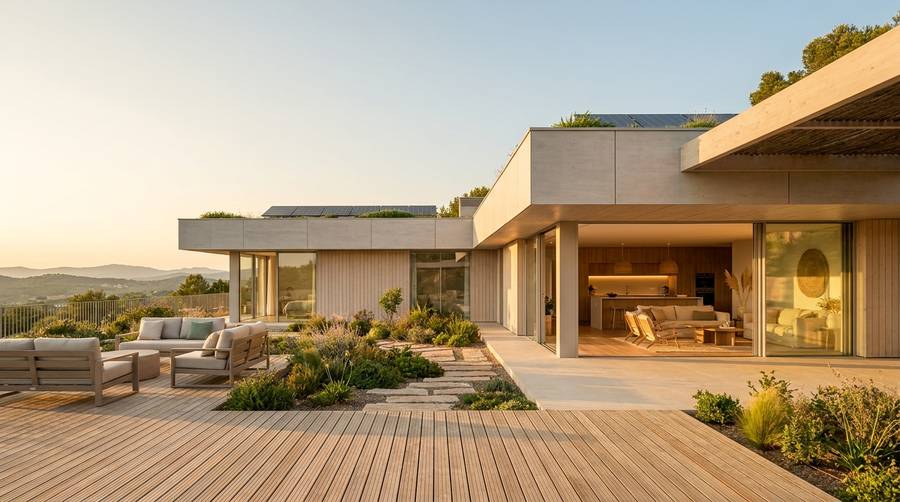
Finishes were chosen to feel Mediterranean and timeless: lime-based renders over insulation, timber cladding for the sun-facing façade, and warm natural interior floors. These choices deliver low maintenance, good durability and resale appeal.
The turnkey process: steps, timing and coordination
The turnkey (llave en mano) model streamlined responsibilities: one contract, one delivery target. This reduced friction for the family and centralized accountability.
Project phases from contract to handover: realistic timeline
The contracted timeline included:
- Design & permits: 3–4 months
- Factory production: 8–12 weeks
- Site preparation & foundations: 4–6 weeks (parallel to factory work)
- Assembly on site and finishes: 3–5 weeks
- Testing, commissioning & handover: 1–2 weeks
Total delivered in 6.5 months from contract signature to keys in hand. That metric was a major selling point for the family.
Coordination between parcel, factory and on-site assembly
Key coordination practices that prevented delays:
- Weekly progress calls tying factory production status to site readiness.
- Logistics windows booked for module transport and crane operations.
- Pre-delivery checks and a photographic acceptance protocol from factory to site.
Permits, paperwork and quality control
Having an experienced turnkey provider handle permits reduced the family's administrative burden. Quality control was enforced through factory QA checklists, airtightness tests and a documented snagging list at handover.
Handover is not the end of work—it's the moment when measured performance must match expectations. Factory checks plus on-site commissioning ensured that the promised energy results were achievable.
Financing and actual costs: how the house was paid for
The family financed the project through a combination of savings and a tailored mortgage for self-builders. Understanding the structure of costs was crucial to avoid surprises.
Cost breakdown and contingencies
Example breakdown (percentages relative to final cost):
- Land acquisition: 25%
- Turnkey construction (factory + on-site assembly): 50%
- Permits, design & inspections: 7%
- Landscape and external works: 6%
- Contingency and minor upgrades: 12%
The final outturn remained within 5% of the initial fixed price thanks to the turnkey contract and early decisions on finishes.
Financing options and mortgages for self-builders in Spain
Relevant financing instruments included:
- Self-build mortgages released in staged payments linked to milestones.
- Green mortgages with preferential conditions for energy-efficient homes.
- Traditional mortgages after completion, used by some to refinance during handover.
Choosing a lender with experience in modular and turnkey projects reduced unexpected paperwork and valuation issues.
Return on investment: time and cost savings versus traditional builds
Measured savings for this case:
- Time saved: roughly 40–60% faster than a comparable traditional build in the same area.
- Cost predictability: fixed-price contract reduced the typical 10–20% overrun seen in traditional projects.
- Operational savings: projected annual energy bills cut by ~60% compared to a standard new-build.
Measurable results: real metrics from the case study
Quantified outcomes make this story useful for future autopromoters. The family could verify performance against initial targets.
Execution times vs initial forecast (days/months)
- Planned end-to-end: 7 months. Actual: 6.5 months.
- Factory production target: 10 weeks. Actual: 9 weeks.
- On-site assembly planned: 5 weeks. Actual: 4 weeks.
Economic savings and comparison with conventional construction
Compared to a local conventional project of similar size, the family recorded:
- Estimated 8–12% lower final cost when factoring in avoided delays and fewer change orders.
- Lower financing costs because the shorter construction period reduced interest paid during build phase.
Client satisfaction: comfort, energy use and final evaluation
Six months after moving in, monitored data showed:
- Average indoor comfort rated by the family: 9/10.
- Average consumption for heating and hot water: 40–60% lower than similar-sized traditional homes in the region.
- Satisfaction with acoustic comfort and daylighting rated high thanks to layout and large windows.
The family highlighted predictability and quality control as the main reasons they'd choose the same path again.
Lessons learned and advice for future self-builders
The case is instructive because it combines measurable outcomes with practical recommendations for others.
Mistakes to avoid and best practices during contracting
- Avoid vague scope documents: define inclusions and exclusions clearly at contract signing.
- Schedule logistics early: secure crane and transport slots well before factory completion.
- Insist on factory QA evidence: photos, checklists and pre-delivery testing reduce on-site fixes.
Recommendations for choosing materials, suppliers and finance
- Prioritize airtightness and continuous insulation over cosmetic savings.
- Choose suppliers with turnkey coordination experience for smoother handovers.
- Discuss staged mortgage releases with lenders experienced in modular housing.
How to ensure sustainability and long-term value
Simple, high-impact choices:
- Orientation and window strategy for passive solar gains.
- Durable external materials that reduce maintenance cost.
- Early integration of renewables sized to realistic consumption estimates.
Inspiring finish: life after delivery
Moving in did more than close a project: it changed daily routines. The family reported calmer mornings, lower utility stress and more time for weekend activities thanks to predictable bills and reliable comfort.
Impact on quality of life and daily routines
A quieter home, stable indoor temperatures and fast commissioning meant fewer post-handover headaches. The children adapted quickly to the layout and outdoor spaces became usable earlier than in a traditional build.
Outlook: maintenance, efficiency and revaluation
Ongoing maintenance is simple: well-specified materials and accessible systems keep lifecycle costs low. The energy performance and modern aesthetic contribute to strong resale value in the local market.
Invitation to consider industrialization as a modern, viable option
If you are weighing options for your self-build, consider that industrialized housing offers measurable advantages in time, cost predictability and energy performance. For a broader view of timelines and practical guidance, see Vivienda industrializada: futuro y guía práctica 2026 for timelines and expectations.
Ready to plan with predictable outcomes? Start by listing your non-negotiables: delivery date, maximum budget and energy target. Those three items shape the most successful turnkey projects.
Artículos relacionados