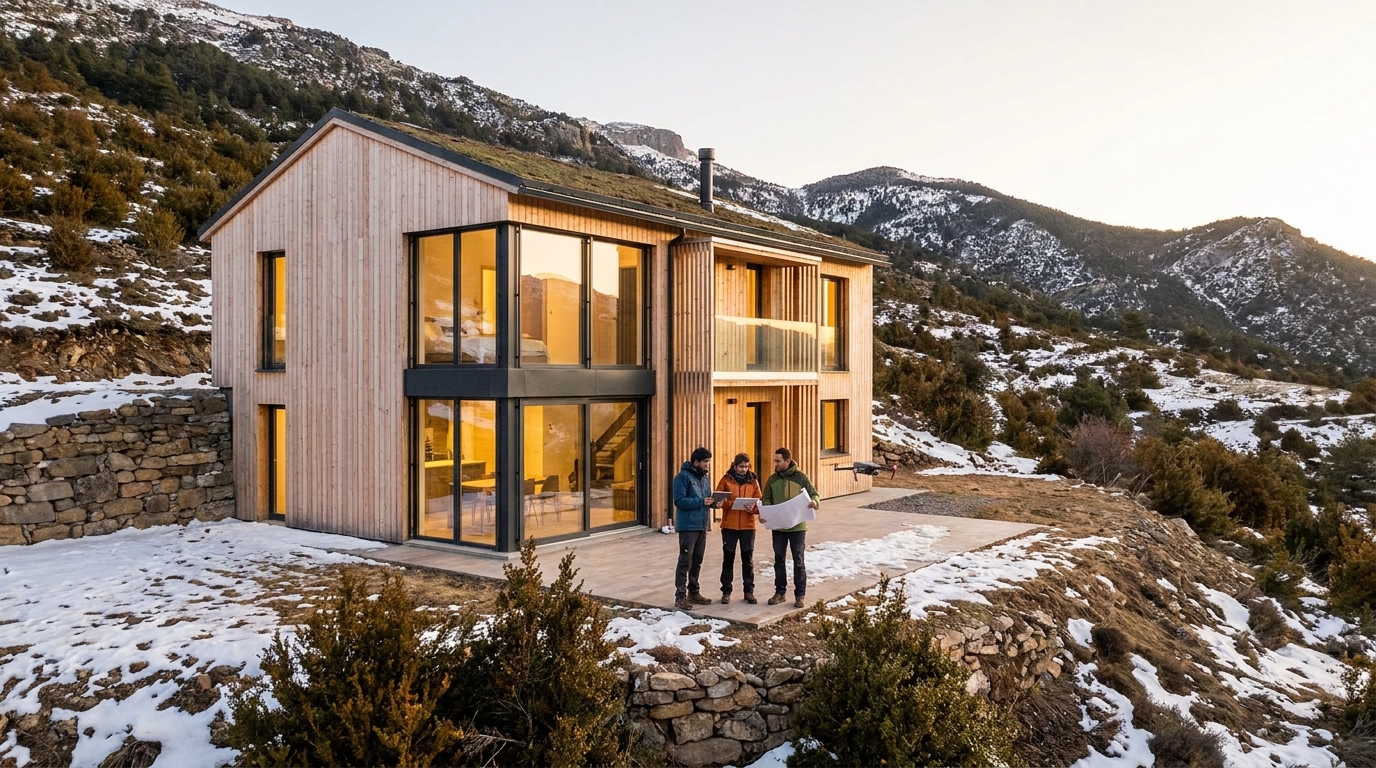
Passivhaus Prefabricated House: A Real Spanish Success
From inhospitable plot to Passivhaus home: one family's journey in extreme climate
They arrived with skepticism—and left with a home that sipped energy. On a windswept Mediterranean hillside, a family faced rocky soil, strong sun and large temperature swings. Their brief: a comfortable, low-running-cost house that would resist the climate and protect their budget. What followed was a disciplined industrialized build with Passivhaus standards and a turnkey delivery that met the goals on time and on budget.
Initial context: location, climate challenges and client objectives
The plot sat at 700 meters altitude, exposed to seasonal storms and intense summer solar gain. The family wanted:
- Reliable indoor comfort year-round
- Predictable final cost (limited appetite for surprises)
- High energy efficiency consistent with Passivhaus principles
- Aesthetic Mediterranean design that blended with the landscape
Choosing an industrialized Passivhaus and motivations
After comparing options, the client selected an industrialized route. The deciding factors were **shorter on-site time**, **fixed-price manufacturing**, and **factory-controlled quality** that supports airtightness and thermal continuity—critical for Passivhaus performance.
Key outcomes: comfort, energy use and family satisfaction
Measured after 12 months of occupation, the house delivered:
- Heating demand: 9 kWh/m²·year (target for Passivhaus: ≤15)
- Primary energy: 55 kWh/m²·year
- Occupant feedback: very high satisfaction for thermal comfort and indoor air quality
"We expected savings—but not living with near-constant comfort and such low bills. The predictability was a game-changer." — Homeowner
Technical choice: why industrialized construction with Passivhaus standards
Choosing the build system is the strategic decision that affects cost, schedule and performance. For this project we evaluated typical systems and aligned them with Passivhaus requirements.
Practical comparison: prefabricated vs traditional in extreme contexts
In severe climates, the differences become measurable:
- Time to enclosure: Prefabrication closed the building envelope in 2–4 weeks on-site vs 3–6 months traditionally.
- Cost predictability: Factory production permitted a fixed-price contract, reducing risk of inflation and on-site overruns.
- Quality control: Controlled environment manufacturing improved airtightness and less rework.
Selection of structural systems: concrete industrialized, light timber frame and steel frame
We assessed three commonly used systems for industrialized housing:
- Industrialized concrete panels: High thermal mass, excellent durability and fire performance. Best where thermal inertia helps dampen diurnal swings.
- Light timber frame: Fast, very adaptable for complex geometries, excellent when paired with robust insulation and vapour control for airtightness.
- Steel frame (steel frame): Very precise tolerances and long spans; needs careful thermal bridging detailing to meet Passivhaus targets.
For this project, a hybrid solution combined concrete elements in ground-contact areas with a timber-framed upper envelope. The hybrid approach balanced **thermal mass**, **speed** and **fabric continuity**.
Impact on thermal efficiency and carbon footprint
Key interventions that improved both energy use and carbon:
- Continuous external insulation with no thermal breaks
- High-performance triple glazing selected for solar gain control and low U-values
- Mechanical ventilation with heat recovery sized for actual occupancy
Result: an operational reduction of heating demand by more than 85% compared with a nearby traditional home of similar size, and a lifecycle carbon profile improved by adopting industrialized manufacturing efficiencies and reduced site waste.
Turnkey process step by step: from first contact to handover
One of the project's strongest selling points was the structured turnkey process. A clear sequence reduced uncertainty for the client.
Plot search and assessment for extreme conditions
Successful projects start with realistic plot assessment. For challenging sites we evaluate:
- Solar orientation and prevailing winds
- Soil bearing capacity and drainage
- Access logistics for modular delivery and cranes
Early detection of constraints lets the design adapt while keeping factory schedules intact.
Design, permits and industrial fabrication: real timelines and milestones
The typical milestone plan used:
- Weeks 0–4: Final brief, site survey and schematic design
- Weeks 4–12: Detailed design and permit submission
- Weeks 12–20: Factory preparation and component fabrication
- Weeks 20–24: On-site assembly and envelope closure
- Weeks 24–28: MEP commissioning, airtightness testing and finishes
In this case, permits took 8 weeks and factory production 10 weeks; on-site assembly was completed in 18 days.
Assembly, Passivhaus quality control and final delivery
Quality control included staged airtightness testing, blower door verification and MVHR commissioning. Handovers included a user manual and an energy performance briefing for the family.
Real metrics and measurable results: energy and economics
Hard numbers build trust. Below are the verified metrics collected during the first full year of operation.
Actual consumption before/after and reduction in energy demand
- Heating demand: reduced from an estimated 65 kWh/m²·year (traditional baseline) to 9 kWh/m²·year.
- Domestic hot water and electricity combined: primary energy ~55 kWh/m²·year.
- Estimated annual savings on energy bills: ~70% compared to a conventional counterpart.
Turnkey timings vs traditional deviations
Time metrics observed:
- Design-to-permit: 12 weeks (within expectations)
- Factory production: 10 weeks (fixed)
- On-site closure: 18 days (significantly faster than traditional builds)
Compared to a local traditional project of similar complexity, the industrialized Passivhaus finished the client’s occupancy-ready phase roughly 4–6 months earlier.
Final cost, efficiency investment and estimated payback
The client’s final construction cost landed in a predictable band within the fixed-price agreement. Key financials:
- Premium for Passivhaus envelope: a moderate uplift relative to standard build, offset by lower mechanical heating equipment and energy bills.
- Estimated simple payback: 8–12 years when accounting for energy savings and reduced maintenance compared to lower-quality alternatives.
Financing and accessibility: mortgages for self-build and modular homes
Financing industrialized Passivhaus projects in Spain is increasingly mainstream, but preparation is essential.
Financing options in Spain for industrialized and Passivhaus homes
Common routes:
- Self-build mortgages (hipoteca autopromotor) staged to project milestones
- Green mortgages or preferential rates for energy-efficient homes
- Combination of mortgage and construction loan with escrowed payments
Presenting clear production schedules and fixed-price contracts improves lender confidence.
How to present the project to lenders: metrics and guarantees that matter
Finance teams look for certainty. Provide lenders with:
- Fixed-price turnkey contract and payment schedule
- Factory production timeline and delivery logistics
- Predicted energy performance and benchmarking (e.g., expected kWh/m²·year)
- Third-party certifications (Passivhaus or equivalent test reports)
For guidance on financing extreme Passivhaus projects, see Casa prefabricada Passivhaus en entorno extremo which addresses lender concerns in similar contexts.
Payment models within turnkey projects and predictability
Common payment structure used here:
- Deposit at contract signing
- Factory milestone payments tied to production completion
- Final payment on airtightness and handover
This model aligns incentives and protects both buyer and manufacturer.
Lessons learned and recommendations for self-builders in extreme climates
The project yielded practical lessons that future autopromoters can apply immediately.
Common mistakes and how to avoid them
- Ignoring orientation: Optimize glazing and shading early to reduce HVAC load.
- Overlooking logistics: Ensure access for modules and cranes before committing to a factory schedule.
- Underestimating airtightness detailing: Factory precision must be complemented by careful on-site junctions.
Keys to securing long-term Passivhaus performance
- Commission MVHR systems and balance flows to actual occupancy
- Schedule follow-up airtightness checks after settlement
- Prioritize maintenance accessibility for external shading and ventilation units
Practical tips to choose a reliable industrialized provider
Vet providers by asking for:
- Documented case studies with measured energy data
- Factory visit options and production QA records
- Clear warranty and after-sales maintenance plans
Impact and outlook: how this case inspires sustainable builds in demanding climates
One house is not a panacea, but it is a proof point: industrialized construction plus airtight Passivhaus design produces predictable comfort and strong energy savings, even on difficult plots.
Sustainability demonstrated: carbon and quality of life
The hybrid material strategy reduced operational emissions dramatically. The family reported:
- Better sleep quality due to stable temperatures
- Lower stress over bills and maintenance
Replicability in Spain 2026: which projects are viable
Sites with solar exposure, limited access or pronounced diurnal swings benefit most from this model. In 2026, advances in factory workflows and financing make replication realistic for mid-sized self-build projects across Spanish regions.
Closing inspiration and next steps for prospective self-builders
The human side matters: this family traded uncertainty for a home that performs. If you are considering an industrialized Passivhaus, start with a rigorous site assessment and insist on measurable performance guarantees.
Ready to explore your plot’s potential? Reach out to experienced industrialized builders, request real case metrics and compare fixed-price turnkey offers. Small upfront effort in assessment and contract detail leads to big wins in comfort, cost predictability and sustainability.