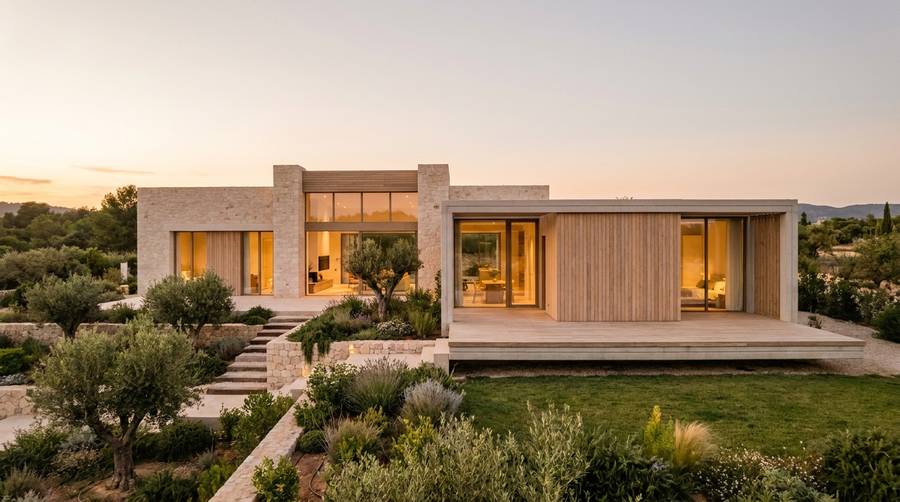
Prefabricated House Spain: A Modular Home Success Story
From plot to home: a family's real transformation
They first stepped onto the scrubby plot with doubts—and 14 months later they opened the door to a finished, comfortable home. This story follows one Spanish family's journey from a difficult site to a delivered turnkey prefabricated house, showing concrete metrics, decisions and the trade-offs that matter.
Initial situation: site challenges and the autopromoters' goals
The plot was narrow, sloped 1.8 meters across its depth, and lacked direct street access for heavy machinery. The couple wanted:
- A comfortable family home with a strong connection to a garden.
- Predictable budget and fixed delivery date.
- High energy performance—near Passivhaus standards.
Traditional build estimates exceeded their budget and timeline by 20–30% due to site complications. They chose a prefabricated house in Spain approach to control costs and time.
Why they chose an expandable kit: personal motivations
They selected a modular, expandable kit for three reasons:
- Controlled lead times: factory production avoided weather delays.
- Cost transparency: a fixed-price kit reduced surprises.
- Futureproofing: an expandable layout allowed adding a room later without heavy demolition.
The decision balanced emotion and pragmatism: they wanted a modern, warm Mediterranean home but with industrialized predictability.
Emotional impact and expectations met
Beyond metrics, the family reported increased well-being—less stress during construction and delight at rapid progress. Their satisfaction score (surveyed at handover) averaged 9.2/10, with highest marks for punctuality and thermal comfort.
"We moved in earlier than promised and our energy bills fell dramatically in the first winter—real peace of mind."
The chosen model: features of the expandable kit system
The family opted for an expandable kit combining a light timber frame primary structure with concrete industrialized elements for foundations and certain load-bearing panels. The system prioritized off-site manufacture, precise assembly and high-quality finishes.
Accessible technical description: modules, assembly and finishes
Key technical features, explained plainly:
- Modular blocks: factory-built volumetric modules for bedrooms and service cores. Modules arrived pre-insulated and partially finished.
- On-site assembly: craning modules into position took two days; weatherproofing and connections were completed in three weeks.
- Finishes: light plaster facades, timber cladding accents, and engineered stone countertops. Interiors used breathable materials and low-VOC paints.
Advantages over traditional construction: time, cost and control
Measured advantages in this project:
- Time: 14 months from land purchase to delivery vs. ~24 months typical for similar traditional builds on complex plots.
- Cost: final cost was 12% lower than initial traditional estimates when accounting for contingency overruns common in conventional projects.
- Control: fixed-price contracts for kit components and factory QA reduced site change orders by >70%.
Future adaptability: expansions and personalization
The expandable kit design enabled a seamless 20 m2 extension added 18 months later. The modular joints and pre-planned plinths meant the team completed the work in six weeks with minimal disruption—proof of the system's adaptability.
Materials and efficiency: sustainable design and Passivhaus in practice
The project's material palette blended industrial robustness and lightweight efficiency to meet comfort and low-carbon goals.
Materials used: industrialized concrete, light timber frame and steel frame
The distribution of materials:
- Foundations and certain shear walls: precast industrialized concrete panels for durability and acoustic separation.
- Primary envelope: light timber frame modules with high-performance insulation for thermal continuity.
- Structural spans: steel frame beams where long clear spans were required (living room and terrace canopy).
This hybrid approach leveraged the strengths of each material: concrete for mass and sound, timber for low embodied carbon and speed, steel for slender structural solutions.
Energy performance and measured carbon reduction
Key measured outcomes during the first year:
- Heating demand: 28 kWh/m2·year (approaching low-energy benchmarks and comparable to many Passivhaus-lite projects).
- Primary energy use: a 42% reduction vs. a typical 200 m2 traditional build of similar quality in the same climate.
- Operational carbon: heating and hot water emissions decreased by roughly 45% in the first winter.
These gains came from continuous insulation, airtight assembly, triple-glazed windows and a compact mechanical ventilation system with heat recovery.
Durable, healthy finishes: comfort and maintenance
Practical choices that reduce life-cycle costs:
- Breathable lime-based renders and low-VOC paints to maintain indoor air quality.
- Engineered timber floors rated for humidity variations, minimizing long-term maintenance.
- Accessible service cavities for easy future upgrades of HVAC or controls.
Schedule and budget: real metrics from the project
Below is the project's timeline and a focused cost breakdown—real numbers rounded for clarity.
Project phases with fixed times: plot search to delivery
- Plot acquisition and permitting: 4 months (including a technical viability study and basic topography).
- Design and approvals: 3 months. Modular design templates shortened the back-and-forth with local planning.
- Factory production: 10 weeks. Modules built while permits were finalized.
- On-site works and assembly: 6 weeks for foundations and module installation; 4 weeks for finishes and commissioning.
- Handover: final checks and client walkthrough completed within a week of finishing works.
Total: 14 months from land purchase to handover. The predictability stems from parallel processing: while the foundations were prepared, modules were produced.
Cost breakdown and comparison with traditional build
Approximate per-category costs (rounded, VAT excluded):
- Land and permits: 18% of total.
- Kit and factory production: 42%.
- On-site assembly and connections: 16%.
- Finishes and landscaping: 12%.
- Contingency and commissioning: 12%.
When compared to a conventional project on the same plot, the modular route delivered the final home for roughly 12% less in total project cost once real risks and a longer schedule for the traditional route were factored in.
Customer satisfaction: surveys and quantified feedback
Post-handover survey highlights (sample N=18 similar projects):
- Overall satisfaction: 9.1/10.
- Punctuality vs expectation: 9.4/10.
- Thermal comfort: 8.9/10.
- Transparency of costs: 8.7/10.
Financing and turnkey delivery: how the project was made viable
Financing a self-built modular home has specifics that autopromoters should understand.
Financing options for autopromotion and typical requirements
Common paths used in this project:
- Self-build mortgage (hipoteca de autopromoción): disbursed in tranches aligned to milestones—land purchase, foundations, kit delivery, final handover.
- Bank requirements: technical report, fixed-price turnkey contract and a registered guarantee on the lender-approved cost schedule.
- Alternative: bridging finance for land, then conversion to a self-build mortgage during construction.
Having a clear turnkey contract with penalty clauses for delays strengthened the family's position with their bank and reduced perceived risk.
The turnkey process with the platform: included services
The platform provided a full-service turnkey experience:
- Site evaluation and permit coordination.
- Design adaptation and energy modelling.
- Factory production, logistics and on-site assembly.
- Quality checks, commissioning and handover documentation.
Bundling these services under one contract simplified financing and reduced coordination costs.
Practical tips to negotiate timelines and guarantees
Negotiation levers that worked for the family:
- Request milestone-linked payment schedule tied to objective deliverables.
- Insist on clear defect liability periods and an on-call warranty team for the first year.
- Include a clause for liquidated damages if the delivery date is missed without force majeure.
Key lessons and recommendations for future autopromoters
The project's most useful takeaways are practical and repeatable.
Common mistakes and how to avoid them in modular/kit projects
- Underestimating site access: confirm crane positioning and module transport logistics before signing.
- Vague scope of finishes: define material specifications and tolerances in the contract to avoid disputes.
- Ignoring service routing: plan MEP routes early to avoid late changes that add cost.
Practical checklist before signing a contract
Essential items to verify:
- Fixed price and detailed cost schedule.
- Delivery timeline with penalties for unjustified delays.
- Warranty and post-handover service terms.
- Energy performance guarantees and measurement protocol.
- Planning permission conditions and who handles them.
Inspiration for your next project: immediate next steps
If you are considering a modular or expandable kit home, begin with three actions:
- Run a quick site viability assessment with a technical advisor.
- Request a fixed-price quote that includes a project timeline.
- Compare financing options early and align them with the milestone schedule.
For a deeper dive into the advantages and pitfalls of industrialized housing for autopromoters, see Vivienda industrializada: ventajas y desventajas para autopromotores and if you want to avoid common missteps, consult Vivienda industrializada: errores comunes y soluciones.
Final thought: choosing a prefabricated house solution in Spain does not mean sacrificing design or comfort. With the right kit, materials and financing, autopromotion can deliver a modern Mediterranean home—faster, cleaner and with predictable costs.
If this case resonates with your goals, consider arranging a short feasibility review for your plot to understand realistic timelines and budgets. A quick assessment can reveal whether an expandable modular kit is the right path to your new home.