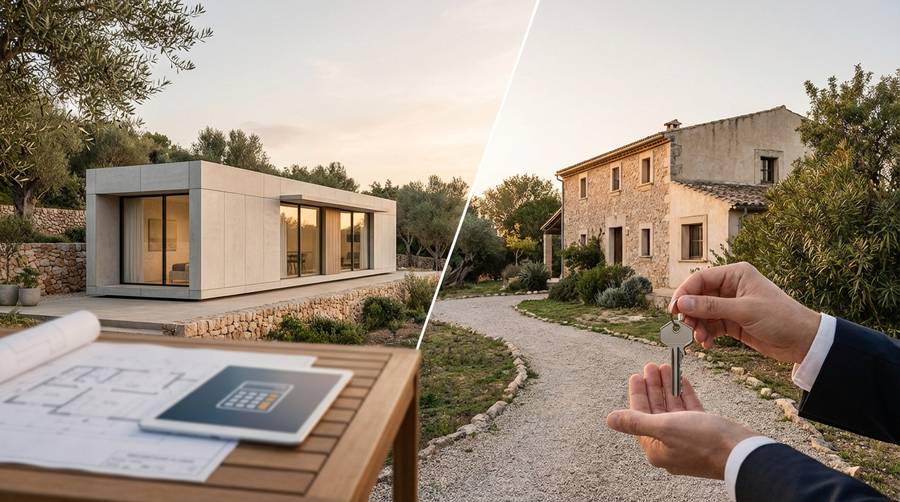
Prefabricated House vs Traditional: Clear Advantages for Self‑Builders
Why choose industrialized housing today: context and initial advantages
Imagine signing a fixed price contract and moving into your completed home months earlier than with traditional build. That reality is why an increasing number of Spanish self‑builders consider a prefabricated house or modular home: predictable schedules, tighter cost control and factory quality under controlled conditions.
Executive summary: what industrialized housing means in Spain 2026
Industrialized housing refers to homes assembled from factory‑produced modules or large panels, finished to a high standard and installed on site. In Spain in 2026 this model sits at the intersection of faster delivery expectations, tighter energy regulations (including wider Passivhaus adoption) and demand for cost transparency.
Key advantages over traditional construction (time, cost control, quality)
- Time certainty: factory workflows reduce weather delays and onsite surprises; closed‑en timelines are common.
- Cost predictability: fixed‑price turn‑key offers lower exposure to escalation in labour or material prices.
- Quality control: repeated production processes and factory inspections improve consistency across finishes and thermal performance.
Who benefits most: self‑builder profiles and common goals
Industrialized housing is especially suitable for:
- Families seeking a predictable move‑in schedule.
- Buyers prioritising energy performance (e.g., Passivhaus ambitions).
- Self‑builders who value fixed budgets and want a managed, turn‑key process.
Technical comparison: modular home vs traditional house
A technical comparison must focus on three core dimensions: process control, timeline predictability and end‑product durability. Below we unpack each with actionable considerations.
Factory quality control vs on‑site execution
Production in an industrial setting allows repeated checks at defined stages: structural assembly, airtightness membranes, insulation continuity and finishing. In contrast, on‑site builds require continuous coordination of trades and are more exposed to workmanship variation.
- Actionable check: ask for the factory quality plan, inspection records and third‑party test reports (airtightness, humidity, thermal bridging) before signing.
Schedules and predictability: closed envelopes and fewer surprises
Modular programs separate the timeline into parallel streams: site groundwork and foundation work run concurrently with factory production. This often shortens the overall schedule and reduces weather‑driven idle time.
- Example metric to request: median weeks from permit to delivery, and median weeks of on‑site assembly.
- Practical tip: build contractual milestones tied to delivery windows and penalties for delays outside force majeure.
Finish quality, longevity and resale value
High‑end prefabricated systems can match or exceed traditional finishes when the manufacturer focuses on durable materials and integration details. Durability depends more on design choices (cladding, drainage, ventilation) than the fact of factory production.
- Checklist for long life: continuous external drainage, breathable wall build‑ups, accessible service cavities and documented maintenance plans.
Materials and systems: industrialized concrete, timber frame and steel frame
Choosing the right structural system is a trade‑off among cost, speed, performance and sustainability. Below are practical profiles to guide decisions.
Industrialized concrete: performance, costs and best scenarios
Precast or large concrete panels offer excellent thermal mass, fire resistance and acoustic performance. They suit plots with higher exposure to wind or where robustness is a priority.
- When to pick concrete: multi‑storey homes, seaside plots, or where acoustic control is essential.
- Cost note: higher transport and lifting costs; compensate with lower on‑site time and long service life.
Light timber frame: efficiency, insulation and sustainability
Timber framing (entrama do ligero) delivers excellent embodied carbon performance, fast fabrication and strong thermal performance when combined with high‑quality insulation. It is an excellent fit for Passivhaus aims.
- Sustainability plus: responsibly sourced timber reduces lifecycle emissions and speeds up assembly.
- Practical caution: ensure details for moisture control and integrate a continuous ventilation strategy.
Steel frame: strength, speed and design flexibility
Steel frame systems provide high precision, long spans and rapid assembly. Ideal where open interiors or non‑standard geometries are required.
- Design note: control thermal bridges and pair steel with adequate insulation layers.
- Use case: quick‑turn ambitious contemporary architectures that require slender profiles.
Financing and mortgages for modular homes and self‑build projects
Financing an industrialized home in Spain follows many of the same rules as traditional self‑build, but lenders increasingly recognise factory production. That creates options—still dependent on documentation and milestone monitoring.
Types of financing available in Spain for modular and self‑build
- Self‑build mortgages: tranche disbursements tied to project milestones (plot acquisition, foundations, assembly, completion).
- Turn‑key project loans: single contract with a manufacturer may be financed as a finished property in some cases—check lender policy.
Typical requirements: plot, project, milestones and documents
Lenders commonly require:
- Ownership or reservation of the plot.
- Detailed project documentation and an itemised budget.
- Clear contractor agreements and a payment schedule with compliance mechanisms.
Advantages and limits of mortgages for turn‑key projects
Advantages: reduced drawdown complexity and predictable final valuations when the product is documented. Limitations: some banks apply conservative valuations to non‑traditional builds or insist on additional technical reviews.
Practical step: obtain a lender pre‑approval that recognises modular systems and include a valuation clause that considers certified energy performance.
Turn‑key process: steps, timelines and realistic costs (practical guide)
Turn‑key delivery condenses responsibilities, but clarity in each phase is essential to avoid surprises. Below is a practical breakdown of phases, typical durations and cost drivers.
From plot search to handover: phases and responsible parties
- Plot acquisition: buyer; check planning constraints and service connections.
- Design and permit: architect and manufacturer; submit plans for license.
- Factory production: manufacturer; building modules and finishing offsite.
- Site works and foundations: local contractor; prepare foundations, utilities and access.
- Assembly and commissioning: manufacturer and site contractor; install modules, finish connections, test systems.
- Handover: manufacturer; final inspections, documentation and warranties.
Estimated timelines and cost examples by system
Typical durations (indicative):
- Design & permit: 3–6 months.
- Factory manufacture: 6–12 weeks for single‑family homes.
- Site works & assembly: 4–12 weeks depending on complexity.
Cost drivers include plot preparation, foundation type, finishes, and transport. Seek itemised budgets showing base cost, optional upgrades and contingency.
Contractual keys to protect the self‑builder (warranties, milestones, penalties)
- Define firm milestones: dates for foundation completion, module delivery, and final handover.
- Include performance guarantees: airtightness, U‑values and completion tests with remedies stated.
- Penalties and retentions: retain a percentage until snagging and performance tests pass.
Sustainability and energy efficiency: Passivhaus and carbon reduction
Industrialisation creates a strong platform for meeting stringent energy goals. Factory precision helps deliver continuity of insulation and airtightness needed for low‑energy standards.
How industrialisation facilitates Passivhaus and energy savings
- Continuity of layers: factory assembly ensures insulation and membranes are applied with fewer interruptions.
- Controlled installation: reduced workmanship variability lowers the risk of thermal bridges and leakage.
Material and design choices that lower carbon footprint
To reduce embodied and operational carbon, prioritise:
- Low‑carbon materials (sustainably sourced timber, low‑cement mixes for concrete).
- Efficient HVAC and mechanical ventilation with heat recovery.
- Solar orientation, high‑performance glazing and shading strategies.
Metrics and examples: annual consumption and estimated savings
While figures vary by climate and design, industrialized homes built to high efficiency standards often see annual heating demand reductions in the range of 60–90% compared to poorly insulated traditional builds. Request energy modeling outputs (PHPP or equivalent) and compare demand and primary energy figures.
High factory quality and airtightness are among the fastest, most reliable levers to cut operational energy demand—and lenders increasingly value certified energy performance in valuations.
Practical conclusion: advantages, disadvantages and how to decide
The decision comes down to priorities: if you value schedule certainty, fixed costs and ambitious energy performance, a prefabricated house often wins. If your project requires extreme customisation on site or you prioritise a fully bespoke artisanal build, traditional methods may be preferable.
Balanced summary: when to choose modular and when to choose traditional
- Choose modular when: you want faster delivery, predictable pricing and high energy performance.
- Choose traditional when: you require incremental changes on site, very complex local masonry work, or have unique heritage constraints.
Decision checklist: budget, plot, timeline and sustainability goals
Use this checklist before committing:
- Confirm plot constraints and access for module delivery.
- Define a realistic budget including transport and site works.
- Decide target energy standard (e.g., Passivhaus) and obtain modelling.
- Obtain lender pre‑approval that recognises modular systems.
Recommended next steps for the self‑builder
Collect at least two detailed turn‑key proposals including: itemised costs, production timelines, test certificates and contractual warranties. If you want a practical primer on mortgage considerations or a direct comparison focused on autopromotores, see related guides such as Vivienda modular: ventajas y desventajas para autopromotores and Casa prefabricada vs tradicional: guía para autopromotores.
If you want tailored support: commission a feasibility study that compares two system options on your specific plot (timing, costs, energy model). That single study often saves months of uncertainty and prevents costly changes later.
If you'd like, I can help you prepare a questionnaire to request comparable turn‑key quotes from manufacturers and a checklist for lender discussions—say the plot size and your energy target, and I’ll draft it.
Artículos relacionados