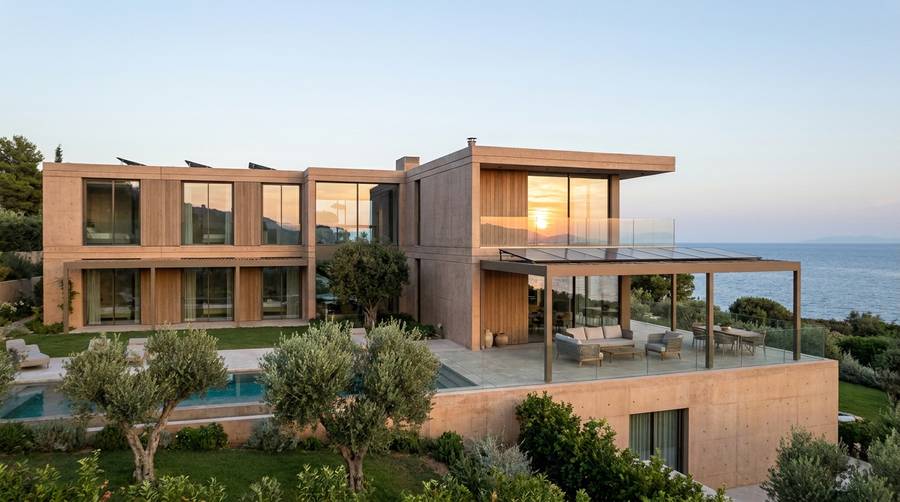
Prefabricated Homes: Mediterranean Modular Living in 2026
Imagine moving into a high-quality, energy-efficient Mediterranean home built in months—not years—and with a fixed final price. That promise is no longer theory: modern prefabricated homes combine industrialized processes, premium materials and predictable delivery to make this a practical path for self-builders in Spain.
1. Why choose premium Mediterranean prefabricated homes in 2026
Prefabricated homes are no longer synonymous with low-quality or temporary solutions. They represent a controlled, industrialized route to deliver superior design, performance and timing for families and small developers.
Advantages versus traditional build: time, cost and project control
- Shorter timelines: Typical on-site assembly of a modular house in Spain takes 4–8 weeks; total project from design to handover commonly 6–9 months versus 18–30 months for traditional builds.
- Fixed or capped pricing: Factory workflows reduce variation. Contracts frequently include a fixed-price turnkey option, lowering budget risk.
- Higher predictability: Indoor factory work avoids weather delays, improves QC and consolidates subcontractor coordination.
Benefits of Mediterranean aesthetics and contemporary materials
Choosing a Mediterranean contemporary design aligns with climate-responsive features: shaded terraces, thermal mass and cross-ventilation. When combined with modern materials—light façades, natural stone, wood accents and large windows—this creates homes that are both attractive and climate-adapted.
How this model fits Spanish regulations and self-builder expectations
Regulatory compliance in Spain focuses on structural safety, energy performance and local urban planning. Prefabricated systems are tested under the same standards as traditional builds and often simplify certification because factory documentation and repeatable tests make demonstrating compliance easier for self-builders.
2. Materials and construction systems that define quality
Selecting the right structural system is a strategic decision that affects cost, timeline, comfort and embodied carbon.
Industrialized concrete: durability and premium finish
Precast concrete elements provide exceptional durability, fire resistance and acoustic performance. For Mediterranean designs, concrete supports clean, minimalist façades and can serve as thermal mass to moderate interior temperatures during summer diurnal swings.
- Typical uses: load-bearing panels, floor slabs and exterior claddings.
- Advantages: longevity, low maintenance, premium finish options.
Light timber frames and steel frame: insulation, speed and flexibility
Light timber framing (entramado ligero) offers excellent thermal performance and speed of assembly. Steel frame provides high accuracy, larger spans and flexibility for open-plan Mediterranean living.
- Timber frame: excellent U-values when combined with modern insulation, favorable embodied carbon for sustainably sourced wood.
- Steel frame: reduced section sizes, precision, and ease of integrating mechanical systems.
Technical comparison and carbon footprint: key data
Comparing systems on embodied carbon and lifecycle impact:
- Timber frames typically show lower embodied carbon per m2 than concrete or steel when wood is responsibly sourced.
- Precast concrete has higher initial embodied carbon but offers longevity and low maintenance.
- Steel frame lies between both in terms of durability and carbon when recycled content and fabrication efficiency are high.
Decision rule: match the system to priorities—carbon and insulation (timber), durability and finish (concrete), or structural flexibility (steel).
3. Energy efficiency and sustainability: achieving a Passivhaus-level home
High-performance prefabricated homes can achieve near-Passivhaus standards with the right envelope, systems and testing—critical for long-term comfort and lower operating costs.
Passive strategies adapted to the Mediterranean climate
- Orientation and shading: design façades to minimize summer solar gains while allowing winter sun where beneficial.
- Optimized envelope: continuous insulation, high-performance windows (low-E glazing), and airtightness detailing tailored for modular joints.
- Thermal comfort: use of thermal mass (concrete interiors or masonry) to dampen temperature swings common in coastal and inland Mediterranean zones.
Active systems: ventilation, heating and renewables
Complement passive measures with efficient systems:
- MVHR (mechanical ventilation with heat recovery): reduces heating/cooling losses while ensuring air quality.
- Electric heat pumps: for heating and cooling with high COPs in mild Mediterranean climates.
- PV arrays and battery storage: sized to cover a high portion of annual consumption—directly reducing operational emissions.
Real metrics: consumption and carbon reductions from built examples
Measured results in recent projects show:
- Primary energy demand reductions of 60–85% compared to standard new builds when combining envelope upgrades and renewables.
- Operational CO2 reductions proportional to grid decarbonisation and onsite renewables; good designs can halve lifecycle carbon over 30 years versus traditional approaches.
Well-designed prefabricated homes can achieve Passivhaus-like performance in the Mediterranean while delivering faster build times and price certainty.
4. The turnkey process explained step by step
Turnkey delivery removes coordination burdens from the self-builder by integrating project phases under one agreement. Below are realistic timelines and responsibilities.
From finding a plot to permits: stages and realistic timelines
- Site analysis & purchase: 1–3 months. Verify access, utilities, and urban parameters.
- Permitting: 2–6 months depending on municipality and complexity.
- Design & approvals: 1–3 months for schematic and technical design in modular systems.
Design and customization: coordinating technical teams
Modular design benefits from early integration between architect, manufacturer and MEP engineers. This reduces costly rework. Typical approach:
- Stage 1: Concept and budget lock-in.
- Stage 2: Technical design and factory engineering.
- Stage 3: Client approvals and finishes selection.
Manufacturing, transport and assembly: closed schedules and quality control
- Factory production: 8–16 weeks depending on complexity.
- Transport & assembly: 1–6 weeks on site for modules and finishes.
- Testing & handover: airtightness tests, systems commissioning and client orientation—usually 1–2 weeks.
These consolidated schedules are a chief advantage: while site work focuses on foundations and connections, the building progresses in parallel off-site.
5. Financing and mortgages for self-building modular homes
Financing a prefabricated house in Spain follows similar logic to traditional self-build mortgages but with nuances that favor modular projects.
Financing options specific to prefabricated homes in Spain
- Self-build mortgages: structured in tranches tied to milestones (plot purchase, foundation, module arrival, completion).
- Turnkey loans: lenders sometimes view turnkey modular projects favorably due to fixed-price contracts and shorter completion risk.
- Green mortgages and incentives: preferential conditions may be available for energy-efficient builds with high-performance certifications.
Preparing documentation and metrics banks request
- Detailed budget and contract with manufacturer (fixed-price preferable).
- Timeline and construction schedule.
- Energy performance estimates and life-cycle cost comparisons if seeking green finance.
Strategies to combine public subsidies, savings and loans
Use a layered approach:
- Secure plot financing first or buy cash if possible to strengthen loan application.
- Apply for energy-efficiency grants at regional/national level early—these can improve loan terms.
- Negotiate payment tranches aligned to project cashflow to minimise interim borrowing.
6. Case studies: real projects and practical lessons
These practical cases illustrate timelines, budgets and satisfaction metrics from actual Mediterranean modular projects.
Case 1 — Coastal Mediterranean home: timings, costs and satisfaction
Project profile: 140 m2 two-storey family home near the coast using a timber frame system with stone and wood façades.
- Total delivery time: 7 months from contract signature to handover.
- Construction cost (turnkey): competitive with traditional local builds—fixed price reduced contingency needs by 8–12%.
- Client satisfaction: higher perceived value due to quality finishes and predictable timeline; post-occupancy comfort ratings >9/10.
Case 2 — Family house with high energy rating: measurable outcomes
Project profile: 160 m2 single-family home, hybrid steel-concrete structure with MVHR and 6 kW PV system.
- Measured primary energy demand: 70% lower than regional new-build baseline.
- Observed airtightness: 0.6 ACH (air changes per hour at 50 Pa)—near Passivhaus thresholds.
- Payback: with current electricity prices and incentives, incremental cost recovered in estimated 12–16 years.
Conclusions: common mistakes and good practices for self-builders
- Avoid late design changes—lock finishes and technical solutions early.
- Prioritise airtightness and continuity of insulation during factory detailing.
- Choose a manufacturer with transparent QA/QC documentation and independent testing records.
7. How to start today: a quick checklist for self-builders
Move from idea to action with a focused checklist that minimizes risk and maximizes value.
Initial decisions: plot, budget and architectural style
- Verify site rules and buildability with the local town hall.
- Set a realistic budget that includes contingency for services and landscaping.
- Choose an architectural language early; Mediterranean contemporary works well with modular systems.
Key questions to choose a manufacturer and technical team
- Can they provide a fixed-price turnkey contract?
- Do they have independent test results (airtightness, acoustic, thermal)?
- What are the warranties for structure, envelope and systems?
Next recommended steps and useful resources
- Obtain at least two turnkey quotes with full breakdowns.
- Request references and visit completed projects if possible.
- Consult local energy advisors to model expected consumption and PV sizing.
Closing: why industrialized housing is the modern, reliable choice
Industrialized prefabricated homes offer measurable benefits: shorter, predictable timelines, competitive fixed pricing, improved quality control and strong potential for high energy performance. For self-builders in Spain seeking Mediterranean aesthetics and contemporary comfort, modular systems are a pragmatic path to achieve both ambition and affordability.
Start your project by clarifying priorities—materials, performance and timeline—and request turnkey documentation that demonstrates the manufacturer’s QA processes. With the right team, you can move from vision to a finished, lived-in home in a fraction of the time of a conventional build.
Ready to assess your plot and options? Gather two turnkey quotes, a site report and an energy model—and you’ll have the facts to decide with confidence.