Industrialized Housing and Timber Decarbonization 2026
Before you decide: a quick overview of timber and decarbonization in industrialized housing
Imagine signing a fixed-price contract and seeing your new Mediterranean-style house finished in months—with a clear carbon accounting score you can show to your mortgage lender. That is the reality increasingly offered by modern industrialized housing in Spain: faster builds, predictable budgets, and measurable reductions in embodied and operational carbon.
This article gives an actionable, no-fluff review of how timber-based systems compare to concrete and steel, where they truly cut emissions, and how to apply these insights if you are an autopromotor (self-builder) pursuing a turnkey modular home.
Timber in construction can store 1.5–2.0 tonnes CO2 per cubic metre in the built structure—turning part of your home's frame into an active carbon sink when sourced and managed correctly.
What we mean by decarbonization in residential construction
Decarbonization spans two complementary goals: reducing embodied carbon (materials, manufacturing, transport, construction) and lowering operational carbon (energy used in heating, cooling, hot water). For industrialized housing, both are affected by system choice, factory precision and airtightness strategies aligned with standards such as Passivhaus.
General advantages of industrialized homes versus traditional builds
- Predictable cost and schedule: factory processes and fixed-price turnkey contracts reduce change orders.
- Lower embodied carbon: optimized material use and potential for renewable materials like certified timber.
- Faster enclosure: shorter exposed construction time reduces transport and on-site emissions.
- Quality control: repeatable manufacturing improves airtightness and thermal performance.
Context in Spain: regulation, demand and 2026 trends
Spain's building codes and market in 2026 favour energy efficiency and life-cycle thinking. Grants and more accessible mortgages for low-carbon homes are emerging. Self-builders benefit from industrialized options that combine modern materials (light timber frame, industrialized concrete panels, steel frame) with turnkey delivery.
1. Carbon sequestration: timber as an active sink
How timber biomass reduces life-cycle CO2
When wood is used in structure, carbon fixed during tree growth is locked into the building for its lifespan. The key is the net balance: carbon stored in the timber minus emissions from harvesting, processing and transport. Responsible forest management and certification (FSC, PEFC) keeps that balance strongly positive.
- Typical storage: ~1.5–2.0 tCO2/m3 of solid timber used in structure.
- Long-life use and reuse amplify sequestration benefits.
Emissions comparison: timber vs concrete and steel at key stages
Compare materials across production (A1–A3), transport (A4), construction (A5) and end-of-life (C):
- Concrete: high CO2 from cement production; often responsible for the bulk of embodied carbon in traditional homes.
- Steel: high process emissions but highly recyclable—recycling content matters.
- Timber: low processing emissions and active carbon storage if sourced sustainably.
Example benchmark: for a 150 m2 single-family home, structure and envelope in timber can cut embodied emissions by 30–50% compared to a similar concrete/steel solution, depending on design choices and transport distances.
Implications for certifications and Passivhaus
Choosing timber does not automatically mean Passivhaus compliance, but timber frames often simplify achieving high airtightness and thermal continuity required by Passivhaus. Pairing certified timber with airtight membranes, continuous insulation and heat-recovery ventilation produces both low embodied and operational carbon.
2. Lower embodied energy from factory production and assembly
Industrialized timber framing vs onsite processes
Factory production reduces waste and enables precision cuts and pre-installed insulation and services. That reduces both material waste and rework emissions typical of in-situ construction.
- Cutting waste: factories typically achieve >90% material use efficiency vs ~60–70% on site.
- Pre-installation: windows, membranes and systems installed in controlled conditions improve airtightness and reduce remedial work.
Reduced transport and faster enclosure: energy and emissions impact
Industrialized delivery concentrates transport phases (factory to site) and shortens the time a project is open to prolonged site traffic. That reduces repeated heavy vehicle trips and onsite equipment emissions.
- Less time on site lowers diesel use, noise and local disruption.
- Tighter schedules reduce storage and double-handling of materials.
Numerical example: average savings in kWh and CO2 for a typical project
Case baseline (150 m2 single-family home, Mediterranean Spain):
- Traditional build embodied energy: ~180–220 GJ (~50–61 MWh) → embodied emissions ~25–35 tCO2e.
- Industrialized timber solution embodied energy: ~110–150 GJ (~31–42 MWh) → embodied emissions ~12–20 tCO2e.
Net reduction: ~8–15 tCO2e saved in embodied emissions; operational savings depend on envelope performance and systems installed.
3. Thermal efficiency and operational energy savings
Timber properties that improve insulation and thermal inertia
Wood has lower thermal conductivity than steel and concrete, which helps reduce thermal bridges in frame systems. When combined with continuous insulation and high-performance glazing, timber systems deliver excellent U-values with less material thickness.
- Thermal continuity: prefabricated panels ensure insulation layers are continuous and well-sealed.
- Comfort: timber moderates indoor temperature swings—valuable in Mediterranean climates with hot days and cool nights.
Integrating with Passivhaus envelopes and efficient HVAC
Industrialized timber envelopes are compatible with mechanical ventilation with heat recovery (MVHR), solar thermal, heat pumps and photovoltaics. Prioritise:
- Airtightness targets (n50 ≤ 0.6 h-1 for Passivhaus) achieved more reliably in factory-made elements.
- High-performance windows (triple-glazed) with low g-values where needed.
- Smart integration of thermal mass where needed (concrete floors or insulated masonry in specific zones).
Impact on energy bills and occupant comfort in Mediterranean climates
Combining timber industrialized envelopes with a Passivhaus approach can cut space heating/cooling energy by 70–90% compared to pre-2010 Spanish stock. For a typical household, expect meaningful reductions in annual energy bills and improved year-round thermal comfort.
4. Circularity and renewable materials across the supply chain
Certified origin and sustainable forest management
Ask for chain-of-custody documentation (FSC, PEFC). Certified wood ensures forests are managed for regeneration, biodiversity and local community benefit—critical for true carbon accounting.
Recyclability, reuse and end-of-life strategies
Timber elements can be disassembled and reused more easily than bonded concrete structures. Design for disassembly increases future reuse value and reduces demolition waste.
Advantages over high-impact extraction materials
Materials with intensive extraction or processing (e.g., primary cement, virgin steel) carry larger upstream emissions. Strategic use of timber and recycled or low-carbon concrete mixes reduces lifecycle impacts.
5. Faster construction and lower site impact
Closed schedules and reduced emissions from prolonged building sites
Shorter on-site timelines mean fewer site emissions (machinery, deliveries), lower disturbance for neighbors, and reduced administrative overhead. A typical industrialized turnkey delivery can reduce on-site months by 50–70% compared to a fully traditional build.
Less waste on site and streamlined logistics in turnkey projects
Factories deliver assembled elements ready for lift-and-place installation. That minimizes packaging waste, on-site cutting and associated disposal. Turnkey delivery also centralizes warranty and quality responsibility.
How this improves cost predictability and project sustainability
Fewer unknowns during execution translate to fewer change orders and a clearer financial plan—this predictability is often decisive for self-builders financing through mortgages or construction loans.
Putting it into practice: a quick guide for Spanish self-builders
Criteria to choose materials and systems based on carbon objectives
Choose systems by ranking objectives: embodied carbon, operational cost, timeline, and resale value. Practical criteria:
- Prefer certified timber for structural elements where you want carbon sequestration.
- Use high-recycled content or low-clinker concrete for foundations and slabs.
- Select factory-produced envelope panels that include insulation and services.
Turnkey process steps: plot, design, finance and delivery
- Parcel selection: check orientation, access, local planning rules and connection costs.
- Preliminary design: define target energy class and embodied carbon goals with your technical team.
- Financial planning: explore mortgage options for self-builders and consider lenders more open to industrialized solutions; document predicted energy savings and embodied carbon reductions to support the application.
- Factory detailing and approvals: ensure the manufacturer provides EPDs (Environmental Product Declarations) and assembly drawings for permits.
- Turnkey contract and schedule: fix milestones for design freeze, factory production, site works and commissioning.
- Delivery and handover: receive performance documentation, commissioning records and user guidance for low-energy operation.
Key indicators to measure (time, cost, emissions) and reference cases to compare
Monitor these KPIs:
- Calendar days from groundworks start to enclosure.
- Final outturn cost vs fixed price (variance %).
- Embodied emissions (tCO2e) from A1–A5 and operational energy per year (kWh/m2).
Reference case (realistic example):
- Project: 150 m2 turnkey timber home in Valencia region.
- Timeline: 6 months from foundation to handover (vs 12–18 months traditional).
- Cost variance: ±3% on fixed-price turnkey contract (typical).
- Embodied CO2: 14 tCO2e (A1–A5). Operational energy: 30 kWh/m2·yr (with MVHR and heat pump).
- Occupant satisfaction: >90% reported high thermal comfort and lower energy bills after 12 months.
Use these metrics to compare offers objectively and to discuss mortgage terms with lenders: lower operational costs and verified embodied carbon performance strengthen affordability cases.
Practical tips and common pitfalls
Specify required documentation up front
Demand EPDs, airtightness targets, and a clear scope in the turnkey contract. Without these, comparing proposals becomes subjective.
Don’t assume all timber is equal
Ask about species, treatment, moisture content, and certification. These affect durability, fire performance and carbon claims.
Plan for integrated renewable systems
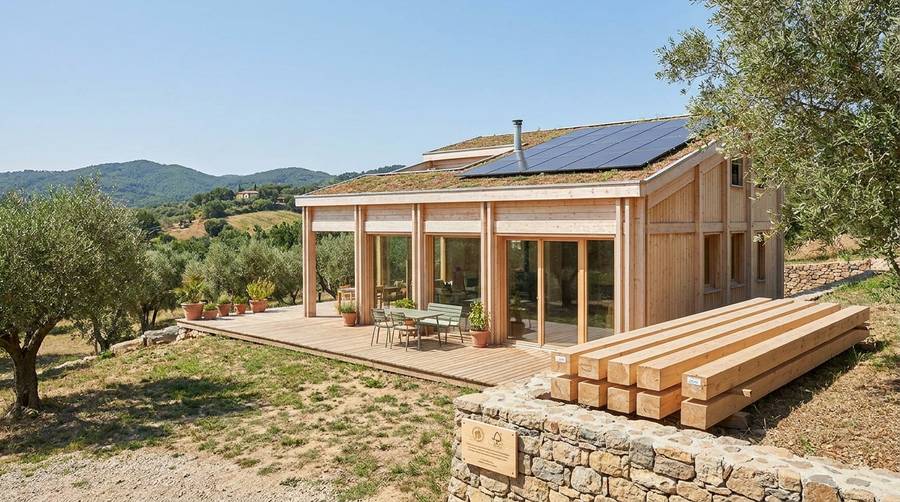
Design roof pitch and orientation for PV, leave space for future battery storage and connect MVHR duct routes during factory assembly for a clean finish.
Final thoughts and next step
Industrialized timber housing offers a clear pathway for self-builders in Spain to reduce both embodied and operational carbon while improving predictability and comfort. The real gains come from combining certified timber, precise factory assembly, airtight Passivhaus-style detailing and a reliable turnkey process.
If you want an evidence-based comparison for your parcel, collect three offers with EPDs and airtightness commitments, and compare the KPIs listed above.
For a broader technical comparison of industrialized solutions and materials you can consult our in-depth resource: Vivienda industrializada: guía comparativa 2026.
Ready to evaluate a turnkey option for your self-build? Gather plot data and your budget range, request EPDs and airtightness targets from manufacturers, and ask for a full schedule. Small upfront diligence yields large reductions in cost, time and carbon.