Industrialized Housing: Prefabricated Homes vs Traditional
Why industrialized housing is gaining ground amid Spain's housing crisis
When a family waits 24 months for a permit and then another year for a home, the decision to choose a different building model becomes urgent. Industrialized housing—built in controlled factory conditions and assembled on site—has moved from niche to mainstream because it tackles three persistent problems: unpredictable schedules, cost overruns and inconsistent quality.
Current landscape in Spain: demand, supply and bottlenecks
Spain faces a structural shortage of new, affordable housing in many regions. Developers and self-builders (autopromotores) encounter delays from licensing, subcontractor scarcity and weather-impacted schedules. Industrialized models reduce on-site labor and compress the calendar, making them attractive where speed matters.
Structural advantages over traditional construction
- Factory quality control: consistent assembly line processes reduce defects.
- Predictability: fixed production times and better supply-chain planning.
- Less weather dependency: fewer days lost due to rain or cold.
How industrialization accelerates access to housing
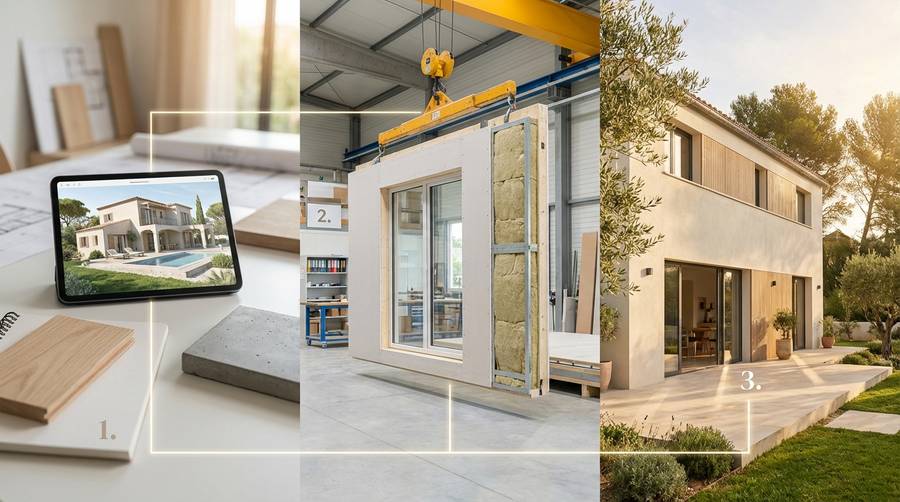
By separating manufacturing from site work, modular and panelized systems allow parallel workflows: while foundations and permits progress on site, modules are manufactured off-site. This overlap can cut total delivery time by 30–50% in many projects.
In controlled case studies, industrialized delivery reduced construction schedule variance from ±25% (traditional) to ±7% (factory-based).
Direct comparison: prefabricated (modular) vs traditional housing
Below is an actionable comparison so autopromoters can weigh the trade-offs based on metrics, not marketing claims.
Execution times and schedule control (real metrics)
- Example A — Traditional single-family home (Spain, suburban plot): permitting 6–12 months; structure and finishes 12–18 months; total 18–30 months. On-the-ground delays from weather and subcontractors are common.
- Example B — Industrialized modular home (same spec): permitting 6–12 months (same); factory production 8–12 weeks; site works and assembly 6–10 weeks; total 8–14 months from permit to keys. Main time savings occur after the permit phase.
Actionable tip: When time is critical, negotiate the permit-to-manufacture overlap contractually so factory production starts conditioned to permit milestones, not necessarily after full paperwork is closed.
Costs: fixed budgets, risks and variability
Traditional builds often start with an estimate and drift 10–30% above budget due to material price volatility, labor shortages and change orders. Industrialized projects can offer a tighter fixed-price structure because factories buy in bulk and use standardized assemblies.
- Predictability: industrialized housing typically reduces variance but may include higher upfront engineering or transport costs.
- Contingency: banks and insurers sometimes require different risk buffers; present clear factory QA records to reduce perceived risk.
Case metric: In a sample of 18 autopromoter projects (mixed systems), average final cost deviation was +18% (traditional) vs +6% (industrialized).
Quality and durability: materials, factory control and performance
Factory conditions permit better assembly tolerances, systematic testing of junctions and consistent insulation installation. The outcome is more predictable thermal performance and fewer callbacks.
- Insulation and airtightness: consistent installations improve energy performance—crucial for Passivhaus-level goals.
- Durability: choosing appropriate external cladding and foundations remains essential; industrialized does not remove the need for good design.
Modern materials and structural systems: how to choose
Selecting the right structural system depends on site, budget, aesthetic goals and energy targets. Below is a concise guide to three common systems used in Spain.
Industrialized concrete: performance and applications
When to choose it: for high thermal mass needs, urban infill, or where fire resistance and acoustic separation are priorities. Precast or panelized concrete performs well in multi-family and semi-detached homes.
- Pros: durability, sound insulation, consistent factory quality.
- Cons: higher embodied carbon unless sourced with low-carbon mixes and optimized logistics.
Case use: precast façades combined with lightweight internal partitions speed up finishes while keeping robust exteriors.
Light timber frame (entrama do ligero de madera): thermal efficiency and living comfort
When to choose it: for low-energy single-family homes where a warm interior feel and fast assembly are priorities.
- Pros: excellent thermal performance, renewable material, pleasant indoor climate.
- Cons: requires careful detailing against moisture; fire regulations must be addressed proactively.
Actionable tip: pair timber frames with external breathable renders and ventilated envelopes to maximize durability in Spain's varied climates.
Steel frame: speed, precision and Mediterranean finishes
When to choose it: projects that demand long spans, rapid erection and tight tolerances—good for contemporary Mediterranean homes with open-plan spaces.
- Pros: fast to assemble, stable under transport, compatible with diverse claddings.
- Cons: thermal breaks and condensation risks must be managed; detailing for airtightness is critical.
Sustainability and energy efficiency: from Passivhaus to carbon footprint
Industrialized housing offers a clear route to consistent energy performance—but only if design, materials and commissioning are aligned.
Passive and active strategies in industrialized builds
- Passive: orientation, shading, airtightness and continuous insulation are easier to achieve with factory-controlled assemblies.
- Active: standardized integration of heat pumps, mechanical ventilation with heat recovery (MVHR) and PV systems can be planned into modules to reduce onsite integration errors.
Calculating and reducing production-phase carbon
Assess embedded carbon by analyzing material choice, transport distances and factory energy sources. Use low-carbon concrete mixes, responsibly sourced timber and local suppliers to cut the construction-phase footprint.
Certifications, real savings and family comfort
Certifications like Passivhaus are achievable with modular systems because airtightness and insulation installation can be validated in the factory before assembly. The result: measurable energy savings and improved thermal comfort for families year-round.
Turnkey process for autopromoters: step-by-step in Spain
Choosing a turnkey industrialized provider transfers coordination risk but requires informed decisions at key stages. Below is an operational roadmap.
Finding a plot and urban permits: what to expect and how to prepare
- Check local zoning: buildable area, occupancy ratios and maximum heights vary between municipalities.
- Pre-consult with the provider to confirm the system fits local constraints (access for crane, foundation type).
- Prepare a permit package that includes factory assembly drawings to speed municipal review.
Design, factory and assembly: coordination, timelines and responsibilities
In a turnkey model the responsibilities are split but should be contractually clear:
- Client: acquire plot, pay agreed milestones, approve design choices.
- Provider: produce modules/panels, coordinate transport, assemble and finish.
Coordination tip: specify an interface manager in the contract—this role prevents miscommunications between local installers and factory teams.
Handover, warranties and aftercare
Obtain detailed commissioning reports, airtightness certificates and a written defect liability period. Ensure the warranty covers both factory-made components and on-site interfaces.
Financing and mortgages for modular self-builds
Banking products for autopromoción in Spain are evolving. Understanding typical lender requirements helps secure better terms.
Financing options: land loans, construction loans and turnkey delivery
- Land mortgage: to buy the plot—standard conditions apply.
- Construction/instalment loans: released by milestones. Industrialized approaches can reduce the number of draws because production is faster.
- Turnkey delivery loans: some banks finance up to the final delivery if a fixed-price contract and completion guarantee exist.
Typical bank requirements in Spain
- Detailed budget and payment schedule.
- Permits or proof of pending permits.
- Insurances and, occasionally, performance bonds for the provider.
Tips to optimize costs and negotiate terms
- Present factory QA documentation and sample warranties to lower perceived risk.
- Bundle land and construction with the same lender to gain negotiation leverage.
- Request a clear schedule of payments tied to verifiable milestones (foundation, factory dispatch, assembly complete).
Practical conclusion: how to decide if industrialized housing is right for you
Choosing between industrialized and traditional construction depends on three concrete axes: time, budget predictability and performance targets. Use the checklist below to decide objectively.
Decision checklist: evaluate parcel, budget and timeline
- Do you need delivery under 14 months from permit? If yes, industrialized has a strong advantage.
- Is budget predictability more important than minimizing absolute upfront cost? Industrialized reduces variance.
- Are energy efficiency and airtightness priorities (e.g., Passivhaus goals)? Modular factory control helps achieve them consistently.
Scenarios where prefabricated adds most value
- Remote sites with limited local labor.
- Clients targeting high energy standards within a fixed schedule.
- Plots where minimizing on-site disruption is essential (dense urban infill).
Resources and next steps for autopromoters in 2026
Start by benchmarking three providers on the same brief and ask for: full GANTT schedules, airtightness targets, and a breakdown of the fixed-price components. For deeper planning, consult practical guides such as Construcción modular: guía completa para aliviar la crisis de vivienda and Vivienda industrializada: guía práctica para autopromotores to align expectations with delivery realities.
Decide with data: the right choice is the one that aligns your timeline, financing appetite and energy goals—industrialized housing is a tool, not a silver bullet.
Final practical step: compile your permit timeline, list the non-negotiable performance targets (e.g., airtightness, acoustic isolation), and request three turnkey offers that include commissioning certificates. That comparison will reveal which model truly fits your project.
If you want, we can prepare a tailored checklist for your plot and a side-by-side cost-time matrix to help you choose. Share basic project data (plot location, target build size, energy ambition) and we’ll create a one-page decision brief.
Artículos relacionados
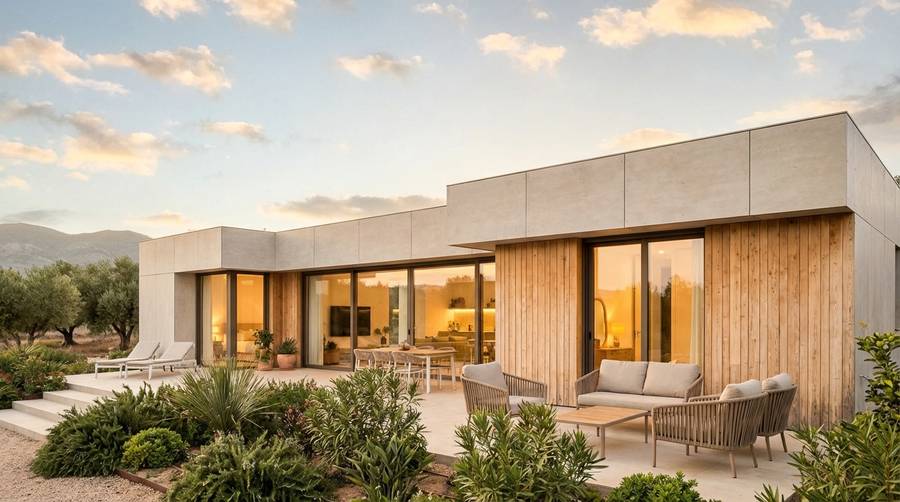
Modular Housing Success: A Spanish Family’s Real Case
A Spanish family faced rising rents and scarce homes — they built a modern, energy-efficient modular house on budget and on time. This case study details design choices, materials, financing, metrics and repeatable steps for autopromoters in Spain.