Industrialized Housing Guide: Self-Build Spain 2026
When Marta and Hugo decided to stop renting and build their first home, they had one non-negotiable: finish within a year and without unpredictable extra costs. That urgency pushed them to choose an industrialized, modular path — and the result was a high-performance Mediterranean home delivered on time and on budget. This guide explains how to replicate that outcome with clear, actionable steps.
Why choose modular self-build: an overview for young promoters
What industrialized self-build is and why it appeals to young promoters
Industrialized housing (also called modular or prefabricated construction) moves most production off-site into controlled factory conditions. For young self-builders this means:
- Predictability: fixed-price contracts reduce exposure to rising material or labor costs.
- Speed: simultaneously preparing the plot while factory modules are built reduces total time to delivery.
- Higher energy performance: factory QA yields better airtightness and repeatable high-quality assemblies.
Quick comparison: modular vs traditional (times, fixed price, quality)
Side-by-side practical metrics to expect:
- Schedule: traditional: 12–30+ months; modular: 6–12 months (from permit to handover).
- Cost certainty: traditional often exposes owner to 10–25% contingencies; modular frequently offers fixed-price phases.
- Quality: factory processes reduce assembly variability, improving thermal and acoustic performance.
What you will learn and how to apply this step-by-step guide
This guide gives a practical roadmap: selecting materials, financing options for autopromotion, the turnkey process timeline, real 2024–2026 case metrics, and a final checklist you can use when speaking with banks and suppliers.
Practical advantages of industrialized housing vs traditional construction
Efficiency and control of timelines: closed schedules and lower uncertainty
Factory production decouples weather and site delays. While groundwork and permits happen on-site, the modules are produced in parallel. This reduces on-site time and gives a predictable critical path. Expect fewer weather-related stoppages and shorter on-site assembly (often measured in weeks).
Budget and risk: fixed price, savings on contingencies and predictability
Modular projects commonly allow you to sign a contract with defined scope and clear change-order procedures. That matters for young promoters with limited buffers: you can plan mortgage or promoter financing with a far smaller contingency.
Quality, durability and comfort: airtightness, finishes and energy compliance
Factories implement QA checks at every stage. The result is better airtightness, consistent finishing quality and easier compliance with energy targets like Passivhaus or nearly zero-energy standards. For families this directly translates to lower heating bills and improved comfort.
Materials and modern systems: choose by project need
Industrialized concrete: when it’s best (advantages and limits)
Precast concrete suits projects that need high thermal mass, long spans or an elevated acoustic performance—for example, homes next to busy roads. Advantages:
- Excellent durability and fire performance.
- High acoustic insulation and thermal inertia.
Limits: heavier logistics for transport and cranes, potentially higher foundation costs. Best when the plot and budget accommodate heavier assemblies.
Light timber framing and steel frame: technical comparison and recommended uses
Light timber frame (entramaado ligero) is lightweight, fast to assemble and offers excellent thermal performance when combined with modern insulation. Use it for single-family Mediterranean homes where speed, natural materials and low embodied carbon matter.
Steel frame provides slimmer profiles, long clear spans and is ideal for more complex geometries or multi-story solutions. Choose steel when you need structural flexibility or minimal thickness walls.
Sustainability of materials: carbon footprint, recyclability and maintenance
Material selection impacts embodied carbon and long-term lifecycle costs.
- Timber: low embodied carbon and renewable if sourced FSC/PEFC. Maintenance: regular treatments depending on exposure.
- Steel: recyclable and durable but higher embodied carbon; offset with efficient design and recycled content.
- Precast concrete: durable and low maintenance, but higher initial carbon—mitigate with low-clinker mixes and design for longevity.
Financing for young self-builders: mortgages, loans and grants
Specific financing options: self-build mortgage vs developer loan
Two main routes:
- Self-build (autopromoción) mortgage: disbursed in construction phases; often requires a clear project plan, builder contracts and cost schedule.
- Promoter/credit to builder: if you use turnkey modular providers, they may offer staged financing which can simplify bank negotiations.
Requirements and key documentation for young self-builders in Spain
Banks commonly request:
- Detailed budget and fixed-price contract or quotation from a certified manufacturer.
- Project plans, building permit (or evidence of permit application) and a timeline.
- Proof of land ownership or purchase agreement and geotechnical/topographic survey.
Strategies to improve financial viability: down payment, phased disbursements and grants
Practical tips:
- Increase initial contribution: a higher down payment reduces lender risk and can improve rates.
- Negotiate staged draws: link disbursements to measurable milestones (foundation complete, modules delivered, final acceptance).
- Search for local grants: some Spanish regions provide aid for energy-efficient homes—check regional housing plans.
Turnkey process step-by-step: from plot to handover
Phase 0–1: plot search and evaluation, urban viability and topography
Start with a short checklist when evaluating a plot:
- Zoning and allowable build ratio (ocupación y edificabilidad).
- Access, topography and constraints for module transport and crane assembly.
- Utilities: availability of water, sewer, electricity and telecoms.
- Microclimate: orientation and shading to optimize passive solar gains.
A basic viability study and topographic survey at this stage avoids expensive surprises later.
Phases 2–4: design, permits and industrial production (estimated timeline and milestones)
Typical timeline and concurrent tasks:
- Design + approvals (8–16 weeks): schematic design, final plans, energy study and permit submission.
- Factory production (8–14 weeks): once permit is granted and factory slots are booked, modules are built under QA protocols.
- Site works and foundations (4–8 weeks): performed while modules are in production to compress total time.
- On-site assembly and finishes (2–6 weeks): craning modules, making connections and completing finishes.
Key milestones to monitor: permit approval, factory production start, module delivery, watertight envelope, commissioning and handover.
Phase 5: assembly, quality control and final acceptance — what to check before you accept
Before final acceptance, inspect:
- Airtightness/Blower-door results and thermal insulation continuity.
- Mechanical systems functioning: HVAC, ventilation, hot water.
- Finishes and joinery quality, plumbing and electrical tests.
- Documentation: warranties, as-built drawings, maintenance manuals and energy certificates.
Ask for the factory quality records and on-site test reports; acceptance without test evidence shifts hidden risks to you.
Case studies and real comparatives (2024–2026 examples)
Case A: Mediterranean single-family in 6 months — costs, times and client satisfaction
Profile: 120 m² single-family home, timber-frame modules, Passivhaus-inspired envelope.
- Total timeline: 26 weeks from permit to keys.
- Construction cost: €1,550/m² (turnkey, excluding land).
- Energy performance: estimated heating demand < 12 kWh/m²·year with mechanical ventilation and heat recovery.
- Client feedback: high satisfaction due to limited disruption and transparent budget.
Case B: Steel-frame project with energy certification — performance and savings
Profile: 180 m² two-storey, steel frame, high-performance glazing and PV-ready roof.
- Total timeline: 9 months (design complexity extended permit stage).
- Construction cost: €1,700/m² (turnkey).
- Measured savings: 40% lower annual heating/cooling energy compared to local baseline.
Practical comparative table: site time, cost/m² and estimated emissions (summary)
Use this as a decision aid when preparing your budget (values indicative):
- Site time: traditional 6–18 months vs modular 2–6 months.
- Cost/m² (turnkey, excl. land): traditional €1,200–1,900 / modular €1,400–1,900.
- Embodied emissions: timber-frame typically lower; concrete higher—optimize with material choice and lifetime.
Practical resources, final checklist and an inspiring prompt to act
Downloadable checklist for young self-builders: permits, decisions and site controls
Core items to include in your checklist:
- Plot viability: zoning, slope and utilities verified.
- Fixed-price manufacturer quotation and delivery window.
- Phased payment schedule linked to measurable milestones.
- Factory QA records and airtightness/commissioning tests included in contract.
- Bank documentation: project plan, budgets, permits and land title.
Frequently asked questions and common mistakes to avoid
Common pitfalls:
- Underestimating site preparation scope—ensure geotechnical survey early.
- Accepting vague warranties—demand clear contractual responsibility for defects.
- Ignoring transport constraints—module size must fit local road limits and crane capacity.
Image brief for AI generator (Findnido brand variables)
Category: "Financiación autopromotor joven"; Title: "Industrialized Housing Guide: Self-Build Spain 2026"; Keywords: "industrialized housing, modular home Spain, self-build modular, prefab home Spain, autopromotion"
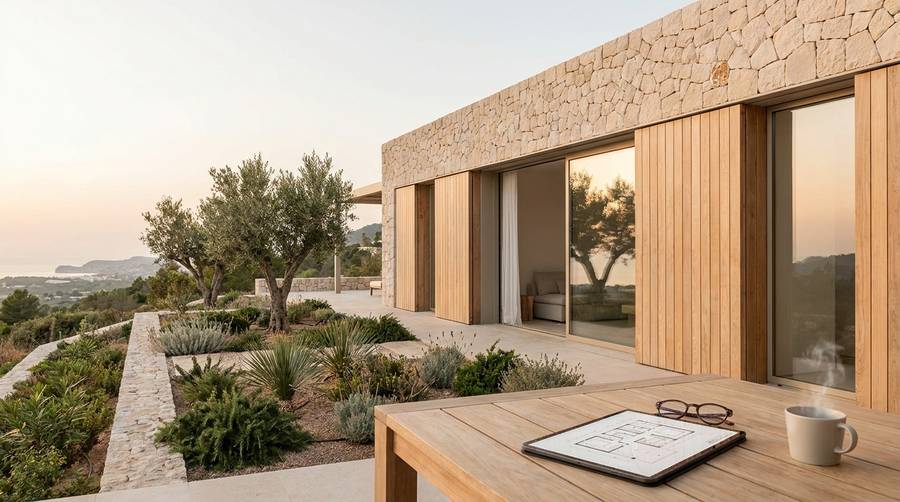
Description: Photographic editorial image of a finished Mediterranean contemporary home in Spain, reflecting the Findnido aesthetic. Real, premium house with light façades, natural stone and wood accents, and large windows that capture soft golden-hour light. A tidy garden and terrace frame the scene, with a young couple reviewing plans on the porch to imply autopromotion. The composition should feel warm, lived-in and aspirational but achievable. Use natural colors, architectural magazine quality framing and avoid any exposed construction elements, container-like modules, or industrial settings. The atmosphere should convey trust, comfort and sustainability.
Next step: Use the checklist above to prepare your plot documents and request two fixed-price quotations from reputable modular manufacturers. When you have those, book an advisor call to review financing options — the right early decisions save months and thousands of euros.
Artículos relacionados