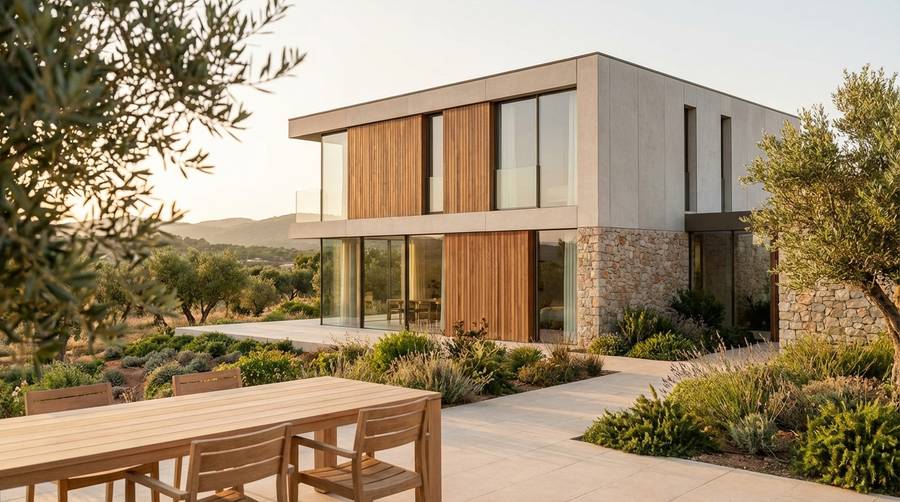
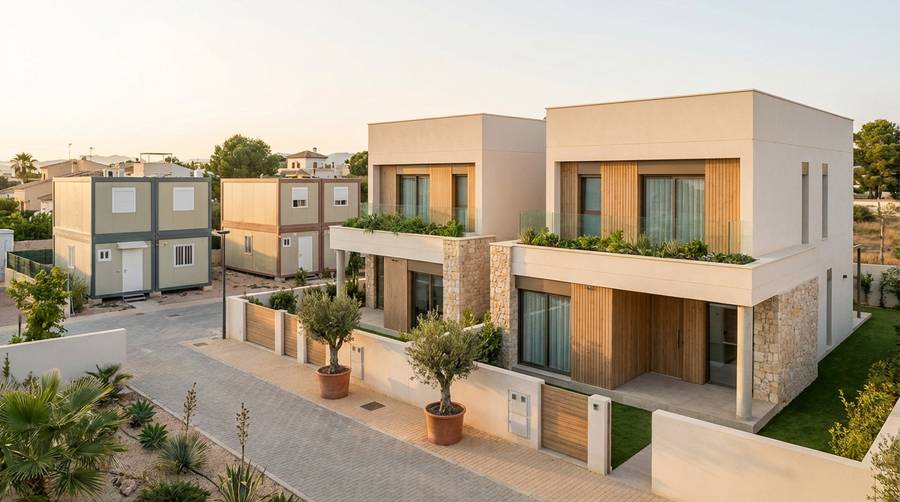
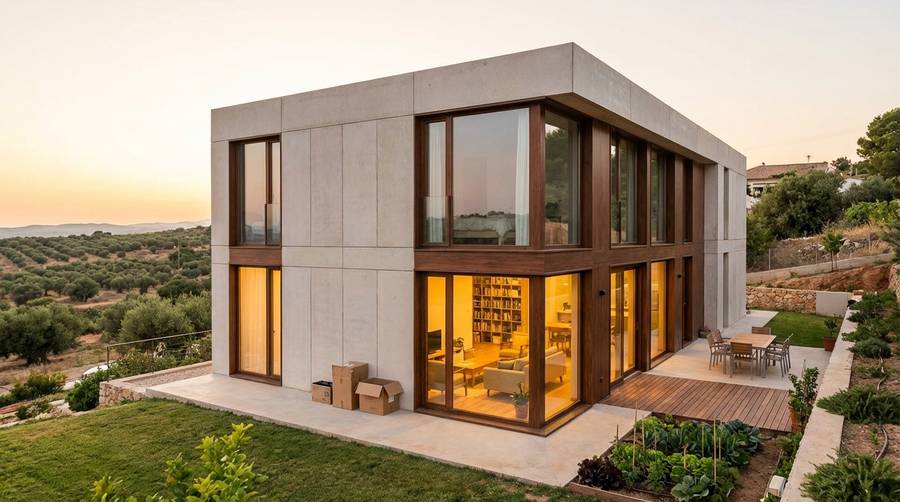
Prefabricated Housing in Spain: Compare, Choose, Decide
Why choose prefabricated housing in Spain today
Hook: If you want a modern, energy-efficient home delivered on a predictable budget and timeline, prefabricated housing is no longer a niche — it’s mainstream.
This section explains the market drivers, the clear advantages vs traditional building, and which self-builder profiles fit best with modular and industrialized homes.
Current market context and affordable housing needs
Spain faces a persistent demand for affordable, high-quality housing. Rising materials and labor costs, coupled with long approval queues, push many buyers to seek alternatives. Prefabricated housing (also called modular or industrialized housing) is scaling rapidly because it moves key work off-site, reduces waste and compresses schedules.
General advantages vs traditional housing: time, cost and predictability
- Shorter calendars: Factory production and on-site work run in parallel, making delivery typically 30–60% faster than traditional builds of similar complexity.
- Fixed-price clarity: Contracts often include a guaranteed turnkey price, limiting scope creep and surprise overruns.
- Quality control: Industrialized processes reduce variability; repeated assembly yields consistent workmanship.
Self-builder profile: when this model fits
Prefabricated housing suits clients who want:
- Firm timelines (e.g., relocating families or investors).
- Energy-efficient, modern designs with controlled budgets.
- Less involvement in daily site coordination but a willingness to manage decisions early (design, finishes, permits).
Technical comparison: prefabricated vs traditional housing
Here we compare build quality, timelines and costs using objective markers so you can weigh trade-offs.
Constructive quality and industrial control
Prefabricated: Controlled environment, standardized inspections and serial production reduce defects. For example, factory humidity and curing control for concrete or timber panels produce predictable thermal and acoustic performance.
Traditional: Site-built variability depends heavily on contractor supervision and weather. High-quality results are possible but require strong project management and often higher contingencies.
Execution times, fixed schedules and risk reduction
- Off-site manufacturing: Works regardless of on-site weather; on-site time focuses on foundations and assembly.
- Predictable milestones: Production lines allow suppliers to promise completion windows — useful for financing and personal planning.
- Risk shifts: Factory defects are easier to rectify than complex on-site errors, and warranties are clearer.
Costs: fixed price, variations and numerical ranges
Typical cost ranges in Spain (indicative, 2025 market averages):
- Entry-level modular single-family (basic finishes): €1,200–€1,600/m² turnkey.
- Mid-range modular with better envelopes and equipment: €1,600–€2,200/m².
- High-end or Passivhaus-equivalent modular: €2,200–€3,000+/m².
Compare to traditional builds where site complexity, finishes and contractor margins typically put turnkey prices from €1,400–€3,200/m² depending on region and specification. The key advantage of prefabrication is cost predictability and reduced risk of upward variation.
Modern materials and recommended systems
Choosing the right structural system is critical for performance, timeline and lifecycle costs. Below are three dominant systems used in Spain’s industrialized housing market.
Industrialized concrete: durability and thermal performance
Pros: Excellent durability, thermal mass and fire resistance. Precast concrete panels and insulated sandwich elements provide robust acoustic and thermal performance.
Cons: Heavier logistics and higher foundation requirements; initial footprint cost can be higher but long-term maintenance is low.
Light timber frame: speed, comfort and sustainability
Pros: Rapid assembly, high thermal insulation potential and lower embodied carbon when sourced responsibly. Timber frames pair well with breathable membranes and natural finishes for a warm interior.
Cons: Requires strict moisture management and good detailing at joints. Fire engineering and approvals must be handled early in design.
Steel frame: precision, adaptability and structural performance
Pros: High precision, long spans possible, and ideal for flexible layouts. Steel systems are quick to assemble and integrate with mechanical systems.
Cons: Thermal bridging must be mitigated carefully; corrosion protection and detailing add cost.
Sustainability and energy efficiency in industrialized homes
Industrialized housing offers an advantageous platform for high energy performance because components are designed and tested before assembly.
Meeting Passivhaus standards and reducing carbon footprint
Achieving Passivhaus (or near-Passivhaus) is feasible with modular systems by focusing on:
- High-performance envelope (U-values ≤ 0.15–0.20 W/m²K).
- Continuous airtightness and quality-controlled assembly.
- Mechanical ventilation with heat recovery (MVHR) sized for the home.
Passive and active strategies: envelope, ventilation and renewables
Key measures that yield predictable savings:
- Orientation and shading design to reduce cooling loads.
- Super-insulation and thermal bridges elimination.
- MVHR with high heat recovery (>80%) and photovoltaic panels sized to household use.
Measuring impact: consumption and energy savings examples
Realistic performance expectations (measured in comparable projects):
- A well-executed modular home with MVHR and PV can reduce primary energy demand by 60–85% compared to a code-minimum Spanish home.
- Operational savings often reach €500–€1,200/year depending on size and local energy prices.
Factory-controlled assemblies plus rigorous airtightness are the most reliable levers to reach Passivhaus-like performance in the Spanish climate.
Turnkey process for self-builders: step by step
Turnkey delivery simplifies the self-build experience by centralizing responsibility. Below is a practical phased roadmap and what to expect in each stage.
From finding a plot to handover: phases and responsibilities
- Site selection and feasibility: soil study, access, and local planning constraints.
- Design and specification: fixed drawings, materials, and performance targets.
- Permitting: submission to local Ayuntamiento and building permits.
- Factory production & foundations: off-site manufacture runs alongside on-site foundation work.
- Assembly and connections: module installation, systems hookup and finishes.
- Final tests & delivery: airtightness test, commissioning and formal handover.
Permits, coordination with utilities and quality control
A solid project manager should coordinate:
- Utility connections and meters scheduling.
- Third-party testing (air tightness, electrical and plumbing sign-offs).
- Warranty documentation and aftercare plan.
Decision checklist: timelines, milestones and guarantees to demand
- Clear turnkey price and what it includes/excludes.
- Production and assembly milestones with penalties or remedies.
- Performance guarantees (airtightness, U-values, MVHR efficiency).
- Manufacturer and installer warranties (minimum 2–10 years depending on element).
Financing, mortgages and economic models for self-build
Financing modular projects requires an approach tailored to staged payments and turnkey delivery. Banks in Spain increasingly allow mortgages and construction loans for these projects, but preparation matters.
Financing options for modular housing and self-build
- Construction-to-permanent loans: release funds by milestones and convert to a mortgage at completion.
- Mortgage with phased drawdowns: lenders release amounts upon independent certification of progress.
- Manufacturer financing: some modular manufacturers provide bridging credit for the factory phase.
Preparing documentation to persuade a bank
To obtain favorable terms, present:
- Detailed turnkey contract with schedule and fixed price.
- Independent technical specifications and performance guarantees.
- Permits or proof of pending approvals.
- Cashflow plan showing drawdown needs and buffer for contingencies.
Real case financial structure: example
Example structure for a 140 m² home:
- Turnkey price: €210,000 (€1,500/m²).
- Down payment 15%: €31,500 (reservation + design fees).
- Construction drawdowns: 50% during factory (staged), 25% at assembly, 10% at handover.
- Mortgage conversion: remaining balance rolled into a 20–25 year mortgage at market rates.
Practical guide and case study: design and real outcomes
This section gives a step-by-step design guide for 2026 and an anonymized case study with metrics to help you compare expectations to reality.
How to design an industrialized home step-by-step (Spain, 2026)
- Brief and budget: define size, rooms, performance targets (e.g., near-Passivhaus), and landscape constraints.
- Choose system: timber frame for faster turnaround and comfort; steel for flexibility; precast concrete for durability.
- Technical package: envelope U-values, airtightness target, MVHR sizing, PV estimate.
- Procure turnkey vendor: evaluate samples, warranties and factory visits where possible.
- Secure financing and permits: present detailed package to bank and obtain building permit.
- Production & assembly: follow milestones, schedule independent testing and final commissioning.
Case study: metrics of time, cost and client satisfaction
Project summary (anonymized family home, Mediterranean coast):
- Size: 150 m² gross.
- System: timber frame with high-performance envelope.
- Turnkey cost: €255,000 (€1,700/m²).
- Factory time: 10 weeks. On-site assembly and connections: 6 weeks. Total from contract to handover: 26 weeks (includes permitting).
- Measured airtightness: 0.38 ACH at 50 Pa. Annual energy use: 20 kWh/m²/year (heating + cooling), delivered by MVHR + PV offsetting 60% of electrical demand.
- Client satisfaction: 9/10 — praised schedule predictability and indoor comfort; noted challenges: permit delays and landscape drainage works cost.
Lessons learned and recommendations
- Start permits early — permitting delays are still the most common schedule risk.
- Define performance targets in the contract to avoid later disputes.
- Allocate contingency for site-specific groundworks (drainage, retaining walls).
Balanced conclusion: when and why opt for prefabricated housing
Summary of advantages and limitations by profile
Best fit: families or investors who value schedule certainty, energy performance and modern design with predictable costs.
Limitations: clients needing extreme customization or who prefer to phase finishes over many years may find factory processes constraining.
Final decision checklist to decide confidently
- Do you need a predictable completion date? If yes, prefer prefabricated.
- Do you require Passivhaus-level performance? Verify manufacturer credentials and testing records.
- Is your plot complex? Factor extra for foundations and access handling.
- Have you secured financing that accepts staged modular drawdowns?
Resources and next steps
For deeper guidance on materials and financing, see our companion guide Vivienda prefabricada: ventajas, materiales y financiación and a practical family case study at Vivienda prefabricada: caso real de transformación familiar. Both resources complement this comparison with procurement templates and lender-ready documentation.
Call to action: If you’re considering a self-build, compile your plot information and target budget — a concise advisory session can clarify whether a prefabricated turnkey route saves you time and money. Contact us for a tailored feasibility review.
Artículos relacionados