Time–Cost of Prefabricated Housing in Spain
Why Time and Cost Are Redefining Industrialized Housing in Spain
Hook: In 2026, building fast is building smart: prefabricated housing has moved from niche to strategic option for Spanish self-builders because speed and predictable costs now determine viability.
The convergence of supply-chain maturation, regulatory nudges toward energy efficiency and rising site costs has placed time and cost at the center of decisions about residential construction. This section distills the macro signals and shows why industrialized methods are no longer just an alternative—they are often the optimal route for autopromoters.
Current landscape: key sector figures 2025–2026
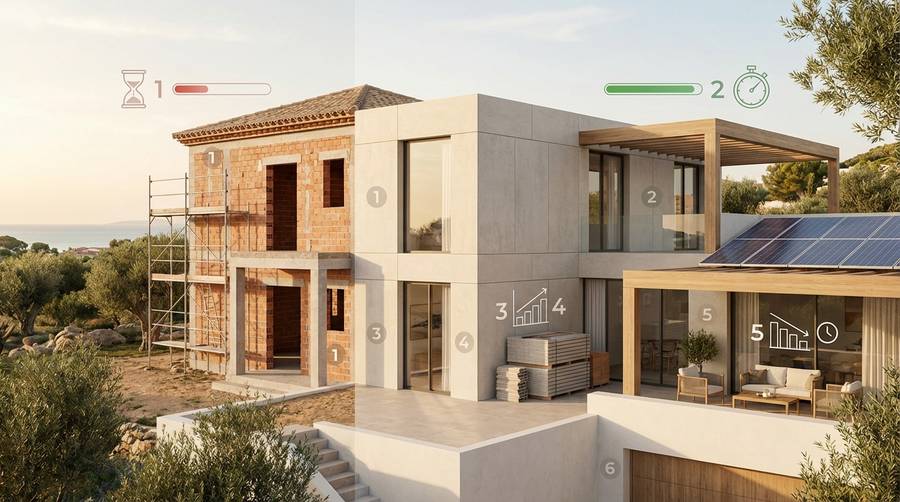
Recent market indicators show accelerated adoption: modular and prefabricated dwellings represented an estimated 8–12% of new single‑family starts in Spain by 2025, with year-on-year growth above 20% in regions with active renewable incentives. Typical delivery times for turnkey prefabricated single-family units now range from 4 to 8 months from breaking ground to handover, compared with 12–24 months for conventional builds.
Multiplier effects: how time savings influence final cost
Time is not a neutral parameter. Shorter schedules reduce financing interest, interim accommodation costs, and escalation risks for labor and materials. In practice, a 40% reduction in on-site time can translate to a 6–12% reduction in total project cost once soft costs and financing are included.
Regulatory and market trends accelerating adoption
EU and Spanish regulations pushing for near‑zero energy buildings (NZEB) and incentives for low-carbon construction increase the value proposition of factory-controlled assemblies. Insurance and lender familiarity are improving, which lowers the perceived risk premium for modular projects and encourages mainstream mortgages for self-builders.
Shorter, predictable schedules are the single most powerful lever to reduce total delivered cost in modern housing projects.
Practical Guide: How to Calculate Time–Cost for a Turnkey Project
For autopromoters, an operational calculation of time and cost is a decision tool. Below is a pragmatic framework to quantify schedule-driven savings and to compare alternatives with transparency.
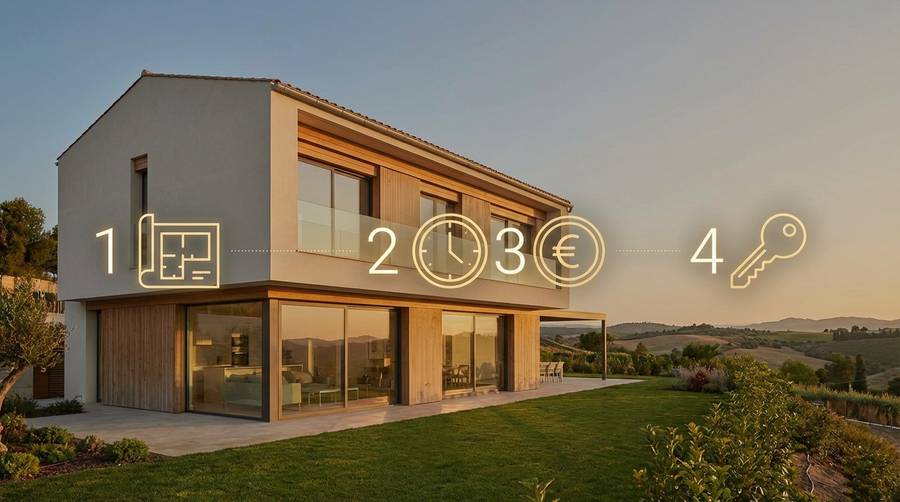
Project phases and critical checkpoints: from plot to handover
- Site selection & due diligence (0–2 months): timber suitability, access, geotechnical and grid connections—these determine logistic complexity.
- Design and permits (2–6 months): industrialized systems reduce revision cycles because components are standardized, often shortening approval iterations.
- Factory production (2–4 months): parallelizes with site work, minimising on-site duration.
- Logistics and assembly (1–3 months): crane days and site finishes are critical path; efficient staging cuts risk.
- Commissioning and handover (0.5–1 month): including energy performance verification (e.g., thermal tests for Passivhaus targets).
Tools and metrics to estimate schedule and budget with precision
Use a layered estimation method:
- Bottom-up task estimates: detailed day-counts per critical activity (crane time, interior finishes).
- Factory lead indicators: module lead time variability (use historical sigma to model risk).
- Cashflow modelling: integrate tranche payments and mortgage interest to capture financing cost of time.
- Sensitivity analysis: test +/- 10–15% on lead times to quantify cost exposure.
Managing contingencies and fixed-price clauses
For turnkey contracts, prioritize clear scope boundaries. Typical clauses include:
- Price escalation caps: indexation linked to specific material baskets (steel, timber).
- Liquidated damages for schedule delays: appropriate when your finance cost is sensitive to handover date.
- Force majeure definitions: limit vague language to preserve accountability.
Technical Comparison: Prefabricated vs Traditional Construction (Data and Examples)
This section compares typologies (light timber frame, steel frame, industrialized concrete) using measured indicators: on-site time, direct/indirect cost breakdown and energy performance.
Construction times by typology
Based on recent project datasets:
- Timber light-frame: factory fabrication 6–10 weeks; site assembly 2–4 weeks. Total on-site time often < 8 weeks.
- Steel frame: comparable factory lead times; assembly slightly faster for multi-storey due to repeatability.
- Industrialized concrete panels: longer curing and heftier logistics but excel on durability and acoustic performance; on-site assembly 3–6 weeks.
Breakdown of direct and indirect costs
Direct costs (materials, main contractor) are often similar across systems when adjusted for performance. The differentiator is indirect cost:
- On-site labor: reduced up to 50% with prefabrication.
- Logistics: higher but predictable—advance planning turns this into a cost control lever.
- Financing and soft costs: shorter schedules markedly reduce interest and supervision fees.
Impact on quality and energy efficiency: Passivhaus and real performance
Factory-built envelope systems achieve tighter tolerances for thermal bridges and airtightness. Measured results from certified projects indicate easier attainment of Passivhaus‑equivalent performance with less on-site remedial work, translating into lifetime operational savings that should be capitalized in project ROI models.
Materials and Processes That Accelerate Schedules and Cut Costs
Choosing the right materials and production strategy is decisive. Here we contrast operational advantages and trade-offs.
Operational advantages of industrialized concrete versus light assemblies
Industrialized concrete brings superior thermal mass and acoustic performance with high repeatability in factory conditions. It requires careful logistics and foundation coordination but reduces on-site finishing time. Light timber systems maximize speed and reduce weight-related site constraints; they typically lower embodied carbon if sourced responsibly.
How modular design and factory prefabrication reduce uncertainty
Standardized modules lower design iterations and simplify regulatory review. They also allow parallel workflows: while foundations are prepared, modules are built off-site. This parallelization is the main driver of schedule compression.
Sustainable economics: operational savings and carbon as a value lever
Energy-efficient envelopes and integration of renewables reduce lifetime costs. In many cases, achieving high energy performance qualifies projects for subsidies or favourable mortgage terms, effectively reducing upfront financing cost and improving net-present-value.
Real Case Studies: Time, Cost and Satisfaction Metrics
Below are anonymized, representative projects built with industrialized systems, showing empirical results and lessons learned.
Project A — Single-family home in Andalusia: schedule, budget and takeaways
Typology: timber light-frame; area: 180 m².
- Planned timeline: 7 months. Actual: 6 months.
- Budget: fixed-price €210,000 turnkey. Final cost variance: +1.8% (minor change orders).
- Energy: predicted primary energy 45% below national code; achieved net reduction in annual bills ~€900.
Lessons: early site survey and logistics planning reduced delivery delays; a fixed-price contract protected the autopromoter from material inflation.
Project B — Mediterranean duplex: material comparison and outcomes
Two identical duplexes: one steel frame, one industrialized concrete. Both delivered within 8 months. The steel-frame unit had 7% lower construction cost but slightly higher projected maintenance at 30 years; the concrete unit delivered better acoustic comfort and higher resale perception.
KPIs and autopromoter testimonials
- Average handover time: 5.5 months (prefab) vs 16 months (traditional).
- Customer satisfaction: 86% high satisfaction in survey covering cost predictability and thermal comfort.
- Autopromoter comment: “Predictability was decisive—we could secure a mortgage because the handover date was credible.”
Financing and Economic Models for Autopromoters in Modular Housing
Financing autopromotion requires bridging construction cashflows with mortgage structures and payment models that reflect factory production.
Mortgage options and requirements for 2026 self‑build projects
Spanish lenders increasingly offer tailored products for self-build modular projects. Key requirements often include:
- Detailed turnkey contract with phased payment schedule.
- Certified energy-performance projections (useful for green mortgage eligibility).
- Independent cost and schedule verification by a technical valuer.
Payment models for turnkey projects and risk mitigation
Common models:
- Staged payments linked to milestones: foundations, factory completion, assembly, certification.
- Escrowed tranche release: mitigates counterparty risk for autopromoter and lender.
- Retention accounts: small retainers until final commissioning to ensure defects handling.
Incentives and public support for energy‑efficient industrialized housing
National and regional programmes now prioritize low‑carbon construction. Projects that meet high-efficiency standards frequently access grants or reduced-rate loans—another reason to consider Passivhaus-compatible assemblies from the outset.
Future Outlook: Scenarios 2026–2035 for Time–Cost in Prefabrication
Projecting forward, three converging forces will shape the next decade: process automation, better integration with digital design tools, and financial product evolution. Below are concrete expectations and tactical recommendations for autopromoters.
Expected innovations that will shorten schedules and lower unit costs
- Higher factory automation: reduced module cycle times and quality variance.
- Digital twin workflows: fewer RFIs and faster permit-ready documentation.
- Supply-chain consolidation: just-in-time logistics tailored for local Spanish contexts, reducing storage and handling costs.
Business strategies to retain competitiveness and customer trust
- Standardize options while allowing localized customization.
- Offer transparent, lender-friendly documentation to simplify mortgage underwriting.
- Invest in post‑handover support to improve satisfaction and referral rates.
Practical recommendations for autopromoters who want to get ahead
- Start with a comprehensive site and regulatory feasibility study to avoid late surprises.
- Choose a turnkey partner with verifiable delivery metrics and a factory production cadence aligned to your schedule.
- Model financing scenarios that include both construction interest and long-term operational savings from high-efficiency design.
For hands-on guidance on coordinating design and supplier timelines, see our practical walkthrough How to design an industrialized home step by step and for focused advice on optimizing time and cost in prefabrication visit Prefabricated housing: optimize time and cost.
Conclusion
Time and cost are inseparable in modern housing delivery. For autopromoters in Spain, industrialized construction offers a defensible route to predictable budgets, faster handovers and measurably better energy performance. The smart approach combines rigorous upfront due diligence, clear turnkey contracts and financing plans that reflect the real schedule advantages of factory production.
If you are considering a modular or prefabricated project, start by benchmarking expected timelines and financing costs side-by-side—and ask for independent verification of factory lead times. For tailored support, contact our advisory team to analyse your plot and project constraints.
Call to action: Reflect on your project milestones now—shortening the schedule by a few months can transform feasibility. Reach out to explore precise time–cost modelling for your plot.
Image prompt for Findnido: Editorial high-quality photo of a finished Mediterranean contemporary single-family home in Spain at golden hour. Light façade combining natural stone, warm wood accents and polished concrete elements. Large windows with warm interior glow, a planted terrace with Mediterranean shrubs and a family casually enjoying the outdoor space in the background. Photographic, magazine-style framing, natural colors, premium and lived-in atmosphere that communicates trust, comfort and sustainability. No exposed construction, no modular boxes, no warehouses—real home, aspirational yet achievable, in line with Findnido brand.