Industrialized Passivhaus: A Family's Turnkey Success
A dream realized: how one family achieved an industrialized Passivhaus
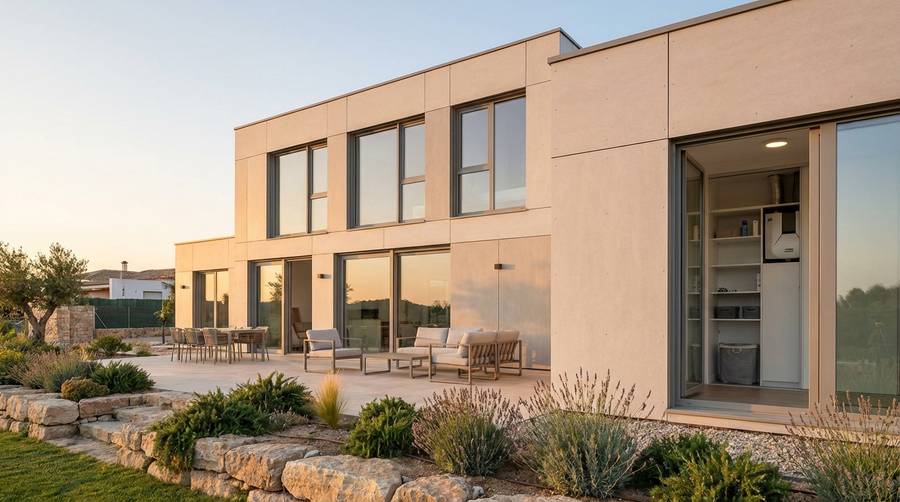
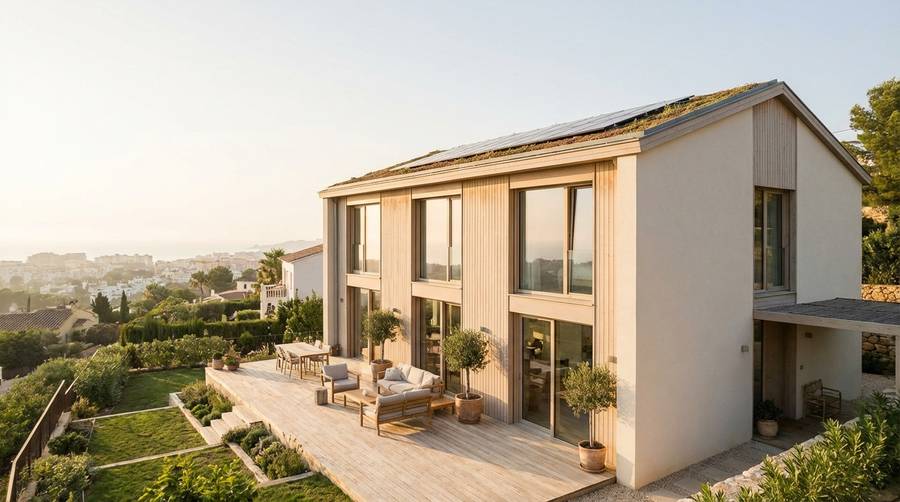
Hook: When Marta and Luis decided to stop renting and build a forever home, they wanted comfort, low bills and a clear schedule. Sixteen months after signing the contract, they moved into a certified industrialized Passivhaus that matched the budget and the lifestyle they imagined.
This case study walks through the project with concrete data: choices that mattered, measurable energy performance, key suppliers, and the process of a true turnkey modular home delivery in Spain.
Initial context: needs, plot and efficiency goals
Marta and Luis are a family of four. Their priorities were:
- Low operational costs (target: < 30 kWh/m²·yr heating demand).
- Fixed price and predictable timeline for financing approval.
- Healthy indoor air and acoustic comfort for remote work and children.
They bought a 520 m² plot on the Mediterranean outskirts of Valencia. The parcel allowed a compact, South-oriented layout—an ideal starting point for an industrialized Passivhaus approach.
Why industrialize: emotional and practical drivers
The family prioritized certainty. Traditional builds had too many unknowns: open-ended schedules, latent defects and frequent onsite decisions. The promise of a prefabricated house with factory-controlled quality and short on-site time fit their need for predictability.
Emotionally, the idea of a modern, bright home with minimal maintenance appealed. Practically, the industrialized route offered fixed-cost contracting that simplified mortgage discussions and eliminated the stress of constant onsite supervision.
Project summary: timeline, budget and team
- Contract signed to keys handed over: 16 months.
- Budget (turnkey, incl. plot works and landscaping): €320,000.
- Delivery team: modular manufacturer, local Passivhaus certifier, MEP contractor, and an independent quality auditor.
The project targeted formal Passivhaus certification. The client chose an industrialized Passivhaus because it offered the best balance between energy performance and cost certainty.
“The factory-controlled process reduced on-site surprises and made the final energy numbers predictable — we hit 22 kWh/m²·yr in practice.”
Technical choices: materials and systems that secured Passivhaus certification
System comparison: precast concrete vs light timber frame vs steel frame
Three structural systems were evaluated for durability, cost, thermal inertia and industrialization maturity:
- Precast/industrialized concrete: High thermal mass and durability. Slightly higher up-front cost but excellent acoustic performance.
- Light timber frame (timber panelized): Fast production, lower embodied carbon in material, and excellent insulation integration. Best for quicker manufacture and lighter transport.
- Steel frame (steel frame modular): Very precise tolerances, efficient for repetitive modules, but with higher thermal bridging risk without careful detailing.
The family chose a hybrid approach: a light timber frame for the main envelope with reinforced concrete elements for the foundation and selected retaining walls. This combination balanced embodied carbon, speed and acoustic comfort.
Envelope and airtightness solutions that mattered
Key actions that delivered Passivhaus-level airtightness and thermal continuity:
- Continuous insulation with high-performance wood-fibre boards.
- Factory-installed airtight membranes and pre-cut penetration seals.
- On-site airtightness testing at three stages: pre-assembly, post-assembly and pre-handover.
These steps reduced on-site variability and ensured the building achieved a 0.45 ACH50 target during certification testing.
Critical components: windows, insulation and MVHR
The team's specification included:
- Triple-glazed, wood-aluminum composite windows with Uf ≤ 0.9 W/m²K.
- High-density natural insulation in external walls (λ ≤ 0.038 W/mK).
- Mechanical Ventilation with Heat Recovery (MVHR) sized for 0.4 ACH and balanced commissioning.
These components provided low thermal losses and excellent indoor air quality — central to the family's comfort.
The turnkey process explained with real numbers
Project phases: from plot search to handover
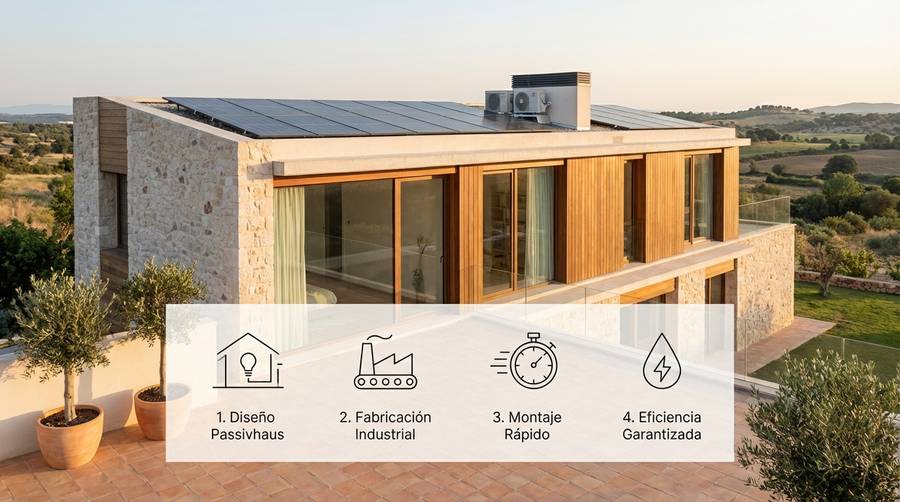
The turnkey workflow reduced friction by defining clear milestones:
- Feasibility and plot validation (4 weeks): orientation, shading study, and basic topography.
- Design and pricing (8 weeks): schematic design, energy model, fixed price offer.
- Factory production (12 weeks): panel manufacture, pre-assembly and quality checks.
- On-site assembly and connections (8 weeks): foundations, crane set, MEP hook-ups.
- Commissioning and certification (4 weeks): airtightness, MVHR balancing, Passivhaus evaluation.
Total on-site assembly time was eight weeks, minimizing neighborhood disruption and weather-related delays.
Time-certain delivery in industrialized construction: schedule and variances
Compared to a conventional build (often 18–30 months), the industrialized turnkey route delivered in 16 months total. Deviations were minor and documented:
- Permit delays: +6 weeks (municipal processing).
- Transport of large panels: +1 week due to oversized load permit timing.
Because the contract used price escalation clauses for rare supply events only, the fixed price integrity remained intact.
Cost control and fixed-price guarantees: main budget lines
Primary cost breakdown (approximate):
- Manufacturing & modules: 46% of total.
- Foundations, site works & connections: 18%.
- MEP, MVHR and windows: 16%.
- Design, certification and management: 8%.
- Landscaping, finishes and contingencies: 12%.
The turnkey contract included completion warranties and a snagging period with defined corrective timelines, which protected the family from late-stage surprises.
Measurable results: efficiency, cost and client satisfaction
Energy metrics and carbon reductions
Measured performance after 12 months of occupancy:
- Heating demand: 22 kWh/m²·yr (below the targeted <30 kWh/m²·yr).
- Primary energy use (including domestic hot water and fans): 48 kWh/m²·yr.
- Estimated operational CO2 reduction vs local conventional home: ~64% annually.
These figures were validated by the Passivhaus certifier and reflected careful detailing and occupant behavior guidance provided at handover.
Cost comparison and operational savings vs traditional build
While the turnkey industrialized route had a slightly higher up-front cost than a low-end traditional build, the family's life-cycle outlook changed the comparison:
- Annual energy cost savings estimated at €700–€900 compared to a similar-sized traditional house.
- Lower maintenance expectations and a 10-year reduced risk of defects thanks to factory QA.
When financed with a mortgage, the predictable schedule and fixed price simplified approval and risk assessment by lenders. For autopromoters, this predictability is often the decisive financial advantage.
Client satisfaction: comfort, acoustics and delivery experience
A post-occupancy survey at 6 months reported high satisfaction:
- Thermal comfort: 9/10
- Acoustic comfort: 8/10
- Delivery experience (timing and communication): 9/10
Marta highlighted that the MVHR system noticeably improved air quality during winter and reduced condensation and seasonal allergies for the family.
Technical and practical comparison with traditional construction
Advantages in schedule and quality control: numeric examples
- On-site time reduced by ~60% versus an equivalent conventional build.
- Fewer on-site trades reduced coordination errors and rework by an estimated 40%.
- Airtightness targets reached on the first test in 70% of factory-sealed systems vs 30% in typical site-built homes.
Limitations and how the team mitigated them
Common constraints include transport logistics, permit alignment and design flexibility. The project mitigated these by:
- Early oversized-load permit applications.
- Design freezes at contract signing to avoid costly late changes.
- Using a hybrid structural approach to allow greater on-site adaptation where needed.
Financing differences: mortgages for self-build and modular housing
For autopromoters in Spain, lenders differentiate between speculative developers and owner-occupier self-builders. The project's fixed price and the turnkey structure simplified the mortgage process by providing:
- Clear milestones for staged drawdowns.
- Documented warranties and third-party certification (Passivhaus) to reduce perceived risk.
Many banks offered competitive terms once the lender saw a validated turnkey contract and the energy model used for mortgage risk assessment.
Quick guide: how to replicate this industrialized Passivhaus in Spain (2026)
Pre-checklist: plot, regulations and Passivhaus prerequisites
- Confirm local zoning for detached housing and solar access.
- Run an early shading and orientation study to optimize passive gains.
- Engage a Passivhaus consultant before detailed design to set targets early.
For a practical step, review our technical guidance in Vivienda industrializada Passivhaus: visión 2026–2035 and the detailed guide Vivienda industrializada Passivhaus: guía práctica 2026.
Design and budget decisions for autopromoters
- Prioritize a compact plan to reduce envelope area and cost.
- Select factory-integrated windows and MVHR to reduce on-site variability.
- Build contingencies into the finance plan for permit timing rather than construction overruns.
How to choose a turnkey provider
Key selection criteria:
- Proven Passivhaus projects and third-party certification experience.
- Clear scope with fixed-price milestones and defined snagging terms.
- Transparent communication channels and a dedicated project manager.
For an example of a completed certified project, see Casa prefabricada Passivhaus: caso real en España, which highlights post-occupancy results similar to this case study.
Lessons learned and next steps for aspiring industrialized homeowners
Common mistakes and practical recommendations
- Avoid late design changes after factory sign-off; they are costly and delay delivery.
- Invest in early site logistics planning to prevent transport delays.
- Document occupant behavior guidance at handover to protect expected energy performance.
Future opportunities: sustainability, innovation and market outlook 2026
Industrialized housing is maturing: better material choices (lower embodied carbon timber products), integrated renewable energy options, and financing products tailored for self-builders make Passivhaus-level modular homes increasingly accessible.
For hands-on technical steps to reach Passivhaus in an industrial process, review our practical checklist in Vivienda industrializada Passivhaus: guía práctica 2026.
Final message: why industrialization is a realistic and achievable path
This family’s story demonstrates that an industrialized Passivhaus is not an abstract ideal: it is a practical path to comfort, low energy bills and schedule certainty. With the right team, early decisions and realistic financing, autopromoters in Spain can achieve high-performance homes that feel premium and lived-in.
Call to action: If you are considering a turnkey modular home, start by validating your plot and energy goals — and contact a certified industrialized Passivhaus provider to get a fixed-price feasibility study tailored to your needs.
Artículos relacionados