Time-Cost Advantage of Prefabricated Homes
Time-Cost Advantage of Prefabricated Homes
Hook: Want a reliable completion date and a fixed final price for your self-built home in Spain? Industrialized housing can deliver both—when managed correctly.
This guide explains, with concrete metrics and actionable checks, how the time-cost approach in prefabricated housing turns uncertainty into predictable outcomes for autopromoters.
Prefabrication shifts risk from the open site to a controlled factory environment—reducing schedule variance and cost overruns by design.
1. What the 'time‑cost' approach means for prefabricated housing
Clear definition: project timeline vs total cost
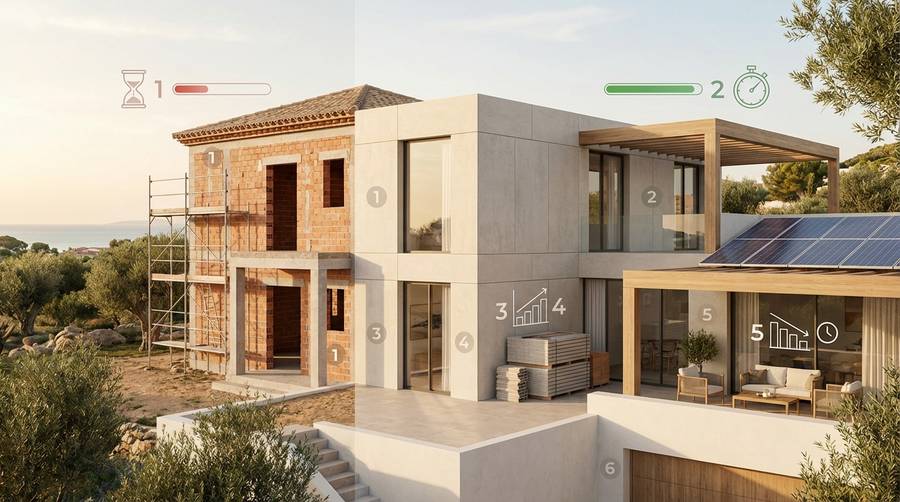
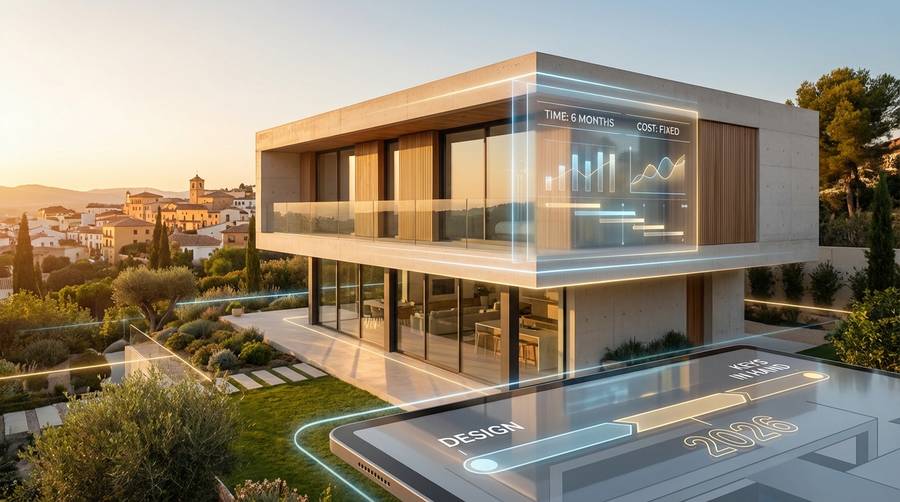
Time-cost refers to designing the delivery model so that the project schedule (delivery date) and the total cost (final contract price) are both predictable. For autopromoters, that means moving away from open-ended site works and toward a factory-led process where major elements are produced under controlled conditions.
Why this matters for autopromoters in Spain
Autopromoters often face three main pain points: long on-site durations, variable budgets, and permit delays. Prefabrication reduces the first two by compressing on-site work and fixing many cost components before breaking ground.
Expected outcomes: closed timelines and fixed budgets
- Shorter on-site phase: typically 30–60% less time on site compared with traditional builds.
- Budget certainty: a fixed-price contract that limits unpredictable change orders.
- Quality consistency: factory conditions reduce rework and defects.
2. Key advantages: how prefabrication reduces time and controls costs
Factory production and parallel workflows: shorter total duration
In prefab projects, while the site is being prepared (permitting, foundations), the factory can already be producing modules or panels. This parallelism is the core time advantage:
- Overlap tasks: site and factory work run simultaneously.
- Predictable cycle times: factories use repeatable processes with established takt times.
- Less weather dependency: fewer stoppages due to rain or cold spells.
Fixed pricing and fewer budget deviations
Because the largest cost items—fabrication, core finishes, and systems—are specified early, contracts can be fixed or include tightly scoped contingencies. Effective measures include:
- Detailed Bill of Materials (BoM) tied to contract stages.
- Change-control clauses that price variations with transparent rates.
- Supplier bundling for long-lead items to reduce markups.
Fewer surprises on site: impact on schedule and quality
Factory assembly reduces on-site coordination between multiple trades and minimizes unforeseen site conditions. That leads to:
- Lower rework rates and faster inspections.
- Improved final quality—less variability in finishes and systems.
- Smoother handover with documented factory test reports.
3. Materials and systems that optimize time‑cost
Industrialized concrete: fast structure, durable performance
Precast concrete elements (beams, walls, decks) speed up structural assembly and reduce curing-related delays. Benefits include:
- Rapid structural completion—large panels can be installed in days.
- Long-term durability and low maintenance in Mediterranean climates.
- Compatibility with high-performance façades and thermal mass strategies.
Light timber frame and steel frame: lightweight and rapid assembly
Both timber and steel framing excel when speed and weight matter:
- Timber frame (entrama-do ligero): excellent for insulation integration and quick panelized assembly. Works well for low-rise housing and Passivhaus targets.
- Steel frame: higher strength-to-weight ratio, ideal for larger spans and faster bolted connections on site.
Choosing between them depends on the parcel, span requirements, and desired thermal performance.
Choose by climate, plot and energy targets (Passivhaus)
Match materials to both the Spanish microclimate and the energy goal. For example:
- Coastal, mild climates: timber frame with high insulation and passive shading.
- Interior, hot summers: concrete elements provide thermal mass and stabilize indoor temperatures.
- For Passivhaus certification: prioritize airtight panel systems, factory-tested thermal bridges solutions, and integrated mechanical ventilation with heat recovery.
4. The turnkey process to minimize delays and cost overruns
From plot search to handover: stages and time milestones
A well-defined turnkey path contains clear milestones and timelines. Typical stages:
- Plot selection and feasibility (0–2 months)
- Concept and fixed-price offer (1–3 months)
- Permitting and factory scheduling (3–6 months)
- Factory production (4–12 weeks, depending on scope)
- Site works and installation (2–8 weeks)
- Commissioning and delivery (1–2 weeks)
Note: overlapping permits and fabrication is the key to compressing total project time.
Coordinate design, permits and factory to avoid bottlenecks
Common delays arise when design is incomplete at factory start or permits lag. Mitigation tactics:
- Use a single integrated project schedule shared by design, factory and site teams.
- Lock down finishes and systems early in the contract to avoid late scope changes.
- Assign a dedicated planner to track long-lead times and permit milestones.
Financing and autopromoter mortgages without schedule slips
Financing autopromotion requires aligning drawdowns with clear project stages. To avoid costly interest and delays:
- Secure a construction or autopromoter mortgage structured around turnkey milestones.
- Include buffer contingencies in the financing plan (typically 5–7% for industrialized projects with fixed price).
- Provide lenders with factory acceptance reports and a validated installation timeline to accelerate approvals.
5. Real cases and metrics: timelines and costs verified
Case study 1: 120 m² home — timelines and budget deviation
Project profile: single-family 120 m², timber-frame panelized system, suburban plot near Valencia.
- Feasibility to fixed offer: 7 weeks
- Factory production: 8 weeks
- Site installation and finishes: 5 weeks
- Total delivery time from contract signing: 20 weeks
- Budget deviation: +1.5% (minor variations due to client-chosen finish upgrades)
Key takeaway: parallel permitting and production compressed time by 40% vs a comparable traditional project and kept cost variance within controlled margins.
Case study 2: Passivhaus modular project — energy savings and payback
Project profile: modular Passivhaus, 150 m², steel-frame modules, inland site with high summer temperatures.
- Factory production and QA: 10 weeks
- On-site installation and airtightness commissioning: 3 weeks
- Measured heating demand: 12 kWh/m²·year (50–70% below local code baseline)
- Operational savings: estimated €400–€600/year on energy bills
- Payback on incremental Passivhaus investment: 12–18 years depending on energy prices and usage
Key takeaway: investing in higher-performance assemblies in a factory environment yields faster, more reliable airtightness and thermal performance than chasing similar targets on-site.
Lessons learned and benchmarks vs traditional construction
- Schedule certainty: prefabrication commonly reduces site program by 30–60%.
- Cost control: fixed-price turnkey contracts limit exposure—typical deviations under 3% in practiced teams.
- Quality and performance: factory QA improves compliance with energy standards like Passivhaus.
6. Practical conclusion: choose the option that optimizes time and cost
Checklist to evaluate industrialized offers
- Is the price fixed or indexed? Ask for a staged payment schedule.
- Are BoM and finish levels fully specified in the contract?
- What are factory cycle times and lead commitments?
- Is there a documented change-control process and defined rates for changes?
- Are energy performance guarantees provided (airtightness, U-values)?
Questions to ask potential suppliers: timelines, warranty and change control
Use these direct questions in vendor interviews:
- What is your guaranteed delivery window for factory production?
- How do you manage permit delays that affect factory scheduling?
- Which items are excluded from the turnkey price?
- What warranty covers assembly defects and system performance?
Next steps for an autopromoter: realistic planning and decisive action
Start with a feasibility review of your plot and a fixed-scope offer. Use an integrated schedule and align financing early. If you want a practical how-to on design stages, see our detailed guide: Cómo diseñar una vivienda industrializada paso a paso.
Final recommendation: prioritize suppliers with transparent factory QA, fixed-cycle commitments and a proven turnkey track record. That combination delivers the time-cost advantage you need.
Ready to compare realistic turnkey offers for your plot? Contact a specialist to get a tailored timeline and fixed-price estimate for your project.