Prefabricated House Guide: Spain 2026
Introduction to sustainable smart homes and industrialized housing
Industrialized housing is transforming how homes are planned, built and delivered in Spain. A prefabricated house uses factory workflows, digital design and controlled assembly to reduce waste, shorten schedules and provide predictable costs. For autopromoters looking to build a modern home in 2026, industrialized housing brings clear benefits: efficiency, higher quality control, and better integration of sustainability and smart home systems.
What we mean by industrialized housing and why it matters in Spain 2026
Industrialized housing describes a process where key building elements are produced off-site and assembled on-site. In Spain this model matters because it responds to a growing demand from families and self-builders for faster delivery, energy efficiency and predictable budgets. Regional planning, improved supply chains and digital design tools make prefabricated solutions increasingly viable for varied plots and climates across the country.
Sector trends: digitalization, efficiency and self-build demand
The sector has shifted from bespoke onsite craft to integrated digital workflows. BIM and parameterized design reduce lead time and errors. Manufacturers coordinate logistics, while on-site teams focus on rapid assembly. This digitalization supports closed schedules and transparent pricing—key drivers for autopromoters. Demand for modular housing and prefabricated house solutions continues to rise as families value time savings and cost certainty.
How sustainability and smart home tech fit industrialized housing
Industrialized homes are well suited for energy-efficient and smart systems. Controlled factory assembly improves airtightness and insulation continuity, essential for meeting ambitious standards such as Passivhaus. At the same time, integrating home automation, efficient HVAC and renewable energy is simpler when systems are planned during production rather than retrofitted. The result is a modern, comfortable and low‑running‑cost home.
Advantages of a prefabricated house versus traditional construction
Comparing a prefabricated house with traditional in‑situ construction highlights practical benefits for self-builders. Below we review construction efficiency, financial predictability and consistent quality.
Construction efficiency: closed schedules and calendar control
Factory-based production allows parallel workflows: while site works prepare foundations, modules or panels are fabricated off-site. This concurrency reduces total project time by 30–60% in many documented projects. For example, in recent Spanish pilot projects, on-site assembly of a 150 m² single-family home was completed in 6–8 weeks after foundations—compared to several months for conventional builds.
Fixed budget and fewer financial surprises
One of the strongest appeals of a prefabricated house is budget predictability. Contracts often include a fixed price for design, manufacture and installation. The reduced exposure to weather delays and subcontractor variability lowers the risk of hidden costs. Transparent scope and fixed milestones help autopromoters plan financing with more certainty.
Quality and durability: factory control versus on-site variability
Controlled environments mean consistent material installation and quality checks at multiple stages. Factory QA processes reduce workmanship variability and improve long-term performance. For example, airtightness and joinery tolerances are easier to achieve in production lines. The result is a durable home with fewer post‑delivery defects.
Materials and modern building systems
Choosing the right structural system impacts cost, thermal performance and design flexibility. Below are three common systems used in Spanish industrialized housing.
Industrialized concrete: performance, uses and practical examples
Precast and industrialized concrete systems provide robust thermal mass and fire resistance. They are particularly suitable for multi-level homes and sites with strict acoustic or structural demands. In Spain, industrialized concrete panels combined with high-performance insulation deliver good thermal inertia, which smooths indoor temperatures and reduces cooling loads during hot months.
Light timber framing: thermal efficiency and sustainability
Light timber frame systems offer excellent thermal performance and low embodied carbon when sourced responsibly. Wood systems are lightweight, enabling faster foundation solutions and reduced transport costs to remote plots. Their high insulation potential makes them a natural fit for Passivhaus-oriented prefabricated house projects focused on low operational energy.
Steel frame: speed, design flexibility and compatibility
Steel frame and cold-formed steel systems (steel frame) provide structural precision and long spans that support open-plan layouts. Steel is highly compatible with factory processes and integrates well with other materials. It supports tight tolerances and rapid on-site assembly, making steel frame prefabricated house options attractive where speed and architectural flexibility are priorities.
Sustainability and energy efficiency (including Passivhaus)
Sustainability is a core motivation for many self-builders. Industrialized methods help reduce waste, improve airtightness and make certification outcomes more achievable.
Passive and active strategies to reduce carbon footprint
Passive design—orientation, shading, insulation and airtightness—cuts demand before adding systems. Active systems such as high-efficiency heat pumps, photovoltaic arrays and mechanical ventilation with heat recovery (MVHR) further reduce operational carbon. When combined, these strategies markedly lower lifetime emissions compared to conventional builds.
Applying the Passivhaus concept to industrialized homes
Passivhaus requirements—high insulation, low thermal bridges, tight airtightness and MVHR—align well with prefabrication. Factory-controlled assemblies achieve consistent insulation layers and seals. Several Spanish projects achieved Passive House certification with prefabricated house methods, often recording very low annual heating demands (<15 kWh/m²·yr in cold climates) and comfortable indoor conditions year-round.
Measurable measures: consumption, savings and certifications
Real projects show measurable savings: reduced heating bills, lower peak loads and smaller system sizing. Certifications like Passive House, LEED or BREEAM add market value and reassure buyers about performance. Monitoring systems can provide homeowners with data on consumption and real energy savings over time.
The 'Llave en mano' process and financing for self-builders
A llave en mano, or turnkey, service simplifies the self-build experience by bundling responsibilities from plot search to final handover. Combined with appropriate financing, it reduces complexity for autopromoters.
Stages of turnkey service: from plot to handover
A typical llave en mano process includes: plot assessment and feasibility; design and permits; factory manufacture of panels or modules; site preparation and foundation; logistics and assembly; systems commissioning; and final delivery with warranty. This end-to-end service minimizes coordination tasks for the client and provides clear milestones and acceptance criteria.
Self-build mortgages and financing options in Spain
Financing a prefabricated house can use standard mortgages, self-build (hipoteca para autopromoción) products, or staged loans tied to milestones. Self-build mortgages often disburse funds in tranches aligned with construction stages. Choosing a lender experienced with industrialized housing helps ensure realistic valuation and acceptable loan-to-cost ratios. Discuss fixed-price contracts and guarantees with lenders to reduce perceived risk.
Contractual keys and how to evaluate offers without surprises
When evaluating turnkey offers, clarify what is included: site works, foundations, connections, landscaping, warranties and penalties for delays. Insist on clear change-order processes and completion criteria. Verify factory QA procedures, insurance and after-sales service. Transparent contracts protect autopromoters from hidden costs and provide a solid basis for financing discussions.
Practical content: guides, real cases and technical comparisons
This section gives practical steps, real project metrics and technical comparisons to help you decide and plan a prefabricated house in Spain.
Guide: How to design an industrialized house step by step in Spain 2026
- Step 1 — Plot analysis: Assess orientation, access, local regulations and soil conditions.
- Step 2 — Program and budget: Define rooms, performance targets (e.g., Passivhaus) and a fixed budget range.
- Step 3 — System selection: Choose between timber, steel or industrialized concrete based on design, site and sustainability goals.
- Step 4 — Detailed design and factory coordination: Use BIM to coordinate structure, MEP and finishes for factory production.
- Step 5 — Permits and financing: Secure licenses and confirm mortgage or staged financing aligned with the llave en mano contract.
- Step 6 — Site preparation and foundations: Prepare services and foundations while factory production occurs.
- Step 7 — Assembly and commissioning: Monitor assembly, test airtightness and commission mechanical systems.
- Step 8 — Handover and monitoring: Accept the home, activate warranties and consider energy monitoring for performance feedback.
Case studies with real metrics: times, costs and client satisfaction
Case A — Coastal single-family home, timber frame, 140 m²: foundation works 4 weeks, factory production 8 weeks, on-site assembly 5 weeks. Total delivery from contract: 24 weeks. Final cost: €210,000 (finished). Client satisfaction: 9/10 on delivery speed and energy performance, measured annual heating under 20 kWh/m².
Case B — Suburban two-storey, steel frame, 180 m²: foundations 6 weeks, manufacture 10 weeks, assembly 6 weeks. Total project 28 weeks. Final cost: €320,000. Air tightness n50 = 0.5 h-1. Clients reported reduced operating costs and high acoustic comfort.
These examples show how different systems affect schedule and budgets while delivering consistent quality and client satisfaction.
Technical comparisons versus traditional builds and competitors
Key comparison points include schedule, waste, predictability and lifecycle performance. Typical findings:
- Schedule: prefabricated house projects often reduce total delivery time by 30–50%.
- Waste: factory production reduces on-site waste and improves material yield.
- Predictability: fixed-price packages reduce cost overruns common in traditional builds.
- Lifecycle: better airtightness and insulation deliver lower operational energy.
Relative to some competitors, industrialized providers that integrate design, manufacture and on-site assembly provide fewer coordination risks and clearer warranties—valuable for autopromoters new to building.
Image for the article (Findnido style)
Description for AI image generator:
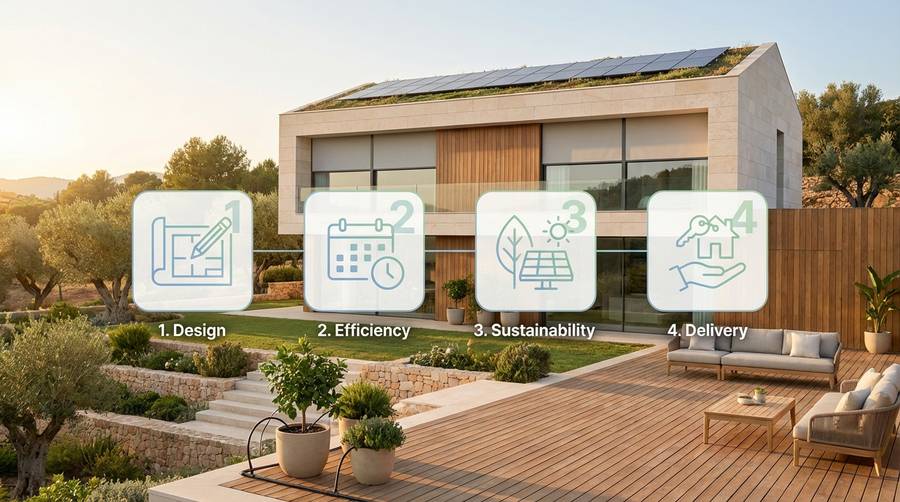
Photographic-quality image of a finished Mediterranean contemporary prefabricated house in Spain at golden hour. The home features light rendered façades with natural wood and stone accents, large floor-to-ceiling windows, a spacious terrace with potted Mediterranean plants and a small lawn. A family of four relaxes on the terrace, enjoying warm natural light. The scene conveys warmth, comfort and sustainability; the building appears premium and lived-in, not modular or industrial. Avoid visible construction joints or exposed modules. Framing is balanced, editorial real estate style, soft daylight, natural colors and a residential Spanish neighborhood setting. Emphasize realistic materials, landscaping and human presence to communicate aspiration and achievability consistent with the Findnido brand.
Conclusion: why choose a prefabricated house for your self-build in Spain
A prefabricated house offers autopromoters in Spain a compelling route to a high-performance, modern home with predictable costs and shorter delivery times. With options in timber, steel and industrialized concrete, and clear pathways to Passivhaus-level performance, industrialized housing suits families seeking quality, sustainability and simplicity. Choosing a reputable llave en mano provider and matching the right financing can make the self-build experience secure and inspiring.
For further practical guidance, explore our detailed planning guide Casa prefabricada: ventajas y guía para autopromotores and the financing-focused overview Casa prefabricada: ventajas, materiales y financiación.