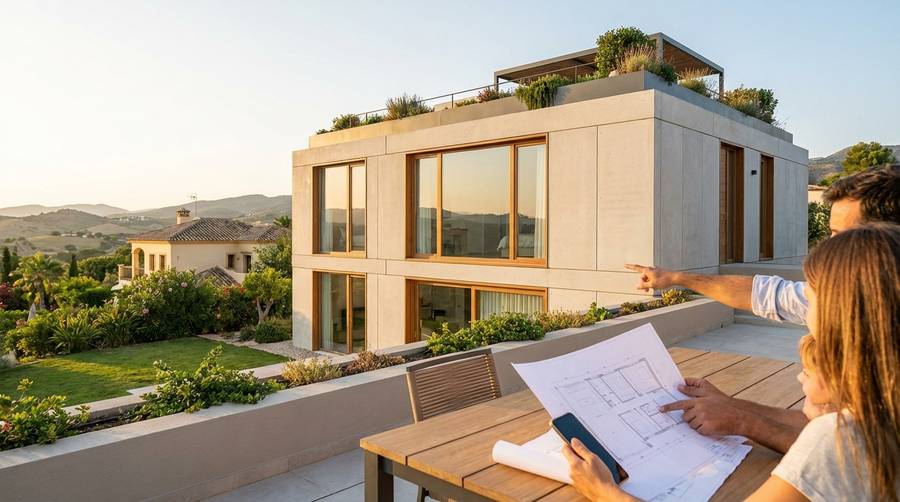
Prefabricated House vs Traditional Home: Clear Pros and Cons
Why consider a prefabricated house in Spain today?
Hook: If you need a reliable delivery date, a fixed budget and a high-performance home — prefabricated houses often deliver on all three. This article helps Spanish self-builders decide by comparing real metrics, construction systems and financing routes.
Current market landscape and trends for self-builders
Demand for industrialized housing in Spain has grown because buyers want predictability, better energy performance, and shorter on-site disturbance. Developers and independent producers now supply turnkey packages that include land assessment, design, factory production and on-site assembly.
Key trends:
- Shorter lead times thanks to parallel design and factory work.
- Adoption of modern systems like precast concrete, light timber framing and steel frame.
- Greater focus on energy certifications (Passivhaus, nearly zero-energy).
What sets industrialized housing apart from myths and prejudices
Popular misconceptions paint prefabricated houses as low-quality or temporary. In reality, modern production lines use strict QA, traceable materials and validated structural systems. The difference is the shift from on-site craft to factory-controlled production.
Bottom line: Quality is determined by design intent, materials and the manufacturer's QA protocol — not by the label "prefab".
Outcomes families seek: time, cost control and quality
Families most commonly prioritize:
- Firm delivery date to plan moves and financing.
- Cost transparency to avoid surprise overruns.
- Energy comfort and reduced running costs.
Prefabricated houses can excel at all three when the project is executed by experienced teams offering a clear turnkey contract.
Prefabricated delivery models can reduce on-site time by 40–70% and cut uncertainty — transforming a complex self-build into a predictable project.
Practical comparison: Prefabricated house vs traditional construction
Construction time and guaranteed schedules — real data and examples
Typical timelines (indicative for Spain):
- Prefabricated house: 6–9 months from permits to handover for a 120–200 m² turnkey project (factory work runs in parallel to site prep).
- Traditional build: 12–24 months depending on site conditions, subcontractor schedules and weather.
Case example: a 150 m² Mediterranean-style modular home was delivered in 8 months including site works; on-site assembly took 7 days. A comparable traditional project of the same size averaged 16 months due to masonry cycles and finishing delays.
Total cost: fixed-price models vs typical overruns in traditional builds
Costs vary by specification, but structurally:
- Prefabricated packages often quote a fixed turnkey price covering design, manufacture, transport and assembly, which reduces budget risk.
- Traditional builds frequently start with a lower initial quote but incur change orders, unforeseen groundworks and price increases on materials and labour.
Example metrics: in recent projects, turnkey prefabricated offers landed within ±3% of the contract price whereas traditional projects commonly exceeded budget by 10–25% when allowances were optimistic.
Quality, industrial control and risks: objective advantages and trade-offs
Advantages of prefabricated production:
- Factory QA: consistent workmanship, controlled environments and serial testing.
- Less weather exposure: components avoid on-site humidity and cold that can compromise finishes.
- Repeatable details: proven assemblies for thermal performance and airtightness.
Trade-offs:
- Design flexibility can be constrained by transport dimensions and factory tooling.
- Site access logistics and lifting equipment are critical and may add cost on difficult plots.
Materials and systems: choose by project needs
Precast/industrialized concrete: durability, acoustic performance and use cases
Strengths: excellent longevity, fire resistance, and superior acoustic mass — suitable for multi-family or seaside homes where robustness matters.
Considerations: higher embodied carbon than timber (unless using low-carbon mixes), heavier logistics and foundations need to be sized accordingly.
Light timber frame: speed, thermal efficiency and design appeal
Strengths: very good thermal performance, rapid assembly, and a warm interior aesthetic. Light timber is ideal for single-family homes prioritizing comfort and low energy use.
Considerations: requires careful detailing for moisture control and fire strategy, but modern treatments and compartmentalization mitigate risks.
Steel frame: structural flexibility, seismic behaviour and cost balance
Strengths: high strength-to-weight ratio, long spans for open-plan layouts and predictable factory fabrication.
Considerations: thermal bridging must be managed with insulation strategies; steel prices fluctuate with market cycles and can affect final cost.
Sustainability and energy efficiency: how industrialized homes cut carbon
Passivhaus strategies and passive solutions applied to prefabricated homes
Industrialized production is compatible with Passivhaus: tight envelopes, continuous insulation, high-performance windows and balanced ventilation systems are more consistently achieved in factory conditions.
Actionable tip: insist on blower-door testing and factory-assembled window units to secure target airtightness.
Carbon footprint: comparative m² metrics and efficient material choices
Comparative tendencies:
- Timber-framed modules typically show lower upfront embodied carbon per m² than concrete systems.
- However, long-term operational carbon can flip the balance — a well-insulated concrete home with heat pumps can outperform a poorly insulated timber house.
Consider whole-life carbon assessments rather than headline material claims.
Certifications, ventilation and active systems to lower consumption
Requested features to reduce running costs and emissions:
- Mechanical ventilation with heat recovery (MVHR).
- Heat pumps sized to real heat demand.
- Photovoltaic-ready roofs and energy storage integration.
From plot to handover: the turnkey process step by step
Plot search and evaluation: urban rules and service connections
Essential checks before buying:
- Zoning and buildability: maximum occupancy, alignments, and permitted footprint.
- Topography and access: crane placement, vehicle access and laydown areas.
- Utilities: water, sewage, electricity and broadband feasibility.
Design, factory production and workshop quality control
Turnkey providers typically follow this flow:
- Concept and permit-ready design adapted to the plot.
- Detailed manufacturing drawings and off-site production with inline inspections.
- Pre-assembly tests where components are trial-fitted before dispatch.
Transport, on-site assembly and final delivery with documentation
On delivery day, the critical path includes:
- Site foundations and services completed to factory tolerances.
- Module/crate delivery and crane installation.
- Connections, commissioning and final QA leading to handover documentation (warranties, manuals, certifications).
Financing and mortgages for self-build and modular homes in Spain
Credit options for turnkey projects and typical bank criteria
Banks generally fund modular projects when there is a clear, closed budget and credible contractor. Common products include:
- Mortgages for self-build with staged disbursements linked to milestones.
- Standard mortgages when the house exists and appraisal is straightforward after handover.
Documentation banks request: closed budget and schedule
Typical bank checklist:
- Detailed turnkey contract with fixed milestones and warranties.
- Manufacturing and installation timeline showing off-site and on-site phases.
- Technical specifications and energy certificates where applicable.
Tip: provide blower-door test targets and MVHR specs early to demonstrate energy performance to the lender.
Negotiation pointers and real-case financing examples
Negotiation levers:
- Ask for a single point of responsibility in the contract (reduces bank risk).
- Secure fixed-price clauses for key trades and a clear scope of extras.
- Use comparables and turnkey references to persuade the bank that the timeline is realistic.
How to decide: a practical guide for choosing the best route
Short checklist to compare offers
Use this short checklist when evaluating proposals:
- Delivery time and penalties for missed milestones.
- What the fixed price includes and excludes (foundation, landscaping, permits).
- Materials and systems: insulation levels, windows specification and ventilation strategy.
- Warranties, after-sales service and documentation at handover.
Concise case studies: measured costs, schedules and client satisfaction
Study A — Mediterranean timber-framed home, 140 m²:
- Turnkey cost: ~1,700 €/m² (including site works).
- Delivery: 7 months from permit to handover.
- Satisfaction: client reports lower energy bills (-45%) and high acoustic comfort.
Study B — Concrete modular home, 180 m²:
- Turnkey cost: ~1,900 €/m².
- Delivery: 9 months, on-site assembly 10 days.
- Satisfaction: strong perception of solidity and low maintenance expectations.
Next steps for self-builders: compare, visit and budget
Recommended sequence:
- Obtain feasibility for your plot (urban rules and services).
- Get at least two turnkey proposals with identical scope for apples-to-apples comparison.
- Visit completed projects or show homes and review builder warranties and aftercare.
Conclusion
Decision logic: Choose a prefabricated house if you prioritise fixed schedules, predictable budgets and high energy performance. Choose traditional construction if you need extreme design freedom and local material choices that can’t be achieved within factory limits.
Both paths work for responsible self-builders. The decisive factors are the quality of the supplier, clarity of contract and realistic site assessment.
If you want a practical next step, start by comparing turnkey offers with clear warranties and ask for references on delivery performance and blower-door results. For design inspiration, see Viviendas prefabricadas lifestyle: diseño y sostenibilidad and our practical guide Casa prefabricada: guía completa para autopromotores.
CTA: If you're planning a self-build, contact a trusted turnkey provider to review your plot and compare two turnkey offers — or reach out to us for an impartial review of quotes and timelines.
Artículos relacionados
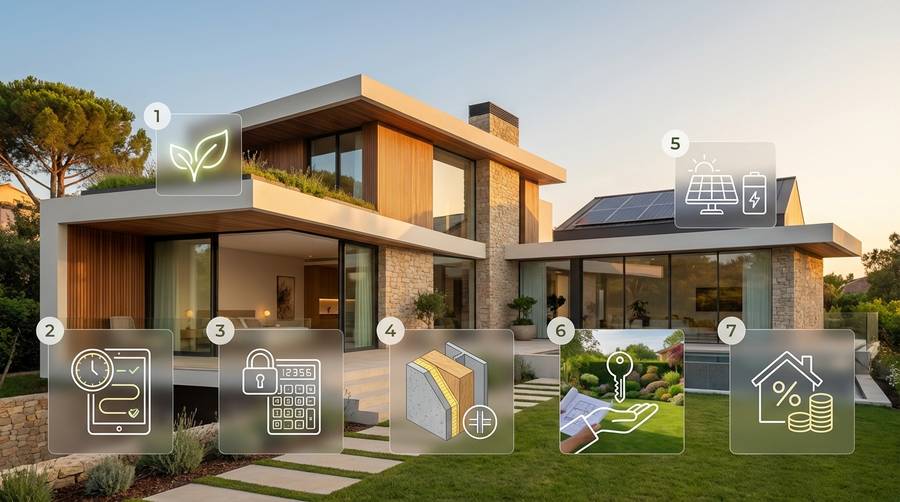
7 Reasons to Choose a Prefabricated House in Spain
A focused, actionable guide for self-builders in Spain explaining why prefabricated houses deliver predictable schedules, controlled costs, modern materials and measurable energy savings. Includes case metrics and a step-by-step planning checklist.