7 Reasons to Choose a Prefabricated House in Spain
Before you decide: what is a prefabricated house and why it matters in Spain 2026
Hook: If you want a modern, energy-efficient home delivered on schedule and within a fixed price, a prefabricated house can be the most reliable route — when done right. This guide cuts through marketing to give clear, actionable reasons why industrialized housing is increasingly the best option for self-builders in Spain.
Clear definition: industrialized housing vs traditional construction
Industrialized housing means major elements of the building are manufactured off-site under factory conditions and assembled on-site. This includes systems built with industrialized concrete panels, timber frame (light-frame), or steel frame. The onsite phase focuses on assembly and finishes.
Traditional construction is site-built masonry and cast-in-place concrete. It requires longer on-site labor, more weather dependence and more variable timing.
Trends for 2026: efficiency, sealed schedules and fixed-price delivery
Markets in Spain are shifting toward methods that reduce uncertainty. Buyers now demand:
- Guaranteed delivery windows.
- Transparent, capped costs in turnkey contracts.
- Higher energy performance aligned with Passivhaus principles.
These trends are supported by technological maturity in materials and improved financing options for autopromotores.
What a self-builder must know before starting
- Inspect the factory process and ask for build logs.
- Request a detailed turnkey contract listing inclusions and tolerances.
- Check compatibility of the system with local climate and planning rules.
Choose predictability: a well-specified prefabricated project reduces schedule risk by up to 60% compared to traditional builds of similar scope.
1) Time savings and guaranteed schedules
Phase-by-phase time comparison: prefabricated vs traditional
Typical phases: design and permits, foundation, shell, MEP (mechanical, electrical, plumbing), finishes and commissioning. Prefabrication compresses the shell and many MEP tasks into concurrent factory work. Result: much shorter on-site phases.
- Traditional: Shell and structure can take months on site and depend on weather.
- Prefabricated: Shell delivered in weeks; onsite assembly measured in days for certain modules.
How industrialized processes reduce on-site uncertainty
Factory conditions control quality and rhythm. Weather interruptions are minimized. Factory QC reduces rework. Standardized interfaces shorten coordination time between trades.
Real example: time metrics and client satisfaction
Case study (Spain, coastal Mediterranean plot):
- Parcel acquisition to permit: 4 months.
- Factory production: 8 weeks.
- Site foundation and assembly: 6 weeks.
- Total delivery from contract: 6.5 months.
- Client satisfaction survey: 92% rated timing and communication as excellent.
Compare that with a similar traditional build averaging 12–18 months and a higher incidence of delay-related costs.
2) Predictable cost and financing options for self-builders
Fixed price: what it covers and what to negotiate
A genuine turnkey fixed price should list:
- Factory production and transport.
- Foundations, site assembly and weatherproofing.
- Thermal insulation, airtightness work, windows and doors.
- Standard MEP and interior finishes as agreed in the specification.
Negotiate explicit allowances for finishes, landscaping and utility connections. Insist on tolerance thresholds and a schedule for change orders.
Mortgage and financing tailored for modular housing
Spanish lenders increasingly accept modular homes for standard mortgages when the property is permanent and affixed to land. Options include:
- Self-build mortgages (hipotecas para autopromoción) with staged disbursements aligned to factory and site milestones.
- Standard mortgages upon completion when the turnkey contract provides certification and final as-built documentation.
Tip: Request lender-friendly documentation from your manufacturer early. It speeds appraisal and reduces financing friction.
Cost case study: budget vs final cost with figures
Example project (3-bedroom Mediterranean single-family):
- Initial turnkey quote: €240,000 (excl. land and VAT).
- Final cost on delivery: €247,500 (1.5% variance due to user upgrades).
- Traditional comparable final cost: €260,000–€300,000 with higher variance risk.
Reason: factory procurement and fixed supply contracts limit price escalation.
3) Modern, durable materials: industrialized concrete, timber and steel frame
Technical and aesthetic benefits of each system
- Industrialized concrete panels: high thermal mass, acoustic performance and durability. Good for coastal sites needing robustness.
- Timber light-frame (entramado ligero): fast assembly, excellent embodied-carbon performance and warm interior finishes ideal for Mediterranean aesthetics.
- Steel frame: high strength-to-weight ratio, large span possibilities and exceptional dimensional stability.
Energy performance and maintenance comparison
Key differentiators:
- Timber systems often achieve lower embodied carbon and are easier to upgrade thermally.
- Concrete provides thermal inertia — useful to stabilize internal temps in hot climates.
- Steel demands careful detailing for thermal breaks but enables open-plan layouts.
Maintenance needs differ: timber requires periodic checks for moisture control; concrete and steel need less frequent finishing work.
Choosing materials by plot, climate and Mediterranean style
Consider:
- Coastal plots: favor durable cladding and concrete or treated timber to resist humidity.
- Interior sunny plots: timber with shading strategies or concrete to exploit thermal mass.
- Design intent: for a Mediterranean contemporary look, combine light façades, natural wood accents and polished concrete details.
4) Sustainability and energy efficiency: moving toward Passivhaus
Construction measures that cut carbon and energy use
Effective measures include:
- Factory-controlled airtightness and continuous insulation to minimize thermal bridging.
- High-performance glazing and external shading tailored to solar orientation.
- Mechanical ventilation with heat recovery (MVHR) or high-efficiency heat pumps.
Certifications and metrics relevant to self-builders
Certifications to consider:
- Passive House (Passivhaus) for severe energy targets.
- Energy Performance Certificates (EPC) required by regulation.
- Environmental Product Declarations (EPDs) for material-level carbon transparency.
Ask manufacturers for measured airtightness and thermal modeling for your project.
Practical case: annual consumption and estimated returns
Example home (120 m², Mediterranean climate):
- Conventional build heating/cooling consumption: ~8,000 kWh/year.
- Well-executed prefabricated Passivhaus-level build: ~2,000–3,000 kWh/year.
- Estimated annual energy cost savings: €600–€1,200 depending on tariffs.
Payback occurs via lower operating costs and higher resale desirability.
Conclusion: how to plan your modular project step by step
Essential checklist before buying land and contracting a manufacturer
- Confirm land use and urban base parameters with the town hall.
- Request manufacturer factory visits and sample assembly inspections.
- Obtain a detailed turnkey contract with a fixed price, milestones and penalties.
- Secure financing pre-approval and align disbursement schedule with the contract.
- Ensure thermal and acoustic performance metrics are documented.
Typical turnkey timeline: from plot to delivery
- Feasibility & permits: 2–6 months.
- Design and specification: 1–3 months.
- Factory production: 6–12 weeks.
- Foundations & site assembly: 4–8 weeks.
- Final finishes and commissioning: 2–6 weeks.
Resources and next steps for self-builders in Spain
Learn more about design and sustainability approaches in our related guides, such as Viviendas prefabricadas lifestyle: diseño y sostenibilidad and Casa prefabricada: guía completa para autopromotores. Use those articles to refine finishes, interior layout and sustainability targets.
Final recommendation: Prioritize a manufacturer who shares verified build data and offers a clear turnkey contract. This is the fastest path to a predictable, energy-efficient home that fits the Mediterranean lifestyle.
If you want tailored guidance for a specific parcel or budget, contact a specialist to review your options and financing pathways.
Image brief for AI generator (Findnido brand)
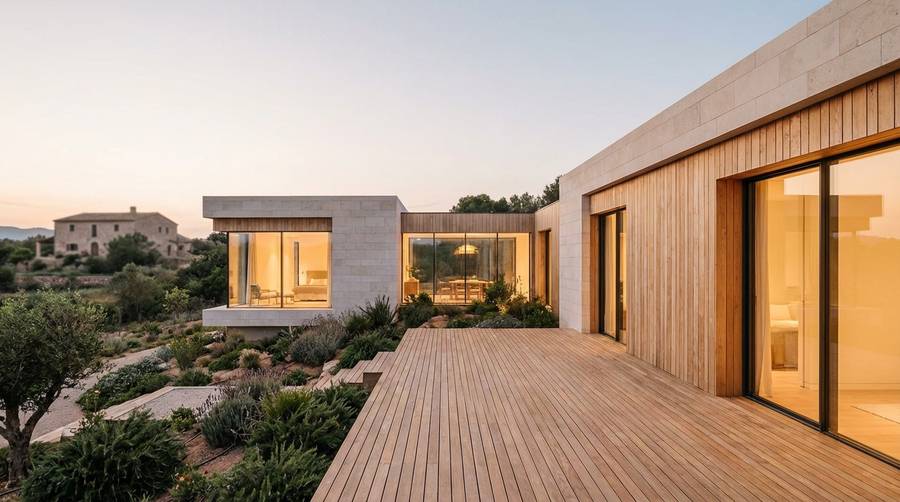
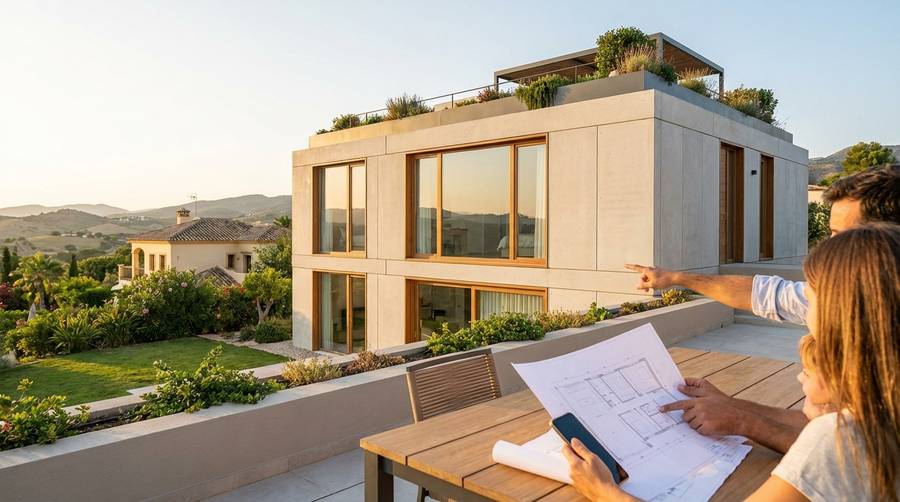
Category: Prefabricadas lifestyle. Create a high-quality real estate-style photo of a finished Mediterranean contemporary prefabricated home at golden hour. The house should be a real-looking single-family residence with light facades, natural wood accents, and polished concrete details. Include large windows showing warm interior light. The setting is a Spanish residential plot with a garden, terrace, and native plants. Show a small family casually using the porch to add lifestyle warmth. Avoid any visible modular joints, container-like shapes, exposed factory assembly, or construction scenes. Photography should be magazine-grade, natural colors, soft golden light and balanced framing. The mood should convey trust, comfort, modern living and sustainability. No sci-fi elements or tiny houses. Brand voice: premium but accessible, modern and reliable.
Artículos relacionados