7 Reasons to Choose Industrialized Materials for Modular Homes
Introduction — Hook: Build with certainty, not guesswork
If you want a modern home in Spain that’s delivered on time, on budget and with measurable energy savings, the choice of materials matters more than you think. This article gives you a compact, evidence-based list of seven reasons to prioritize industrialized materials for modular housing. Read it to get practical comparisons, an actionable checklist for tendering and a real project timeline to benchmark your plans.
Before you choose: how to use this list for your modular project
What you will find here and how to apply it to your plot in Spain
This is a checklist-style, decision-focused guide. You'll get:
- Seven concrete reasons framed around cost, time, sustainability and habitability.
- Comparative data and a short case study with timelines and costs.
- Practical questions to ask constructors, lenders and project managers.
Use the sections as filters: mark which criteria are must-have for your plot (soil type, access, grid connections) and weigh them against the advantages below.
Key criteria we use: cost certainty, schedule reliability, sustainability and liveability
We prioritize metrics you can verify: fixed-price contracts, on-site installation days, U-values and measured consumption. If a claim lacks numbers, treat it as marketing.
How to read comparisons and case studies to make real decisions
Look for three data points when comparing offers:
- Lead time: factory production + on-site assembly days.
- Price transparency: what’s included in the turnkey quote.
- Energy metrics: calculated or measured annual kWh/m² and target certification (e.g. Passivhaus).
1) Efficiency and cost control thanks to industrialized materials
Why industrialized concrete and steel frame allow fixed prices
Industrialized materials enable off-site production under controlled conditions. That translates into consistent material quality and predictable labour hours. Manufacturers can offer a fixed-price package because variability in weather, logistics or on-site surprises is dramatically reduced.
For example, precast concrete panels and steel frames are manufactured to millimetre tolerances and assembled with repeatable workflows — this reduces contingency line items typically added to traditional builds.
Cost comparison: practical example (times and estimated savings)
Comparative snapshot for a 140 m² single-family house in Spain (indicative figures):
- Traditional build: 14–18 months; price variability ±10–18% due to on-site changes.
- Industrialized (concrete panel/steel frame): 6–9 months; price variability ±3–7%.
Typical observable savings are primarily on indirect costs (shorter financing period, fewer site management days). In many autopromoter projects we track a 3–8% lower total cost once schedule savings and predictable subcontracting are included.
Risks and how to avoid them: guarantees, contracts and professional oversight
Common pitfalls:
- Incomplete turnkey scopes (missing finishes, services or landscaping).
- Unclear warranty responsibilities between factory and on-site teams.
Mitigation checklist:
- Demand a single turnkey contract that lists deliverables to completion.
- Require factory and installation warranties (minimum 2 years for workmanship, 10 years for structure).
- Hire an independent technical advisor during the tender stage to validate quantities and interfaces.
2) Fixed schedules: speed and certainty in delivery
Breakdown of the turnkey process: from plot to handover
A typical industrialized turnkey process includes:
- Site assessment and permits (variable — typically 3–6 months depending on municipality).
- Factory design finalisation and production (6–12 weeks).
- Foundations and site preparation (2–4 weeks).
- On-site assembly and connections (2–6 weeks).
- Finishes, commissioning and handover (2–4 weeks).
The controlled parts (factory + on-site assembly) are the ones that deliver schedule certainty.
Case study: typical project timeline, phases and real duration
Project snapshot — 160 m² Mediterranean family home using steel frame and prefabricated façade panels:
- Permitting and design: 4 months.
- Factory production: 8 weeks.
- Foundations: 3 weeks.
- Assembly and weather-tight: 3 weeks.
- Fit-out and commissioning: 4 weeks.
Total on-site schedule from foundation start to handover: about 10–12 weeks. That compares with 30–40+ weeks for a similar traditional build.
Questions to ask your promoter or builder to ensure delivery
- What parts are manufactured off-site and what is the factory lead time?
- Which completion milestones are linked to payment stages?
- Are there liquidated damages or delivery guarantees in the contract?
3) Modern materials comparison: concrete, timber frame and steel
Advantages and typical applications for each system
Precast concrete panels: excellent for thermal mass, fire resistance and acoustic separation. Ideal for multi-storey or sites requiring high durability.
Light timber frame: high thermal performance, fast to assemble, lower embodied carbon when sourced responsibly. Suitable for low-rise single-family homes with tight schedules.
Steel frame: high structural precision, long spans, quick assembly. Often used in hybrid solutions (steel frame structure + timber infill).
Thermal and acoustic performance: comparative data and Passivhaus examples
Representative U-values (indicative after assembly and insulation):
- External wall, timber frame with high-performance insulation: 0.12–0.18 W/m²K.
- Steel frame with continuous insulation: 0.15–0.20 W/m²K.
- Precast concrete with external insulation: 0.18–0.25 W/m²K (improved with thermal breaks).
Passivhaus projects in modular systems typically aim for specific heating demands <15 kWh/m²·year. Achieving this requires airtightness protocols, MVHR (mechanical ventilation with heat recovery) and careful thermal bridge control — independent of the primary structural material.
Maintenance, durability and Spanish climate considerations
Durability notes:
- Concrete systems perform well long-term in coastal or high-exposure sites but need appropriate detailing to avoid thermal bridges.
- Timber frames must be specified with moisture control and appropriate external claddings for humid coastal zones.
- Steel frames require corrosion protection and thermal breaks, especially near the coast.
Choose components tested for the local climate and insist on manufacturer performance data for durability and certified assemblies.
4) Sustainability and energy efficiency: lower carbon without losing comfort
How industrialized materials facilitate higher energy performance
Factory production enables better quality control of insulation placement, airtightness and window installation — the three most common failure points in traditional builds. That precision directly reduces operational energy consumption.
Passivhaus strategies applied to prefabricated homes: practical examples
Common strategies that translate well to modular systems:
- Continuous insulation layers to minimise thermal bridges.
- Factory-installed high-performance windows with certified U-values.
- Pre-integrated MVHR units and ducting to speed up commissioning.
Projects that combine these measures often report 30–60% lower heating/cooling consumption compared to standard new builds, depending on climate and occupant behaviour.
Measuring impact: carbon metrics and medium-term returns
Measure both embodied carbon and operational carbon. Industrialized concrete may have higher embodied carbon than timber, but shorter construction schedules reduce site emissions and waste, and operational efficiencies reduce lifetime energy use.
Typical payback considerations:
- Energy savings can recover incremental costs for high-performance assemblies in 8–15 years depending on energy prices and incentives.
- Lower maintenance and insurance exposure (due to quality control) contribute to lower lifecycle costs.
“Precision in production reduces both waste and surprises: that’s the clearest path to lower lifetime cost and carbon.”
Next step: financing, mortgages and making the jump to self-build
Financing options for autopromoters in Spain and usual requirements
Autopromoter mortgages commonly require:
- Detailed turnkey contract with payment schedule.
- Cost plan and schedule aligned with bank drawdown stages.
- Technical valuation and insurance certificates.
Modular turnkey packages that include final certifications and guarantees typically improve access to standard residential mortgage products instead of construction loans with higher margins.
Key points to budget for a turnkey modular home and secure a mortgage
Budget checklist:
- Land purchase and taxes (ITP/AJD or VAT depending on plot).
- Permits and project fees.
- Turnkey construction cost — ensure it includes finishes, external works and systems.
- Connection fees (water, electricity, sewage) and landscaping.
- Contingency (3–7%) — lower than traditional builds but still necessary.
Practical resources: checklist for meetings with banks and contractors
Bring these documents to your first meetings:
- Turnkey contract draft with milestones.
- Factory specification sheets for primary systems and windows.
- Estimated energy performance report (PHPP or energy simulation).
- Site plan and geotechnical summary.
Use the checklist to get comparable offers from lenders and to avoid surprises during appraisal.
How to integrate this in your project workflow (quick action plan)
One-page action plan:
- Define priorities: cost certainty, schedule or sustainability — rank them.
- Shortlist systems (concrete / timber / steel) and ask for factory performance data.
- Request turnkey quotes with fixed-price milestones and warranties.
- Prepare bank package (contract + energy report + schedule).
- Hire an independent technical advisor for the tender review and handover checks.
Also read our deeper guides on turnkey industrialized housing to compare offers: Vivienda industrializada: ventajas y guía llave en mano and Casa prefabricada: ventajas y guía para autopromotores.
Conclusion — Make the material choice that matches your priorities
Industrialized materials are not a one-size-fits-all solution, but they systematically improve cost predictability, shorten schedules and help reach higher energy performance when specified correctly. The right choice depends on your site, climate and priorities — however, the process advantages (factory QA, reduced on-site risk and integrated systems) are consistent.
If you are considering an autopromoted modular home in Spain, start by asking manufacturers for verified performance data and a turnkey contract with clear milestones. If you’d like, our team can review your tender or help prepare the bank package.
Ready to compare turnkey offers or need a technical checklist for your bank meeting? Contact us to get a tailored review.
Image description for AI generation (Findnido brand style)
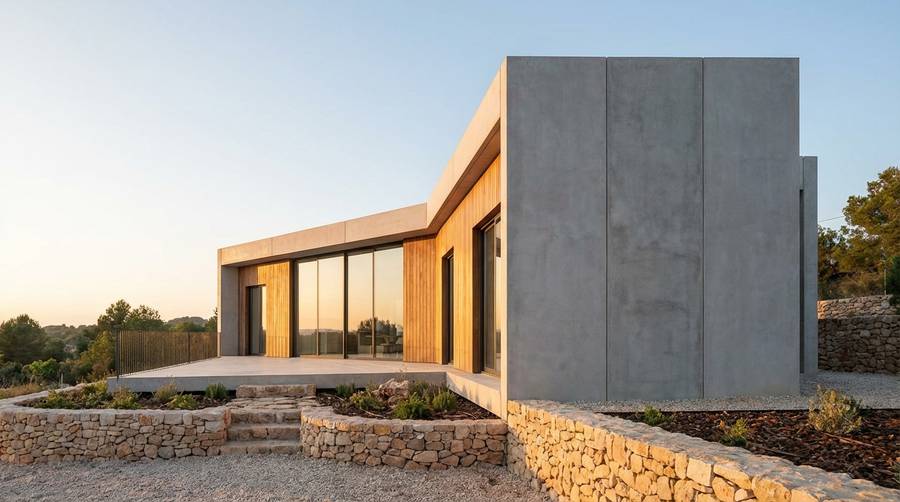
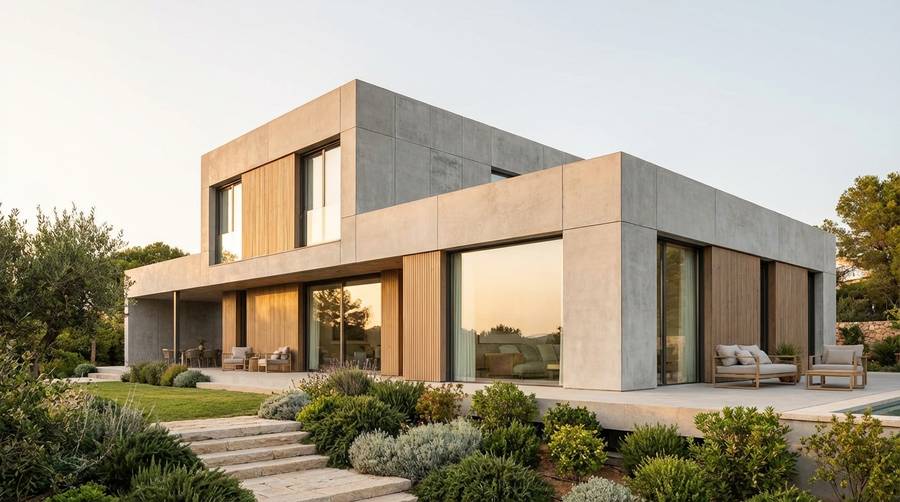
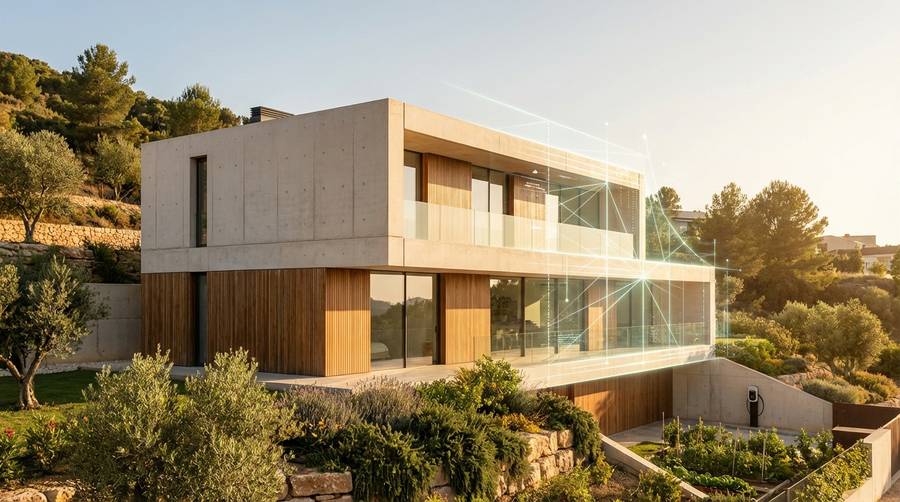
Photographic, editorial-quality image of a finished Mediterranean contemporary home in Spain representing industrialized materials. The house should appear premium and lived-in, with light façades combining smooth concrete and warm vertical wood cladding, large floor-to-ceiling windows and a terrace with casual outdoor furniture. Golden-hour soft light, natural colors, balanced composition. Include modest integrated solar panels on the roof and Mediterranean landscaping (olive or lavender, stone paths). Avoid visible modular connections, container-like forms or construction scenes. The mood is trust, comfort and sustainable modern living — real estate magazine photography style, realistic and aspirational.