Passivhaus Industrialized Homes in Spain
Why premium Passivhaus will lead residential industrialization in Spain
Hook: Spain is entering a decisive decade where energy policy, rising utility costs and buyer expectations converge—making premium Passivhaus industrialized housing not a niche, but a market imperative.
This section synthesizes market data, competitive advantages and regulatory drivers shaping adoption from 2024 to 2030. It is aimed at autopromoters who expect technical clarity and actionable guidance.
Current market snapshot: key figures and 2024–2030 projections
Industrialized housing in Spain grew steadily after 2020; conservative industry estimates project annual growth rates between 8–12% through 2030 for certified energy-efficient builds. Passivhaus-certified projects remain underrepresented but are the fastest-growing segment within modular and prefabricated solutions, driven by:
- Stricter energy regulations and municipal incentives.
- Mortgage and financing products increasingly favoring low-energy buildings.
- Homeowner demand for lower operational costs and higher indoor comfort.
Competitive edge: energy efficiency, comfort and lower operational costs
Passivhaus industrialized homes combine predictable factory quality with the performance standards that reduce heating and cooling demand by up to 90% versus conventional stock. For autopromoters this translates into:
- Smaller HVAC systems and simpler distribution, lowering installation costs.
- Stable thermal comfort and air quality, increasing occupant satisfaction.
- Lower lifecycle operating costs—often repaying a portion of the upfront premium in 10–15 years depending on local energy prices.
Regulatory and social trends driving adoption
EU and Spanish roadmaps emphasize near-zero energy buildings and carbon reduction. Municipalities increasingly require or incentivize high-efficiency envelopes. Socially, buyers rank low energy bills and healthy indoor environments in top purchase drivers—especially families and older homeowners.
By 2030, Passivhaus-level manufacturing methods will likely become the de facto standard for premium modular housing in Mediterranean climates—prioritizing thermal comfort, predictability and carbon reduction.
Materials and systems that will define industrialized Passivhaus
This section compares three leading systems and provides lifecycle and climate-adaptive guidance for Mediterranean Spain.
Technical comparison: precast concrete, light timber frame, and steel frame
Precast concrete: offers thermal mass and durability. In factory-controlled panels it provides excellent airtightness and sound insulation. Best for urban plots and coastal exposure. Drawbacks include higher embodied carbon unless industrialized low-CO2 mixes and supply chain decarbonization are used.
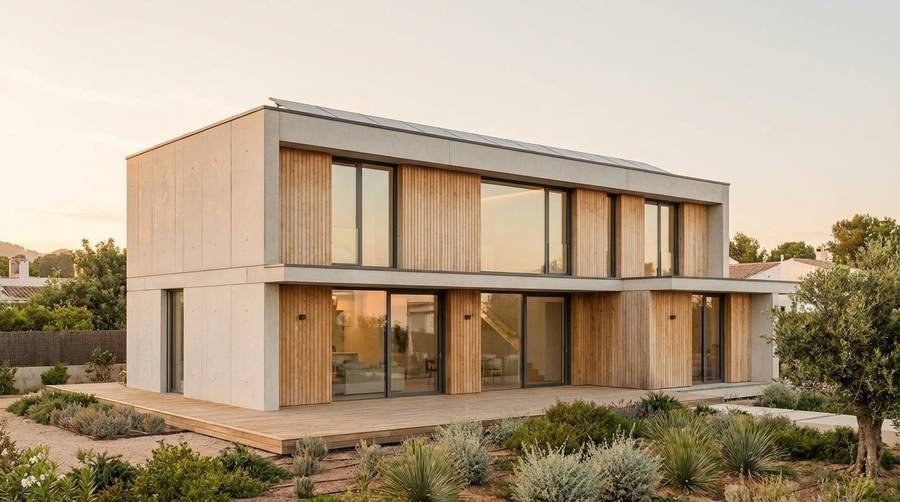
Light timber frame: superior embodied-carbon profile, fast assembly, and natural hygrothermal behavior. With proper detailing and high-performance insulation it meets Passivhaus targets easily. It is particularly suited to low-rise family homes and plots with good moisture control.
Steel frame: precise tolerances and long spans; ideal where large open-plan interiors or multi-storey modules are required. Thermal bridging control requires careful design and thermal breaks. Steel performs well when combined with external insulation systems.
Impact on carbon footprint and lifecycle metrics
Lifecycle assessments (LCA) show that choosing timber over concrete can reduce upfront embodied carbon by 20–45%, but operational carbon typically dominates total CO2 emissions across 60-year scenarios. Therefore, the optimal choice balances embodied carbon reductions with superior operational performance—an area where Passivhaus certification amplifies lifecycle benefits.
Material selection for Mediterranean climates
Design decisions must prioritize:
- High-performance insulation with moisture-resilient materials.
- Airtightness strategies adapted to coastal humidity.
- External shading and thermal mass balance to avoid summer overheating.
For most Spanish autopromoters, mixed systems (e.g., timber or steel frame with a concrete slab or façade elements) provide the best trade-off between comfort, durability and carbon.
Design and turnkey processes for demanding autopromoters
Delivering a premium Passivhaus industrialized home hinges on process control as much as technical specification. Below are realistic timelines and control points.
Project flow: from plot search to turnkey handover with real timelines
A practical timeline for a 120–180 m² single-family Passivhaus industrialized home:
- Plot acquisition & feasibility: 1–3 months.
- Concept and Passivhaus planning: 2–4 months (including PHPP iterations).
- Factory production and component delivery: 2–3 months.
- Site assembly and weather-tight envelope: 2–6 weeks.
- Installation of services, finishes and commissioning: 4–8 weeks.
- Certification and handover: 1–2 weeks.
Total realistic delivery time: 6–10 months from permit-ready designs. This assumes permits move at average municipal pace and that turnkey suppliers are engaged early.
Optimizing closed timelines and fixed-price control
Key methods to protect schedule and budget:
- Use factory-built and testable assemblies to reduce site variability.
- Agree fixed scope packages and change-order rules at contract start.
- Early integration of utility connections and site works to prevent hold-ups.
Integrating Passivhaus design with premium aesthetics
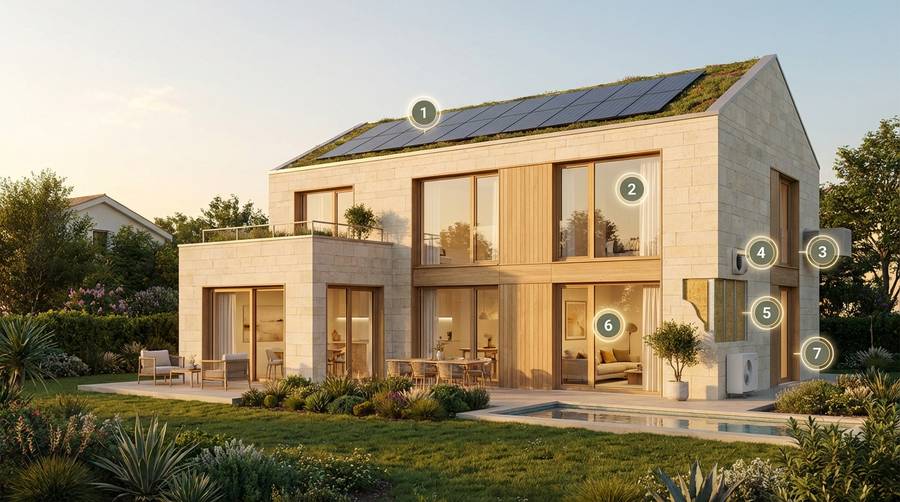
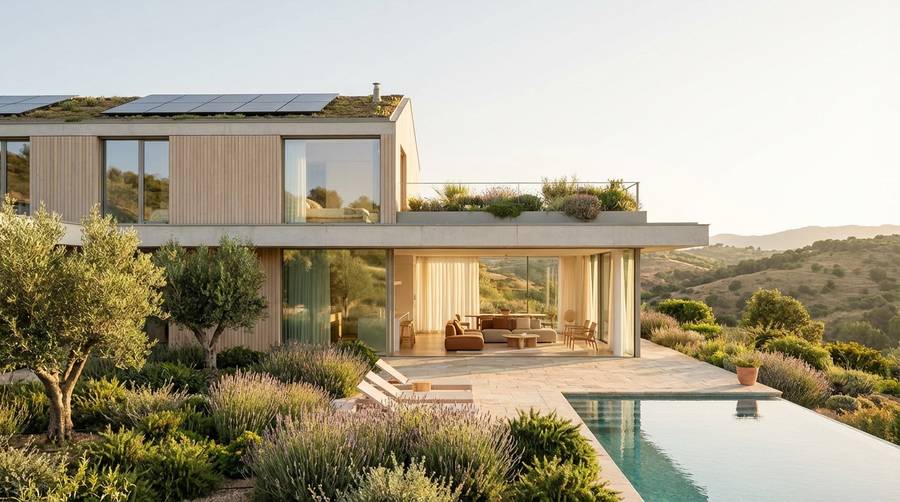
Passivhaus detailing need not compromise Mediterranean aesthetics. Use continuous insulation behind traditional-looking facades, large triple-glazed windows with deep shading, and natural materials like wood and stone to achieve a premium look while meeting performance targets.
Financing and economic models for modular self-builds
Financing industrialized Passivhaus homes requires clarity on valuation, risk and lender acceptance. Below are practical options and modeling tips.
Mortgage options and financial products in Spain
Banks increasingly offer mortgages for self-build and modular projects, but underwriting varies. Common routes:
- Self-build mortgages with staged drawdowns aligned to project milestones.
- Green mortgage discounts for certified low-energy homes.
- Bridge loans for plot purchase combined with construction loans for the build phase.
Advice: obtain lender pre-approval based on turnkey contract, detailed cashflow and energy performance projections before plot purchase.
Return models: energy savings versus initial cost
Model the net present value (NPV) over 30 years. Typical inputs:
- Upfront premium for Passivhaus industrialization: 5–12% versus standard modular builds.
- Annual energy savings: 60–85% depending on baseline building.
- Maintenance differentials: often neutral or favorable for factory-made components.
In many Spanish regions, energy savings plus potential green mortgage discounts shorten the payback window to 10–15 years.
Real cases of bank acceptance and viability
Some national lenders now include industrialized Passivhaus schemes among preferred collateral if backed by recognized manufacturers and warranties—this materially lowers borrowing costs for autopromoters.
Case studies: measurable Passivhaus industrialized projects
Below are anonymized and aggregated case data to illustrate achievable outcomes and lessons for replication.
Project A: execution times, cost per m² and client satisfaction
Summary metrics for a 150 m² two-storey family home:
- Total delivery time: 9 months (from permit-ready design).
- Fixed turnkey cost: €1,900/m² (including landscaping and connections).
- Client satisfaction (NPS-style survey): 82/100 citing comfort and predictable costs.
Key enabler: early engagement of a turnkey provider that managed both factory production and on-site assembly.
Project B: real energy performance and annual emissions reduction
For a 130 m² bungalow in a Mediterranean inland location:
- Measured heating demand: 10 kWh/m²·yr (Passivhaus target achieved).
- Estimated annual CO2 reduction vs reference build: 2.8 tonnes CO2e/yr.
- Observed cooling comfort maintained with passive shading and night ventilation.
Lesson: passive strategies combined with high-performance glazing typically deliver the best operational outcomes with modest incremental cost.
Lessons learned and best practices
- Certify via a recognized body early to avoid late-stage redesigns.
- Standardize module interfaces to speed up approvals and assembly.
- Invest in quality control in the factory—this is where most gains are secured.
Challenges and opportunities over 5–10 years
The sector faces adoption barriers but also clear opportunities for scale and innovation.
Adoption barriers and industry remedies
Common barriers: municipal permitting delays, limited local manufacturing capacity, and perception gaps about modular quality. Remedies include standardized permit templates, training for local planners, and visible demonstration projects that show finished homes rather than construction tents.
Process and technology innovations likely to transform the sector
Expect advances in digital twin design, automated factory quality control, low-CO2 concrete mixes and hybrid timber-concrete systems. These will lower costs and accelerate certification.
Market scenarios and strategic recommendations for autopromoters
Scenarios range from conservative (steady growth) to accelerated (policy-driven scale-up). Strategic priorities for autopromoters:
- Engage turnkey specialists early.
- Prioritize lifecycle analyses, not just upfront cost.
- Seek green financing and relevant municipal incentives.
Conclusion: an actionable roadmap to build the Passivhaus premium home
Priority checklist to start a Passivhaus industrialized project
- Secure plot with basic utility access and solar orientation.
- Obtain pre-approval from a lender using a turnkey quote and energy model.
- Select a factory-built system aligned with climate—timber, steel or concrete hybrid.
- Run PHPP early and iterate until envelope energy targets are met.
- Contract a turnkey provider with warranty, testing and commissioning included.
Resources, partners and metrics for success
Measure success by:
- Airtightness (n50) and verified heating/cooling demand (kWh/m²·yr).
- Customer satisfaction scores post-occupancy.
- Lifecycle CO2 per m² over 60 years.
Final vision: marrying sustainability, quality and economic viability
Industrialized Passivhaus homes in Spain are a pragmatic path to combining high comfort, significant operational savings and lower lifecycle emissions. For autopromoters willing to plan to factory-led precision, the benefits are measurable and replicable.
Call to action: If you are planning a self-build and want a tailored feasibility checklist or a finance-ready turnkey quote, contact a certified industrialized Passivhaus provider to translate this roadmap into a realistic project plan.
Artículos relacionados