Industrialized Housing Guide Spain 2026
Guide: How to design an industrialized house step by step in Spain (2026)
Industrialized housing is rapidly becoming the preferred route for self-builders in Spain who want quality, speed and budget certainty. This guide explains how to design a modular or industrialized home from the first idea to a ready-to-live handover. It focuses on practical decisions that affect cost, schedule and sustainability while keeping the homeowner in control.
Defining objectives: program, budget and timelines
Start with a clear brief. Define the program (rooms, storage, accessibility), target budget range and a realistic schedule. Industrialized housing allows fixed-price offers and predictable site times, so set priorities: is energy performance more important than faster delivery? Establishing objectives early reduces costly changes later.
Choosing a constructive system: hybrid options and compatibility criteria
Selecting the best constructive system is essential. Consider the following criteria: thermal performance, structural requirements, moisture resilience, aesthetic goals and local planning restrictions. Hybrid solutions—combining concrete, light timber frame and steel—often deliver the best mix of performance and cost.
For an in-depth guide to hybrid systems and when to choose them, see the linked resource: Casa prefabricada híbrida: guía para autopromotores.
Project planning: permits, urban rules and team coordination
Plan permits early. Municipal urban rules in Spain often set setbacks, height limits and façade treatments. Engage an architect familiar with modular systems to coordinate technical drawings, structural calculations and energy compliance documentation. Early coordination between architect, manufacturer and contractor avoids delays in fabrication and assembly.
Materials and systems: industrialized concrete, light timber frame and steel frame
Modern industrialized housing in Spain relies on three main material families: industrialized concrete systems, light timber frame (timber frame) and steel frame. Each offers specific advantages in durability, thermal behavior and construction speed.
Technical comparison: thermal, structural and durability performance
Concrete industrialized panels provide high thermal inertia and excellent acoustic insulation. They are durable and perform well in coastal climates. Light timber frame systems excel in thermal continuity and rapid assembly. Timber offers high insulation capacity per thickness and reduces embodied carbon when sourced responsibly. Steel frame systems deliver precision, long spans and consistency; they are ideal where structural freedom or very tight tolerances are needed.
When comparing systems, consider the whole-wall U-value, airtightness potential and maintenance needs. A well-detailed timber or steel frame wall can outperform traditional masonry in both thermal performance and airtightness, two key factors for low operational energy.
Effective hybrid combinations: when to pair concrete with timber or steel
Hybrids are common: use industrialized concrete for foundations, basement walls and ground floor slabs where moisture and inertia matter, then switch to timber or steel frame for upper floors and roof areas to save weight and speed up installation. A concrete podium with timber upper floors balances stability and sustainability. Steel can be combined with concrete for large cantilevers or open-plan spans where structural capacity is critical.
Impact on schedule and costs by material choice
Generally, timber and steel frames reduce on-site assembly time compared with masonry. Industrialized concrete components reduce variability and deliver fast enclosure times when produced off-site. Costs vary by design complexity and finish level; however, industrialized housing often offers lower cost volatility and shorter finish-to-handover windows than traditional construction.
Sustainability and energy efficiency in industrialized homes
Sustainability is central to modern industrialized housing. Combining low-embodied-carbon materials with high-performance thermal envelopes and airtight construction leads to significant lifecycle savings and comfort improvements.
Passivhaus strategies applicable to hybrid systems
Passivhaus principles—high insulation, continuous airtightness, thermal bridge reduction and controlled ventilation—apply to industrialized housing. Prefabricated panels and factory-made modules usually achieve superior airtightness due to controlled assembly conditions. Integrate mechanical ventilation with heat recovery (MVHR) and high-performance glazing to reach low space heating needs while keeping natural comfort levels.
Calculating and reducing carbon footprint: materials and lifecycle
Assess embodied carbon across material choices. Timber from sustainably managed forests often shows the lowest embodied carbon, especially when it replaces heavy masonry. Industrialized concrete systems can be optimized by reducing cement content and using recycled aggregates. Lifecycle analysis should include transport distances, manufacturing energy and expected building lifespan. Modular strategies that shorten construction duration also lower on-site emissions and waste.
Certifications and incentives available in Spain for industrialized housing
Look for national and regional incentives tied to energy efficiency and low-carbon construction. Certification schemes like Passivhaus or local energy labels help access some grants and improve financing conditions. Check updated 2026 programmes at municipal and autonomous community levels for subsidies linked to new construction with high energy performance.
Turnkey process: from plot to ready-to-live delivery
A true turnkey process reduces complexity for the self-builder. The provider handles design, permits, manufacturing, assembly and final finishes, delivering a home ready to occupy. This model is particularly suitable for clients who prioritize time certainty and a single contractual responsibility.
Searching and evaluating a plot: orientation, access and constraints
Plot selection heavily influences design and performance. Favor southern orientation for solar gains, evaluate local wind and shading patterns, and confirm access for transport of prefabricated elements. Check topography, flood risk and easements. An early site visit with the manufacturer ensures the chosen system fits logistical constraints.
Phases of a turnkey contract: design, factory production, assembly and finishes
A typical turnkey workflow includes: schematic design and budget, technical design and permit submission, factory production of elements, transport to site, crane-assisted assembly, on-site finishes and commissioning. Factory production and parallel early works on site reduce total calendar time significantly.
Quality control, guaranteed timelines and handover protocols
Turnkey contracts should include quality checkpoints, airtightness testing, thermal commissioning and a clear defects liability period. Insist on guaranteed milestone dates. Transparent inspection reports and a formal handover protocol with as-built documentation make the final move-in smooth and protect the owner.
Financing and self-builder mortgages for modular housing
Financing industrialized housing requires understanding specific bank criteria for off-site construction and staged payments. Several mortgage products for self-builders and modular projects are available in Spain, often tied to certification or a turnkey contract.
Financing options: self-build mortgages and specific loans
Banks typically offer self-build mortgages that release funds in stages aligned with project milestones: land purchase, structure completion, and final handover. Some lenders provide specialized loans for modular projects if the manufacturer provides fixed-price and delivery guarantees. Compare terms and require clarity on interest during construction.
Typical requirements and documentation for banks in modular projects
Lenders commonly request the technical project, budget, schedule, turnkey contract and proof of manufacturer solvency. They may also require warranties on delivery dates and structural guarantees. Early engagement with a mortgage specialist familiar with modular housing eases approval.
Financial planning: payment schedule and risk mitigation
Plan your cash flow: expect staged payments during manufacturing and a final payment at handover. Keep contingency reserves for permitted changes and unforeseen site conditions. Fixed-price turnkey contracts transfer most schedule and cost risk to the contractor, reducing the need for large contingencies.
Case studies and practical comparisons
Real-world projects illustrate the practical benefits of industrialized housing. The following case studies show measured outcomes and client feedback.
Case 1: 120 m² house (concrete + timber hybrid) — times, cost and client satisfaction
Project summary: 120 m² two-storey house using a concrete ground floor and light timber upper floors. Total production and on-site assembly time: 14 weeks from factory delivery to handover. Final construction cost (2025): €1,600/m² including finishes. Client satisfaction survey (post-occupancy after 12 months) scored 9/10 for comfort and noise control. The hybrid solution delivered thermal inertia at the base and lightweight, fast assembly above.
Case 2: Passivhaus house with steel frame — energy performance and estimated savings
Project summary: 150 m² single-family home using steel frame and high-performance envelope to Passivhaus standard. Airtightness: 0.35 ACH@50Pa. Annual heating demand estimated at 12 kWh/m²·yr. The owner reports a 75% reduction in space heating energy compared with a nearby traditional masonry home of similar size. Initial premium for Passivhaus detailing was recovered through energy savings and comfort gains within 12–15 years, depending on energy prices.
Comparison with traditional construction: quantitative analysis (schedule, cost/m², variability)
Comparing industrialized housing with traditional on-site construction shows consistent advantages: shorter enclosure times (often 3–6 months faster), lower cost variability due to fixed-price factory contracts and improved predictability of finishes. Typical cost per m² can be competitive or lower once schedule savings and reduced management costs are included. Variability in traditional projects tends to be higher because of weather, labor shortages and site coordination issues.
Image description for AI generation (Findnido brand)
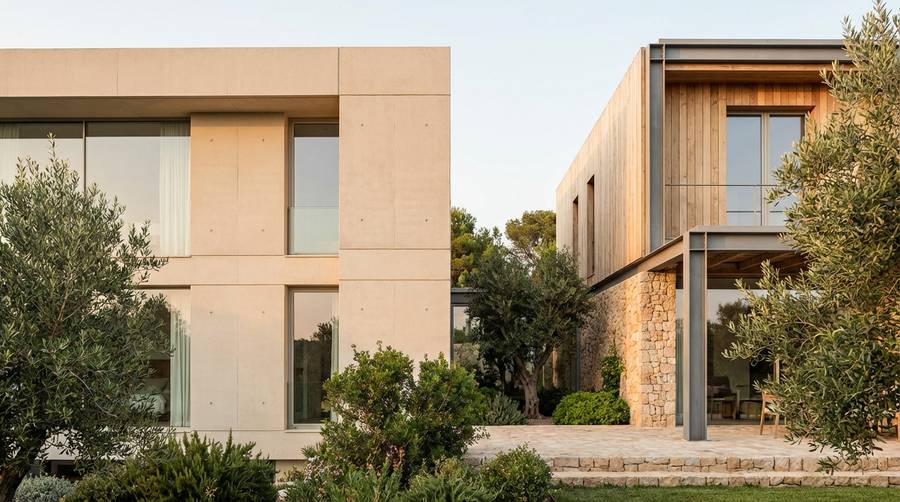
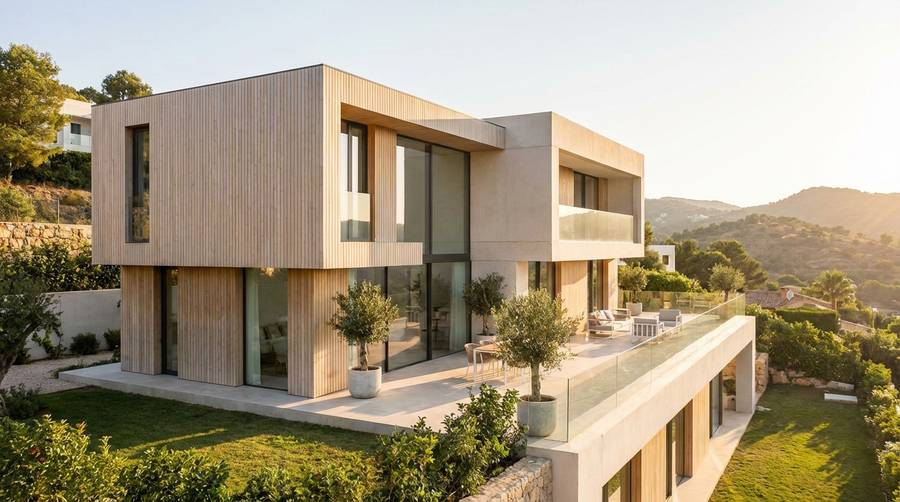
Generate a high-quality architectural photograph in the Findnido brand style: a finished Mediterranean contemporary single-family home in Spain at golden hour. The house shows a light, textured façade combining natural stone, warm wood cladding and smooth light concrete. Large windows and terraces open to a modest landscaped garden with native plants and a small paved terrace. The scene should feel lived-in: subtle outdoor furniture, a bicycle, soft interior lighting visible through the glazing. Balanced framing, natural colors, magazine-quality real estate photography. Mood: trust, comfort, modern life and sustainability. Avoid any exposed construction systems or modular joints; the house must read as a premium, finished residence. Do not show container-like modules or industrial warehouses. Include soft shadows and warm sunlight to highlight material textures.
If you are considering an industrialized home in Spain, this guide provides the key decisions and realistic metrics to help you plan. For tailored advice and cost estimates for your plot, contact a specialist who combines design, manufacturing and turnkey delivery.
Artículos relacionados