Industrialized Housing: A Turnkey Modular Success
Industrialized Housing: A Turnkey Modular Success
Hook: When a young family in Spain needed a new home in under six months, traditional construction was not an option. They turned to industrialized housing—and the result changed their expectations about speed, cost certainty, and comfort.
From plot to home: the story of a modular development that exceeded expectations
Initial context: why the family chose industrialized housing
The family required a home that matched three non-negotiable goals: a sealed delivery date, fixed budget, and high energy performance. After comparing traditional build timelines and variable costs, they selected industrialized housing for predictable scheduling, factory-controlled quality, and clear financial terms.
Project vision: time, budget and sustainability objectives
The project set concrete targets: complete manufacturing within 10 weeks, onsite assembly in 14 days, and achieve an energy rating equivalent to near-Passivhaus standards. The team prioritized low operational costs and reduced carbon footprint as measures of long-term value.
Early steps: plot hunting and the decision-making moment
The search for a plot emphasized orientation, access, and local planning restrictions. After confirming urban parameters, the clients engaged a turnkey industrialized housing platform to run feasibility, produce a fixed-price quote, and propose systems aligned with the sustainability goals.
Critical challenges to overcome under a tight schedule
Time constraints: micro-schedules and coordination demands
Delivering a home in a compressed schedule required rigorous sequencing. The factory schedule, logistics for transporting modules, and on-site foundation works had to be synchronized to the day. The project used milestone-based contracts and digital coordination tools to avoid delays.
Budget restrictions and the need for a fixed price
For autopromoters, financing often depends on a clear cost cap. By selecting an industrialized housing package with a fixed-price turnkey contract, the family secured bank financing without surprise contingencies. This approach shifted risk away from the client and into the production and delivery chain.
Site conditions and local planning requirements
Unexpected soil conditions or municipal constraints can derail timelines. The team completed a targeted geotechnical study and pre-validated key urban parameters with the town hall before finalizing the contract. That upfront effort avoided costly rework and saved weeks in approval time.
Findnido’s solution: express assembly and a true turnkey process
Choosing the construction system: precast concrete, steel frame or light timber?
The project evaluated three systems: precast concrete, steel frame, and light timber frame. Each offers trade-offs:
- Precast concrete: excellent thermal mass, durability, and acoustic performance—preferred where longevity and fire resistance are priorities.
- Steel frame: high precision, speed of assembly, and long spans for open-plan layouts.
- Light timber frame: lower embodied carbon, rapid factory production, and excellent thermal behavior when coupled with high-performance insulation.
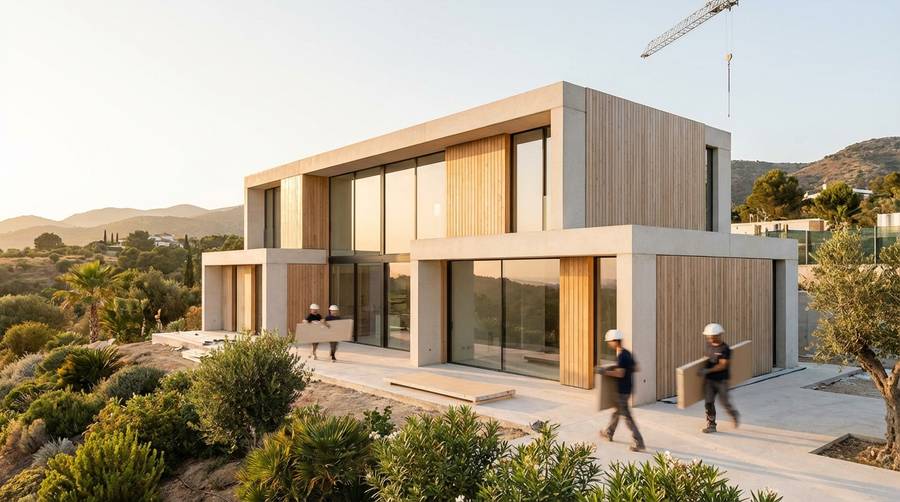
Finding the right balance, the client selected a hybrid approach: a concrete base for robustness and acoustic separation, with light timber frame upper volumes for speed and sustainability—leveraging the strengths of industrialized housing workflows.
Planning and synchronization: factory prefabrication and assembly in weeks
Factory production ran in parallel with on-site civil works. Key practices that reduced calendar risk:
- Time-boxed production windows with buffer weeks for quality control.
- Just-in-time logistics for module transport to reduce on-site storage needs.
- Fixed teams for assembly to maintain craftsmanship consistency.
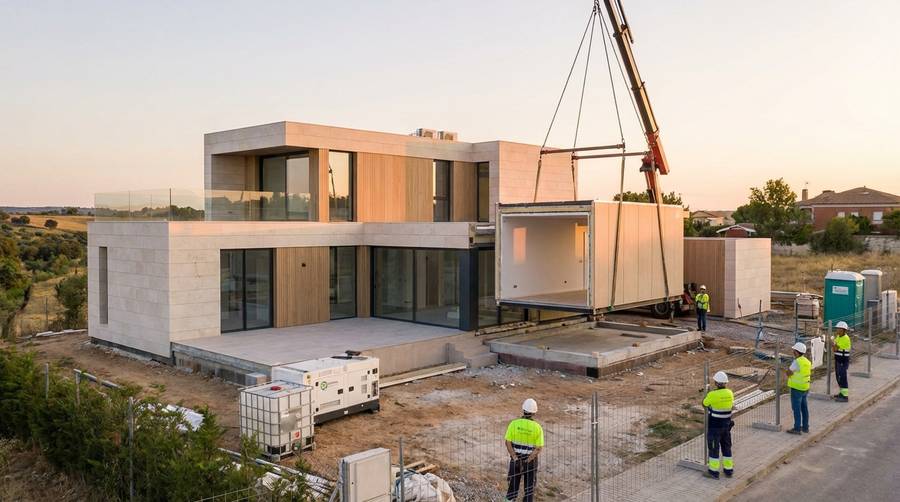
Result: modules left the factory on schedule and the on-site assembly phase was completed in 12 days—well within the target.
Full-service management: permits, financing for autopromotion and deliverables
As a turnkey industrialized housing provider, the platform managed administrative tasks and guided the family through autopromoter mortgage options. The package included:
- Permit application coordination with local authorities.
- Assistance compiling documentation for construction mortgages and phased drawdowns.
- Final commissioning and handover with appliance and systems training for the family.
Measurable results: time, cost and energy performance
Construction metrics: production lead time, assembly days and commissioning
Concrete metrics from the project:
- Factory manufacturing: 9 weeks from order confirmation to dispatch.
- Onsite assembly: 12 days for module craning, connections and envelope sealing.
- Commissioning: 7 days to test HVAC, PV integration and final inspections.
These metrics illustrate how industrialized housing compresses the typical 12–18 month schedule of traditional builds into a reliable multi-month delivery.
Final budget vs estimate: fixed price performance and deviations
The project closed at the agreed fixed price with minimal contract variations. Deviations under 2% originated from optional landscaping upgrades requested after the turnkey proposal—an outcome avoided at large through clear scope definition in the contract.
Sustainability and comfort: energy rating and carbon reduction
Energy outcomes achieved:
- Simulated annual heating demand reduced by 60% compared to a reference traditional build.
- Built with high-performance insulation, triple-glazed windows and mechanical ventilation with heat recovery to approach Passivhaus benchmarks.
- Embodied carbon reduced via lightweight timber elements and efficient transport logistics; operational carbon lowered by integrated photovoltaic systems.
Result: industrialized housing delivered a faster handover, transparent cost control and measurable energy savings—without compromising architectural quality.
Technical and value comparison with traditional construction
Faster schedules and better quality control through industrialization
Factory conditions enable consistent workmanship, standardized connections, and systematic quality checks. For autopromoters, that means fewer surprises during final inspection and a shorter timeline to occupancy when choosing industrialized housing.
Cost differences and contractual risk for the autopromoter
Traditional builds often expose the client to scope changes and variable subcontractor costs. In contrast, a fixed-price turnkey industrialized housing contract transfers many of those risks to the provider and simplifies financing with clearer cashflow forecasts.
Materials and durability: performance of concrete, timber and steel options
Comparative notes:
- Concrete delivers long-term durability and sound insulation but has higher embodied carbon unless produced with low-carbon mixes.
- Timber reduces embodied carbon, is fast to fabricate and offers good thermal performance when detailed correctly.
- Steel provides precision and structural efficiency, particularly for wide spans, but requires corrosion protection and thermal bridging mitigation.
Practical guide for autopromoters: replicate this success in Spain
Step-by-step checklist: from plot to turnkey delivery
- Validate plot orientation and municipal constraints with a pre-application.
- Choose a turnkey industrialized housing provider and confirm a fixed-price scope.
- Decide on the structural system based on site, budget and sustainability targets.
- Run a focused geotechnical study and finalize foundation design while modules are manufactured.
- Coordinate logistics: transport permits, crane scheduling and utility connections.
- Perform final commissioning and request a comprehensive handover dossier.
Financing tips: autopromotion mortgages and payment strategies
Key financing recommendations:
- Negotiate phased drawdowns aligned with factory milestones to reduce upfront capital needs.
- Use a fixed-price turnkey contract to obtain better mortgage terms from lenders.
- Explore green incentives for energy-efficient builds to lower financing costs.
Common mistakes and recommendations to ensure quality and timing
Avoid these pitfalls:
- Delaying local permit validation—start municipal checks early.
- Underestimating site access constraints for oversized module transport.
- Vague scope definitions—insist on a detailed turnkey specification.
Closing and next steps: lessons learned and how industrialization broadens access to quality housing
Impact on family life and long-term benefits
The family moved in on the promised date and reported immediate benefits: lower monthly energy bills, improved acoustic privacy, and a home that feels robust and contemporary. The predictable delivery allowed them to plan school enrollment, work transitions, and long-term finances with confidence.
How industrialized housing democratizes access to high-quality homes
By shifting uncertainty away from the autopromoter and into standardized production pipelines, industrialized housing reduces barriers for more families to obtain architect-designed, energy-efficient homes at transparent costs.
Recommended next steps to start your project with confidence
If you are considering an industrialized housing route, begin with a feasibility call that includes: site review, preliminary cost estimate, and a discussion of financing paths for autopromotion. For a concrete example of an express assembly and turnkey delivery, read this case: Vivienda industrializada: Caso real de entrega llave en mano.
Final thought: Industrialized housing is not just faster construction—it is a method to secure cost certainty, quality and sustainable living at scale.
Want to explore how industrialized housing could work on your plot? Contact a certified turnkey provider to request a tailored feasibility study and a fixed-price illustration for your project.