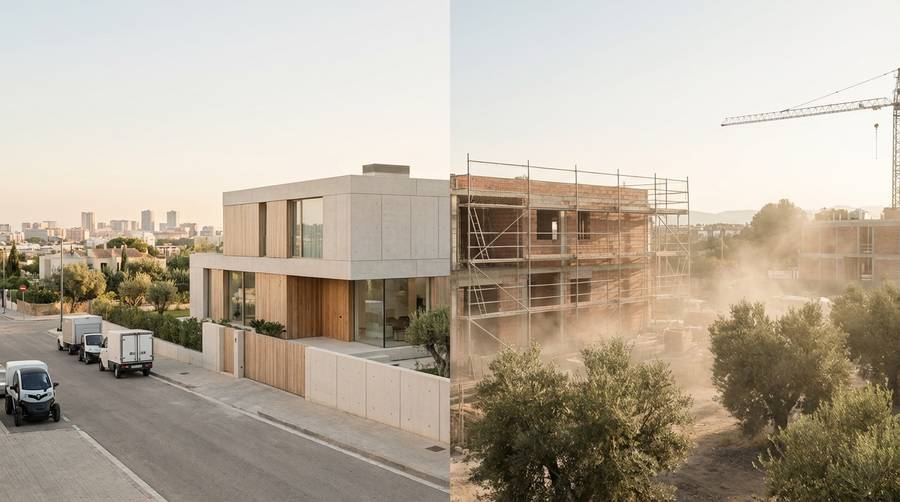
Industrialized Housing: Common Mistakes and Practical Fixes
Hook: The promise of industrialized housing is faster delivery, predictable costs and better energy performance—but projects still fail when teams treat speed as a sprint rather than a system. This article pinpoints the most common mistakes and gives precise, actionable remedies so your turnkey modular project in Spain finishes on schedule, within budget and to spec.
Why assembly speed matters: risks and opportunities
Speed in assembly is more than a marketing claim. It directly impacts cost, client satisfaction and the ability to meet energy and regulatory targets. When managed well, quick assembly reduces financing costs and exposure to weather risk. When mismanaged, it amplifies delays and hidden expenses.
Impact on final cost, delivery time and client satisfaction
Direct savings: shorter on-site timelines reduce labour days, site overheads and temporary facilities. In practice, a well-planned modular assembly can cut on-site time by 40–70% compared with traditional builds.
Indirect savings: reduced financing charges (interest during construction) and earlier occupancy—critical when owners are paying rent or carrying two mortgages.
Client perception: meeting agreed delivery dates increases satisfaction and referral likelihood; missing them damages reputation.
Urban risks: permits, utilities and neighbourhood coordination
Common urban constraints include restricted delivery hours, narrow access, protected trees and neighbours' objections. These factors can easily add weeks if not anticipated.
How to measure assembly speed: key metrics to track
- On-site days from first delivery to handover.
- Factory-to-site lead time: from module completion to installation.
- Percentage of on-time deliveries by transport provider.
- Defects per unit at handover (quality metric).
In a 2024 Spanish pilot, synchronising factory schedules with transport reduced on-site time from 42 to 18 days and cut unexpected costs by 28%.
Error 1 — Insufficient planning of the urban environment
Many projects assume a blank plot. Urban reality is messier: access limitations, underground services and permit timing frequently derail schedules.
Lack of access and soil study: consequences and warning signs
Consequences: last-minute crane relocations, failed foundation assumptions, suspended works due to unknown services.
Warning signs: imprecise cadastral data, lack of topographical survey, missing utility maps or outdated municipal records.
Practical solution: pre-purchase parcel checklist
- Obtain a recent topographic survey and geotechnical report before committing.
- Verify legal easements and existing service ducts with the utility companies.
- Measure access width and turning radii for the largest transport unit that will arrive.
- Confirm crane placement zones and permitted working hours with the council.
Preventive advice: early coordination with local authorities and services
Start permit dialogue before buying the land. Early contact with the ayuntamiento prevents surprises on noise windows, street occupation permits and traffic management requirements.
Error 2 — Choosing the wrong construction system for the context
Selecting between industrialized concrete, light timber frame and steel frame is strategic. Each has strengths; the error is a mismatch between system and site constraints, local regulation or client priorities.
How to choose between industrialized concrete, timber frame and steel frame
- Industrialized concrete: excellent acoustic performance and thermal mass; suited to urban plots with strict acoustic regulations or multi-storey needs.
- Timber frame (light-frame): fast factory production, high thermal performance, lower embodied carbon when sourced responsibly; ideal for single-family homes and Passivhaus targets.
- Steel frame: high precision and larger clear spans; good for atypical forms or when slender sections are needed.
Frequent errors: non-compliance with local codes and unrealistic assembly times
Teams often assume factory claims for assembly time translate directly on-site. But local seismic, fire or acoustic demands can require extra interventions—fireproofing layers, acoustic partitions—that extend both factory and site schedules.
Resolutive recommendation: technical and economic decision criteria
- Compare whole-life cost, not just factory price: include transport, craneage, finishes and warranty support.
- Run a compliance check against municipal rules early; factor required additional treatments into lead time.
- Prioritise systems with established local supply chains to avoid transport bottlenecks and customs delays.
Error 3 — Poorly sized transport and assembly logistics
Transport is the silent risk. A single failed delivery window can cascade into weeks of delay.
Typical problems: access limitations, restricted hours and urban rules
Local restrictions on heavy vehicles, night deliveries and protected streets are common. Narrow streets or low bridges will force module downsizing, increasing on-site assembly time.
Operational solutions: route planning, special permits and timing
- Conduct a route survey from factory to site and simulate the largest load movement.
- Apply for special transport permits and reserves for public space occupation well in advance.
- Schedule deliveries during permitted windows and avoid peak traffic times to reduce risk.
Practical tips: coordination with carriers and contingency plans
Two practical rules:
- Always have a Plan B for crane placement and a staged unloading plan if access fails.
- Use experienced carriers familiar with Spanish municipal procedures; require written delivery SLAs and penalties for missed slots.
Error 4 — Lack of integration between factory and site (“Turnkey” mismatches)
Turnkey promises fail when factory outputs and site expectations are not harmonised—resulting in rework, delays and disputes.
How mismatches affect time and cost: real examples
Example: a 140 m2 single-family home where cladding panels were produced without the specified window junctions. Result: three days of on-site rework per façade, two additional crane days and a 12% cost overrun on finishing.
Solutions: quality protocols, controlled prefabrication and synchronized deliveries
- Define acceptance criteria for modules before dispatch (dimensions, finishes, utilities stubbed and tested).
- Use mock-up units to validate interfaces between factory-made modules and site-installed elements.
- Implement delivery windows aligned to site milestones with joint sign-offs upon reception.
Practical warning: contractual clauses and payment milestones
Include clauses that link milestone payments to objective deliverables: factory tests passed, modules installed and utilities commissioned. This aligns incentives and provides clear dispute resolution triggers.
Error 5 — Weak team communication and project management
Poor communication multiplies simple errors. A missing dimension or ambiguous drawing can create chain delays across factory and site.
Consequences: delays from misalignment between design, factory and assembly
When design changes are not pushed to the factory in time, modules may be manufactured to obsolete specs requiring rework or replacement.
Tools that solve this: digital coordination, milestone meetings and clear roles
- Adopt a shared digital platform for drawings, RFIs and progress logs with version control.
- Hold fixed weekly milestone meetings with a clear agenda and one accountable representative per discipline.
- Assign a single point of contact for the client, factory and site to avoid conflicting instructions.
Preventive advice: shared documentation and named phase owners
Keep a central, time-stamped document repository and require sign-off for any design change. Appoint a phase owner responsible for cost, time and quality for each major milestone.
How to ensure fast, predictable assemblies: a step-by-step plan
This condensed plan converts the previous diagnostics into an operational sequence you can apply to your next turnkey project.
Action plan: from parcel search to turnkey delivery
- Pre-acquisition due diligence: topography, geotechnical report, service maps and access survey.
- System selection workshop: compare industrialized concrete, timber and steel using whole-life metrics.
- Factory validation: build a mock-up and set acceptance criteria for modules.
- Logistics planning: route simulation, permits and crane strategy.
- Contract alignment: define milestones, deliverables, penalties and warranties.
- Operational coordination: weekly milestones, single points of contact and digital documentation.
- Handover and close-out: commissioning, final QA, client walkthrough and satisfaction survey.
Final checklist: permits, logistics, fabrication, assembly and QA
- All municipal permits and traffic occupation approvals confirmed.
- Transport carrier SLA and crane reservation signed.
- Factory pre-dispatch checklist completed and witnessed.
- On-site acceptance protocol and QA checklists ready for each module arrival.
- Client acceptance and handover documents prepared.
Success indicators and documenting case studies
Track the metrics listed earlier and document them in a short case study template: planned vs actual days, cost variance, defects, client satisfaction and lessons learned. This makes continuous improvement tangible.
Case study: a 120 m2 turnkey modular home in Valencia (realistic metrics)
Context: single-family, timber-frame industrialized house targeting Passivhaus levels.
- Site prep and foundations: 12 days.
- Factory production of modules: 28 days (including window installation and MEP stubs).
- Transport and assembly: 3 days of crane work, 2 additional days for finishes on-site.
- Total on-site: 17 days (site prep + assembly + finishes).
- Cost variance vs traditional build: -11% on construction costs (excluding land) and -22% shorter overall calendar time to occupancy.
- Client satisfaction (surveyed at handover): 9/10 (speed and energy performance highlighted).
Key success factors: early municipal coordination, a factory mock-up for window junctions and a single coordinator managing factory-site handovers.
Conclusion
Bottom line: industrialized housing delivers its promises when you treat speed as a systems problem—one that combines site intelligence, the right structural system, tight logistics and disciplined communication. Avoid the five common errors by applying the checklists and processes above.
If you are planning a turnkey modular project and want a targeted review of your parcel, system choice or logistics plan, contact a specialist. A quick independent audit before purchase can save weeks and tens of thousands of euros.
Call to action: Consider scheduling a 30-minute planning audit to validate your parcel and assembly plan—small effort, major risk reduction.
Artículos relacionados