


Industrialized Housing Guide: How to Design a Modular Home
Industrialized Housing Guide: How to Design a Modular Home
Hook: If you want a high-quality home built faster, with predictable cost and top energy performance, industrialized housing is your best route. This guide walks you step by step through design, materials, financing and delivery in Spain (2026).
Why choose industrialized housing in Spain in 2026
Industrialized housing—often called modular or prefabricated—has evolved into a resilient, high-quality option. In Spain, it now combines Mediterranean architecture, modern materials and advanced energy standards. Below are the decisive reasons to choose this route.
Advantages vs traditional construction: time, cost control and quality
Faster delivery: Factory production allows parallel work: the structure is manufactured while site work proceeds. Typical on-site assembly for a 120 m² house can be completed in 3–6 weeks after foundations.
Fixed or transparent budgets: Industrialized processes reduce change orders. Many projects close with a fixed-price turnkey contract, minimizing risk for the self-builder.
Consistent quality control: Components built in controlled conditions achieve higher repeatability and lower rework than full in-situ builds.
Sustainability and energy efficiency: cutting carbon and meeting Passivhaus
Modern modular homes are well-suited to reach passive house targets. Factory precision improves insulation continuity and airtightness. Combined with efficient HVAC and solar-ready design, industrialized housing can reduce operational energy by 70–90% compared to conventional builds.
Certifications and lifecycle: Choose systems that facilitate Passivhaus certification and lifecycle assessments to minimize embodied and operational carbon.
Who benefits: ideal autopromoter profiles and common use cases
- Families seeking a predictable timeline and budget for a new home.
- Autopromoters with a clear plot who want a turnkey delivery.
- Investors building rental homes with controlled costs and energy performance.
Industrialized housing reduces build-time variability and delivers superior airtightness, often enabling Passivhaus levels of comfort with lower running costs.
Modern materials and systems: how to choose
Material choice defines long-term performance. Below are the primary systems used in high-quality modular housing in Spain.
Industrialized concrete: performance, durability and uses
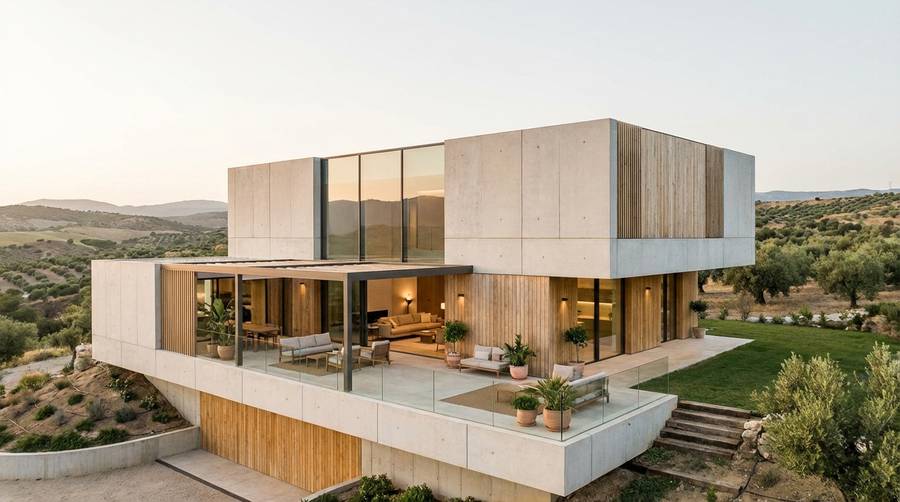
Precast and industrialized concrete offer excellent thermal mass, durability and acoustic insulation. Use concrete systems where thermal inertia and longevity are priorities—ground floors, retaining walls and compact thermal stores for solar systems.
Advantages: fire resistance, low maintenance and high lifespan. Consider insulated precast panels to balance mass with U-values that meet modern energy codes.
Light timber frame and steel frame: performance and comfort comparison
Timber frame (lightweight): High thermal performance, breathable assemblies and fast factory assembly. Ideal for warm Mediterranean designs when combined with proper moisture control.
Steel frame (steel frame): High dimensional stability and strength-to-weight ratio, suitable for larger spans and open-plan interiors. Steel enables thinner wall sections while maintaining insulation depth.
- Insulation compatibility: Both systems allow high-performance continuous insulation layers and airtight membranes.
- Acoustic strategies: Add mass where necessary: floor slabs or internal lining to reach target decibel reductions.
Finishes and thermal envelope: solutions for Mediterranean aesthetics
Choose finishes that respond to the local climate and the desired Mediterranean look: light lime renders, natural stone cladding, and horizontal timber slats. For thermal performance, target continuous external insulation, high-performance windows (triple-glazed in cold zones), and shaded facades to limit summer gains.
Design and planning your industrialized home — step by step
Design must balance program, energy targets and on-site constraints. Below is a practical workflow from concept to construction-ready package.
Define program, orientation and energy goals (e.g., Passivhaus)
- List rooms, sizes and priority spaces (living, bedrooms, workspace).
- Assess plot orientation and shading. Maximize winter solar gains on the main living facades.
- Set an energy target early: baseline code, nearly zero-energy (NZEB) or Passivhaus. Targeting Passivhaus changes design choices from day one.
Integrating Mediterranean architecture: facades, porches and indoor-outdoor flow
Design verandas, deep porches and shaded terraces to match Mediterranean living. Use large windows oriented to private gardens and integrate thermal mass elements inside for night-time cooling.
Tip: A well-dimensioned porch reduces solar gains up to 40% in summer while preserving winter sunlight.
Technical planning: timelines, permits and adapting to the plot
Prepare a clear timeline with two parallel tracks: factory production and siteworks. Allow typical durations:
- Design and permits: 3–6 months (depends on the municipality).
- Factory production: 6–12 weeks (modules and components).
- Site assembly and finishes: 4–10 weeks (after foundations).
Confirm local building regulations early. Municipalities in Spain may require specific facade treatments or materials for new homes.
The turnkey process explained: plot to handover
A turnkey contract simplifies the autopromoter's journey. Here is the sequence and what to expect at each stage.
Searching and preparing the plot: common steps and constraints in Spain
Key checks before purchase:
- Zoning and buildability: maximum footprint and permitted uses.
- Topography and access: crane and truck access for module delivery.
- Utility connections: distance to mains and estimated connection costs.
Include geotechnical surveys and plot boundary verification in the initial budget.
Factory phase and on-site assembly: a typical schedule and quality control
Factory production includes structural frames, insulation, windows and often complete mechanical systems. Quality control checkpoints commonly include dimensional checks, airtightness detailing and factory testing of HVAC components.
On-site, the workflow follows: foundations and utilities, module placement, envelope completion and commissioning.
Handover, aftercare and warranties: tests and client support
Before handover, perform these tests and document results:
- Airtightness test (Blower Door).
- Thermal imaging to detect cold bridges.
- Function test of HVAC and domestic hot water systems.
Obtain written warranties that cover factory defects, structural elements and mechanical systems. A robust aftercare plan reduces early-life complaints and increases homeowner satisfaction.
Financing and mortgages for modular self-builds
Financing modular homes can follow models similar to traditional self-construction, but lenders evaluate different metrics. Below are practical financing options and how to present your case to banks.
Self-builder mortgages: types, requirements and documentation
Common products include construction mortgages and phased disbursement loans tied to completion milestones. Required documentation typically includes:
- Approved architectural and structural project.
- Turnkey contract with the manufacturer/constructor.
- Cash-flow plan and contingency provision.
Note: Banks ask for reliable cost estimates and evidence of manufacturer experience.
Financing models for modular housing: milestone payments and insurance
Many modular manufacturers accept payments by milestones: design, factory start, factory completion and on-site handover. Combine this scheme with construction insurance and a retention clause to protect the buyer.
How to present a modular budget to banks: metrics they look for
Key figures that convince lenders:
- Guaranteed maximum price (if available).
- Schedule with deliverable milestones.
- Comparable projects or references with final costs and completion dates.
Case studies and technical comparisons with real data
Real metrics help make decisions. Below are anonymized case studies representative of typical projects.
Case 1: 120 m² single-family home — times, final cost and homeowner satisfaction
Project snapshot:
- System: timber-frame modules, ventilated facade with stone accents.
- Timeline: design and permits 4 months; factory 8 weeks; on-site assembly 6 weeks.
- Final cost: €1,450/m² (turnkey).
- Post-occupancy satisfaction: 9/10 (comfort, low bills, delivery on schedule).
Lessons: early agreement on finishes and a clear utility connection plan prevented delays and overruns.
Case 2: Passivhaus single-family in industrialized concrete — energy metrics and ROI
Project snapshot:
- System: insulated precast concrete panels with mechanical ventilation and heat recovery.
- Energy result: primary heating demand < 15 kWh/m²·year.
- Incremental cost vs standard modular build: +8% but payback through energy savings and resale premium estimated at 10–12 years.
Conclusion: investing in high-performance envelopes accelerates ROI in regions with energy cost volatility.
Technical comparison: cost per m², delivery time and sustainability ratios vs traditional build
| Metric | Industrialized (typical) | Conventional |
|---|---|---|
| Delivery time | 6–5 months (design to keys) | 10–18 months |
| Cost (turnkey) | €1,200–1,700/m² | €1,000–1,800/m² (variable) |
| Operational energy | 30–70% lower | Baseline higher |
| Embodied carbon | Depends on materials; optimized systems lower lifecycle carbon | Often higher due to on-site inefficiencies |
Next steps for your modular project: start with confidence
Turning the idea into a delivered home requires methodical early steps. Use this short roadmap to prepare your first consultation.
Practical checklist for the first meeting with a manufacturer or contractor
- Plot information: cadastral reference, orientation and topography.
- Budget range and financing preference.
- Reference images and required program (rooms, sizes).
- Energy target (e.g., Passivhaus, NZEB).
- Timeline expectations and flexibility.
Frequent mistakes by autopromoters and how to avoid them
- Underestimating connection costs: commission surveys early.
- Delaying decisions on finishes: finalize them before factory production.
- Choosing the cheapest offer without references: verify delivered projects and warranties.
Resources and contacts: templates, cost simulators and financial advice
Gather the following documents and tools before signing a contract:
- Standard turnkey contract template and a clear scope of supply.
- Cost simulator or spreadsheet that lists unit costs and contingency.
- Consult with a mortgage adviser experienced in self-build finance.
Learn more about the fundamentals of industrialized housing in our companion piece: Vivienda industrializada: Guía práctica para autopromotores 2026.
Artículos relacionados
Industrialized Housing Spain: Top 6 Things Autopromoters Need
A concise, practical guide for self-builders in Spain: six focused sections that compare costs, materials, energy strategies and financing options for industrialized and modular homes, with real metrics and a turnkey checklist.