Passivhaus Pitfalls: Common Errors and Practical Fixes
Introduction — Hook: Why some Passivhaus projects fail before they start
Hook: Many autopromoters choose a Passivhaus approach expecting minimal heating bills and comfort. Yet poor decisions early on can erode those benefits faster than anyone realises. In this guide we identify the real-world mistakes that compromise Passivhaus performance in industrialized and modular homes, and we provide clear, actionable solutions you can apply today.
Up to 30% of a certified building's expected energy savings can be lost through preventable mistakes in site choice, detailing and execution.
Why not every Passivhaus performs the same: initial mistakes that compromise outcomes
Plot choice mistakes: orientation, shading and micrometeorology
Problem: Choosing a parcel without evaluating solar access, local shading or wind patterns undermines passive gains.
- Actionable fix: Run a solar-path study for the exact coordinates. Use free tools (e.g., SunCalc) and validate on-site during different times of year.
- Microclimate check: Inspect neighboring buildings, mature trees and slope-driven wind channels. Document seasonal effects — don’t rely only on maps.
- Decision rule: If winter direct-sun hours on main glazing drop below 60% of ideal, change orientation, window sizes or add selective glazing.
Unrealistic expectations about turnkey timing and costs
Problem: Autopromoters expect the 'llave en mano' industrialized route to be instant and risk-free. In reality, hidden tasks and approvals extend timelines.
- Actionable fix: Build a two-tier schedule: guaranteed factory lead times + conservative on-site buffer (typically +20–30%).
- Contract tip: Require milestone-linked payments and clear penalties for delays, while protecting yourself with force majeure clauses narrowly defined.
Failing to integrate design with the chosen industrial system
Problem: Treating architecture and the construction system as separate decisions leads to detailing conflicts that create thermal bridges, leaks or rework.
- Actionable fix: Insist on a co-design phase where the architect, factory engineer and façade consultant sign off on interface details.
- Practical measure: Produce an 'interfaces manual' before production: window reveals, junctions to foundation and roof per the selected system (concrete, timber frame, steel frame).
Common bioclimatic design failures and practical solutions
Incorrect window orientation or size: optimizing solar gains
Problem: Oversized west glazing or undersized southern glazing causes overheating or missed passive gains.
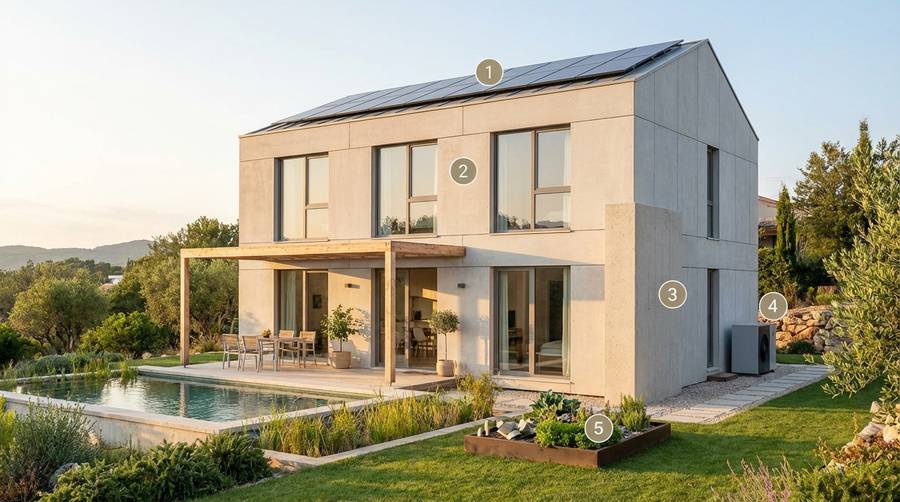
- Fix: Use simple rules: maximise glazing to the south (with overhangs sized for summer shading), minimise west-facing glazing and use high-performance glazing on the east/west façades.
- Toolbox: Run a quick dynamic simulation (DesignBuilder, PHPP-lite) focusing on annual heating and cooling hours — iterate window sizes until overheating hours disappear.
Thermal bridges from detailing: simple on-project remedies
Problem: Small junctions (balconies, lintels, sub-frames) cause heat loss and moisture risk.
- Immediate fixes: Add thermal breaks at steel connections, continuous exterior insulation where possible, and avoid compressible insulation at load-bearing points.
- Specification tip: Require Psi-value documentation for every detail from suppliers and validate in the contract.
Lack of Mechanical Ventilation with Heat Recovery (MVHR/VMC): right sizing and installation
Problem: Either omitting MVHR or installing an undersized/poorly ducted system destroys airtightness benefits.
- Selection: Choose units with verified SFP and efficiency figures; size for actual internal gains and occupancy, not just floor area.
- Installation rules: Keep ducts short and rigid where possible, seal every joint with airtight tape and mandate commissioning tests (flow balancing).
Errors choosing materials and industrial systems
Picking systems by price, not thermal performance (U and Psi values)
Problem: A cheaper wall system with higher U-value can increase lifetime energy costs and risk non-compliance.
- Comparative approach: Require manufacturers to provide U-values for panel assemblies and Psi-values for junctions. Compare whole-element performance, not only insulation thickness.
- Procurement tip: Use life-cycle cost comparisons over 30 years, including maintenance and replacement rates.
Sealing and joints in concrete, steel frame or timber systems: best practices
Problem: Joints are the most common leakage points in industrialized homes.
- Factory controls: Pre-treat joint surfaces, use compression seals with proven durability and validate adhesives for compatibility with the substrate.
- On-site practice: Follow a joint sealing sequence: primer, compatible sealant, external tape. Record serial numbers of materials in a QA log.
Material compatibility and durability: criteria for sustainable choices
Decision factors: Moisture tolerance, differential movement, UV exposure and maintenance needs.
- Rule of thumb: Combine materials with similar hygrothermal behaviour and allow movement joints where necessary.
- Specification: Ask for accelerated ageing test results or warranties that document expected service life.
Execution and on-site assembly failures — and how to avoid them
Quality control during assembly: checklists and clear responsibilities
Problem: Assembly teams treat panels like generic components instead of part of an airtight, thermally continuous envelope.
- Implement: A stage-based QA checklist with sign-off at factory dispatch, arrival, pre-assembly, and final assembly.
- Who signs? Require the site manager, factory rep and client’s technical advisor to sign critical stages.
Managing moisture and airtightness in union phases
Problem: Temporary exposure during transport and assembly creates moisture risk and can compromise insulation.
- Prevention: Protect panels during transit, schedule assembly promptly, and verify exterior tapes/seals before leaving the site.
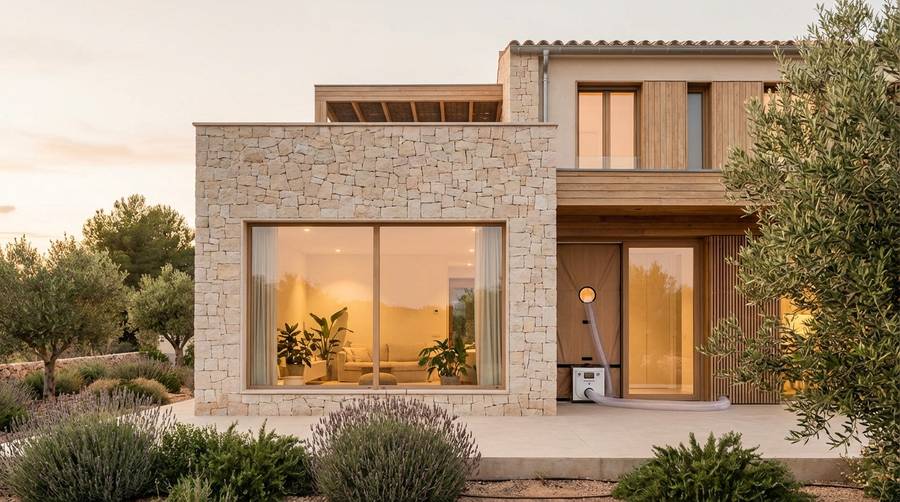
- Test: Conduct interim Blower Door tests at 50% and 100% enclosure completion to detect problems early.
Factory-to-site coordination: reduce rework and delays
Problem: Mismatched interface details between factory documentation and on-site conditions cause stoppages.
- Coordination method: Use BIM-lite or a shared drawing register; perform a pre-assembly mock-up of critical corners.
- Contractual safeguard: Define tolerances for panel dimensions and penalty/repair terms for out-of-tolerance components.
Financial and project-management mistakes for autopromoters
Not planning financing specific to self-build/modular mortgages
Problem: Standard mortgages do not cover factory production phases or staged payments.
- Action: Seek a dedicated autopromotion or modular mortgage that covers plot purchase, factory production and site assembly stages.
- Practical tip: Keep a contingency fund of 8–12% for unexpected scope adjustments—this reduces the chance of cash-flow halts.
Underestimating extras and contingencies in 'fixed price' contracts
Problem: Fixed-price offers often exclude site-specific works: demolition, utilities connection, retaining walls.
- Checklist: Validate the fixed price includes foundations, connections, permits, and temporary works. If not, quantify each excluded item before signing.
- Negotiation tip: Convert vague exclusions into priced provisional sums in the contract.
No clear turnkey contract: must-have clauses and guarantees
Contract essentials: scope of supply, tolerances, commissioning tests, warranty periods and remedies for non-conformity.
- Include: airtightness target with agreed retest procedure, MVHR commissioning report and a final acceptance protocol tied to retention funds.
- Warranty structure: Separate manufacturer warranties from the turnkey contractor warranty; ensure transferability.
Evaluating and correcting real performance after handover
Key tests: Blower Door, thermography and consumption checks
Process: Run a final Blower Door test, perform thermal imaging in heating season and compare metered consumption with modelled loads.
- Thresholds: For a Passivhaus-step dwelling, aim for n50 <= 1.0–1.5 h-1 depending on local standards and the chosen certification ambition.
- Data check: If measured consumption exceeds model by >20%, run airtightness and thermal-bridge diagnostics immediately.
Corrective actions without losing guarantees
Approach: Follow a documented process: identify root cause, produce a repair plan, get written manufacturer sign-off and log repairs into the building file.
- Tip: Use non-invasive measures first (improvement of seals, MVHR balancing) and escalate to component replacement only if necessary.
Monitoring and occupant habits to preserve Passivhaus performance
Advice: Install simple monitoring (indoor temperature, humidity, energy meters) and train occupants on MVHR use and shading operation.
- Behavioural guideline: Keep persistent ventilation running, avoid intermittent over-ventilation and use external shading in summer.
- Maintenance: MVHR filters quarterly, seal checks annually and façade inspection every 5 years.
Practical lessons and final checklist to avoid the most frequent errors
Pre-contract checklist: design, materials, schedules and responsibilities
- Site solar/path study and microclimate report.
- Co-design sign-off between architect and factory.
- Thermal performance datasheets (U, Psi) for all assemblies.
- Financing plan that covers pre-production and assembly phases.
- Clear turnkey contract with airtightness target and retest clause.
On-site assembly checklist: QA, tests and documentation
- Factory dispatch QA certificate for each module/panel.
- Interim and final Blower Door tests recorded with tracer results.
- Signed assembly interface log and materials serial numbers.
- MVHR commissioning and balancing report.
Post-delivery checklist: verifications, warranties and sustainable maintenance
- Final thermography and comparison with predicted model.
- Registered warranties and maintenance schedules accessible to homeowner.
- Simple monitoring dashboard for first 12 months of operation.
Case example: realistic metrics from an industrialized Passivhaus in Spain (anonymised)
Context: 140 m² two-storey family house, steel frame panels, MVHR, south-oriented glazing.
- Factory lead time: 12 weeks. On-site assembly: 6 days for panel erection, finishes 8 weeks.
- Budget outcome: Fixed-price envelope matched estimate within 6% due to a pre-agreed provisional sum for site works.
- Performance: Blower Door n50 = 0.9 h-1; measured annual heating demand 22 kWh/m²·year — within 10% of the modelled Passivhaus-step target.
- Lessons learnt: Early joint detailing and an MVHR commissioning protocol eliminated a potential 25% performance degradation seen on a previous project.
For more on high-performance prefabricated homes and occupant guidance see our detailed guide Casa prefabricada Passivhaus: guía para autopromotores.
Conclusion — Your immediate next steps
Bottom line: A Passivhaus-quality industrialized home delivers comfort and low running costs — but only if you avoid early site mistakes, align design with the production system, demand measurable performance data and enforce a strict QA regime during assembly.
Start with a short checklist: perform a site solar study, demand U/Psi documentation, require staged airtightness testing and secure appropriate financing. These five actions remove the most common risks.
If you’d like a tailored checklist for your plot or a review of manufacturer datasheets, contact our technical team — a brief audit can save months and significant expense.
Artículos relacionados