Industrialized Housing: Energy Efficiency Outlook 2026
Panoramic vision: the future of energy efficiency in industrialized housing
When a family moved into a modular home in Alicante in just 16 weeks, they assumed it would cost more or perform worse than a traditional build — and they were wrong. That single case reflects a broader shift: industrialized housing is leaving the construction margins and becoming a mainstream, measurable route to lower energy use, shorter delivery times and predictability in cost.
Current state and 2026–2035 projections: market data and estimated energy savings
Industry surveys and early adopter projects in Spain show that industrialized housing can reduce operational energy by 30–60% compared with conventional builds, depending on envelope performance and systems integration. Market adoption accelerated after 2020; by 2026 we expect modular and panelized systems to represent 12–18% of single-family starts in regions with strong policy support and supply-chain maturity.
Projections to 2035 hinge on three variables: policy alignment with decarbonization targets, cost declines in engineered materials (notably industrialized concrete and timber systems), and financial instruments for self-builders. Under a conservative scenario, aggregated lifecycle energy demand for new standalone homes could decrease by 25%–35% when industrialized methods and Passivhaus-inspired envelopes are standard.
Advantages vs traditional construction: fixed price, closed schedules and thermal performance
- Fixed-price certainty: Manufacturing-led workflows shift much of the cost variability offsite, reducing the frequency of budget overruns linked to weather and labour shortages.
- Shorter closed timelines: Effective on-site assembly windows shrink from 9–15 months to 3–6 months for many single-family typologies.
- Better thermal continuity: Factory-controlled assembly of the envelope reduces workmanship variability, improving U-values and diminishing thermal bridging.
Impact on carbon footprint and Spain’s sustainability goals
Lifecycle assessments on comparable prototypes show embodied carbon trade-offs: industrialized concrete panels can carry higher initial emissions than timber frames but enable thinner, highly insulated envelopes and lower operational emissions that offset embodied differences within 10–20 years. Selecting low-impact concrete mixes and reclaimed timber narrows that gap. For Spain to meet its building decarbonization targets, scaling industrialized housing optimized for energy efficiency and renewable-ready systems will be essential.
Industrialized methods can cut construction-related emissions and operating energy simultaneously — but only when material choices, airtightness and system integration are governed by clear performance targets.
Technological trends and materials shaping efficiency
Emerging materials: industrialized concrete, light timber framing and steel frame — energy benefits and costs
Each structural system brings trade-offs relevant to energy and cost control:
- Industrialized concrete: Provides thermal mass and durability. When used with high-performance insulation and reduced cement mixes, it supports passive comfort and long service life. Unit cost is moderate when produced at scale.
- Light timber frame (entramado ligero de madera): Low embodied carbon, fast to assemble, and naturally compatible with high-insulation envelopes. Moisture control and airtightness are critical.
- Steel frame (steel frame): Precise tolerances and repeatability. Thermal breaks and careful detailing are required to avoid bridging; useful for bespoke spans and larger openings.
Choosing a system should reflect a project's climate, budget and lifecycle targets. Hybrid solutions—concrete plinths with timber superstructures—are increasingly common in Mediterranean contexts.
Integrating Passivhaus principles and strengthening the thermal envelope
Adopting Passivhaus standards in modular builds focuses the design on three measurable levers: airtightness, thermal continuity and heat recovery ventilation. In industrialized production, achieving airtightness targets (e.g., n50 ≤ 0.6 h−1) is easier because joints and interfaces are executed in a controlled environment.
Practical steps for self-builders:
- Specify target U-values for walls, roofs and floors based on local climate maps.
- Prioritize continuous insulation and mechanical ventilation with heat recovery (MVHR).
- Use factory testing (blower door trials) before site assembly.
Automation, sensors and active energy management
Embedding IoT sensors and simple automation into the building fabric turns a high-performance envelope into an optimized home. Typical deployments include temperature/humidity sensing, occupancy-driven ventilation and solar PV production monitoring. These systems reduce energy waste and provide actionable data to occupants and lenders assessing long-term performance.
Technical comparison: energy performance across construction models
Thermal performance and energy balance: prefabricated vs traditional (comparative data)
Benchmarked projects in Spain show average delivered heating demand:
- Traditional masonry build: 45–90 kWh/m²·year (wide variance due to detailing).
- Prefabricated timber/steel frame with good insulation: 20–35 kWh/m²·year.
- Prefabricated Passivhaus-grade modules with MVHR: 10–15 kWh/m²·year.
These ranges depend on design choices and occupant behavior. Prefabricated systems show superior repeatability in achieving low energy demand.
Total costs and construction times: analysis with real figures and sensitivity by typology
Real-world figures (Spain 2024–2026 averages):
- Turnkey industrialized single-family (100–140 m²): €1,400–€2,300/m², delivery 12–24 weeks factory + 4–8 weeks on-site.
- Traditional build turnkey equivalent: €1,200–€2,200/m², delivery 9–15 months on-site; higher risk of overruns.
Sensitivity drivers include site complexity, foundation needs, specification level and local labour shortages. Industrialized routes compress uncertainty by moving value to controlled production.
Case studies: measured metrics for real projects
Example 1 — Mediterranean single-family, Alicante region:
- Structure: timber frame panels
- Timeline: 6 weeks factory + 2 weeks assembly
- Cost: €1,650/m² turnkey
- Energy consumption (first-year measured): 12 kWh/m²·year
- Client satisfaction (NPS-style survey): 82/100
Example 2 — Suburban home, Valencia province:
- Structure: hybrid concrete ground floor, steel-frame upper
- Timeline: 10 weeks factory + 6 weeks site
- Cost: €1,900/m² turnkey
- Energy consumption (first-year): 18 kWh/m²·year
- Client reported fewer defects and faster move-in readiness than neighbouring builds.
These cases underline two patterns: predictable timelines and low operational consumption when the envelope and systems are integrated from design stage.
Regulation, market and financing for self-builders in Spain
Regulatory landscape and certifications: Passivhaus, CTE and public incentives
Key regulatory touchpoints for autopromotores:
- CTE (Código Técnico de la Edificación): compliance remains mandatory; industrialized homes must document equivalence in performance.
- Passivhaus certification: optional but increasingly valued by buyers and lenders as proof of low operational cost.
- Public incentives: regional grants often prioritize high-efficiency retrofits and new builds with demonstrable energy savings—check current programmes at municipal and autonomous community levels.
Financing options and mortgages for self-construction and modular housing
Financing for autopromoción typically follows two routes:
- Self-build mortgage (staged releases): Funds are drawn against milestones (land, foundations, assembly, completion). Industrialized workflows suit staged draws because milestones are predictable.
- Turnkey mortgages: Some lenders offer mortgages that fund a turnkey contract as a single draw upon completion, reducing interim financial management for the client.
Example numeric illustration: For a €250,000 turnkey home with a 20% down payment, staged financing reduces interim interest exposure and can simplify cashflow for a self-builder who retains their primary residence during construction.
Market strategies for autopromotores to position an efficient project
To attract buyers or lenders, present clear performance documentation:
- Predicted and measured energy demand (kWh/m²·year).
- Warranty scopes: structural, envelope, systems.
- Lifecycle cost comparisons vs traditional alternatives.
Linking to evidence-based content increases trust. See further reading on energy-focused industrialized housing: Vivienda industrializada: el futuro de la eficiencia energética and a balanced comparison at Casa prefabricada: ventajas y desventajas para autopromotores.
Practical 2026 guide: designing an efficient industrialized home step by step
From plot search to turnkey delivery: timeline and critical milestones
Recommended high-level timeline for a typical 120 m² self-build in Spain:
- Weeks 0–8: Plot acquisition, feasibility and geotechnical survey.
- Weeks 8–16: Concept design, thermal targets and contractual selection of industrial partner.
- Weeks 16–28: Offsite production (panel/module manufacture) and permit processing.
- Weeks 28–32: Foundation and on-site assembly.
- Weeks 32–36: Services connection, commissioning and handover.
Key milestone: secure an airtightness and MVHR test plan within the contract to avoid surprises at handover.
Design choices and materials to maximize efficiency while controlling budget
Design priorities:
- Passive-first orientation and shading strategies for Mediterranean climates.
- Compact form to reduce envelope area per floor area.
- Continuous insulation with high-performance window systems.
Material shortcuts that harm performance (and should be avoided): underspecified airtightness membranes, thermal break omissions, and poor junction detailing between prefabricated components.
Technical and economic checklist: metrics to measure, tests and post-delivery guarantees
Checklist items for contracts and acceptance:
- Target U-values and documentation.
- Airtightness target and factory/site blower door tests.
- MVHR performance curves and commissioning report.
- Measured first-year energy consumption (metering plan).
- Structural and envelope warranty durations and scope.
Highlighted image description for AI generator (Findnido)
Visual brief for a Findnido-style architectural photograph
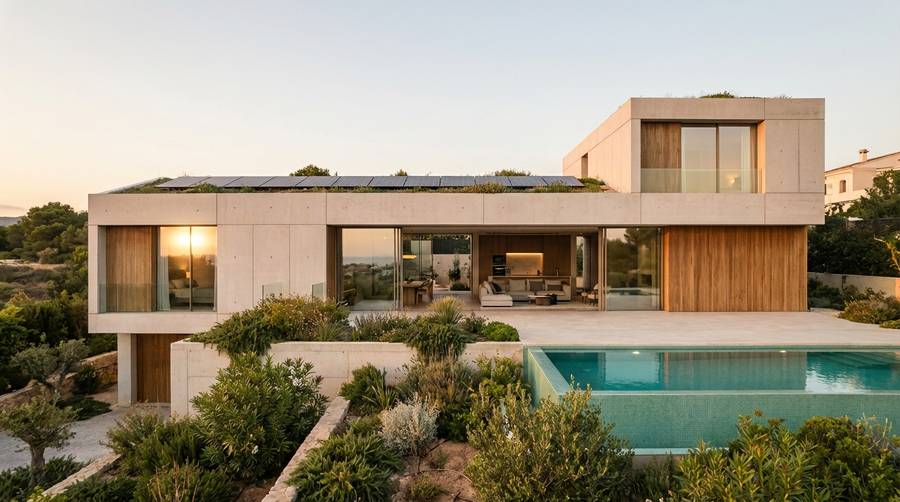
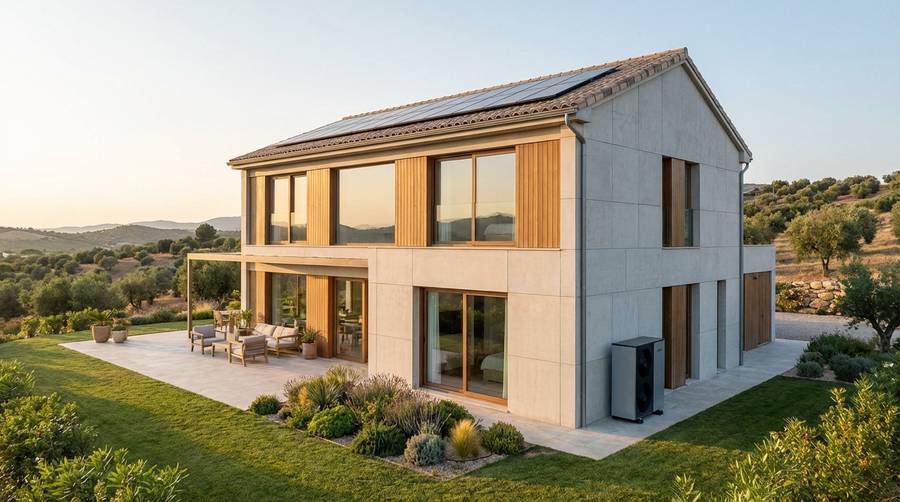
Photograph a finished Mediterranean contemporary home in Spain at golden hour. The house should look real and lived-in: light-colored façades with warm natural materials (wood accents, polished concrete details), large windows showing warm interior light, and a terrace with Mediterranean planting (young olive trees, potted shrubs, neat lawn). Include a small family or a couple naturally enjoying the exterior to convey comfort and trust—no forced poses. The composition must feel premium and magazine-quality: soft daylight, balanced framing, natural colors and shallow contrast. Avoid showing construction elements, modular containers, or exposed systems. Add a small, subtle Findnido logo in one corner. The overall mood: aspirational, sustainable, and achievable.
Ready to plan your industrialized home? If you want a tailored feasibility review for your plot and an estimated turnkey plan based on today’s material and financing conditions, reach out for a data-driven quote and timeline—your next step toward a predictable, efficient home.
Artículos relacionados
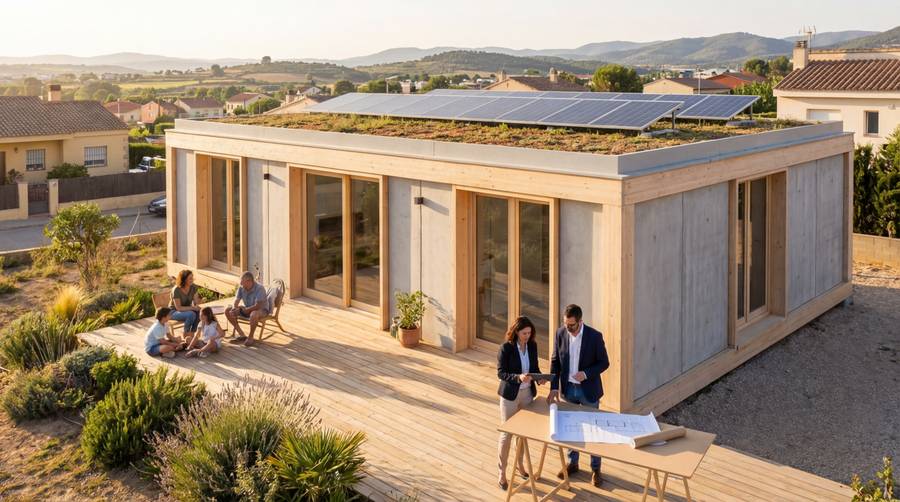
Industrialized Housing: A Spanish Turnkey Success Story
A family in Spain moved from long waiting lists and uncertainty to a delivered, energy-efficient turnkey home built with industrialized methods. This case study reveals the decisions, timelines, real metrics and practical lessons for self-builders in 2026.